
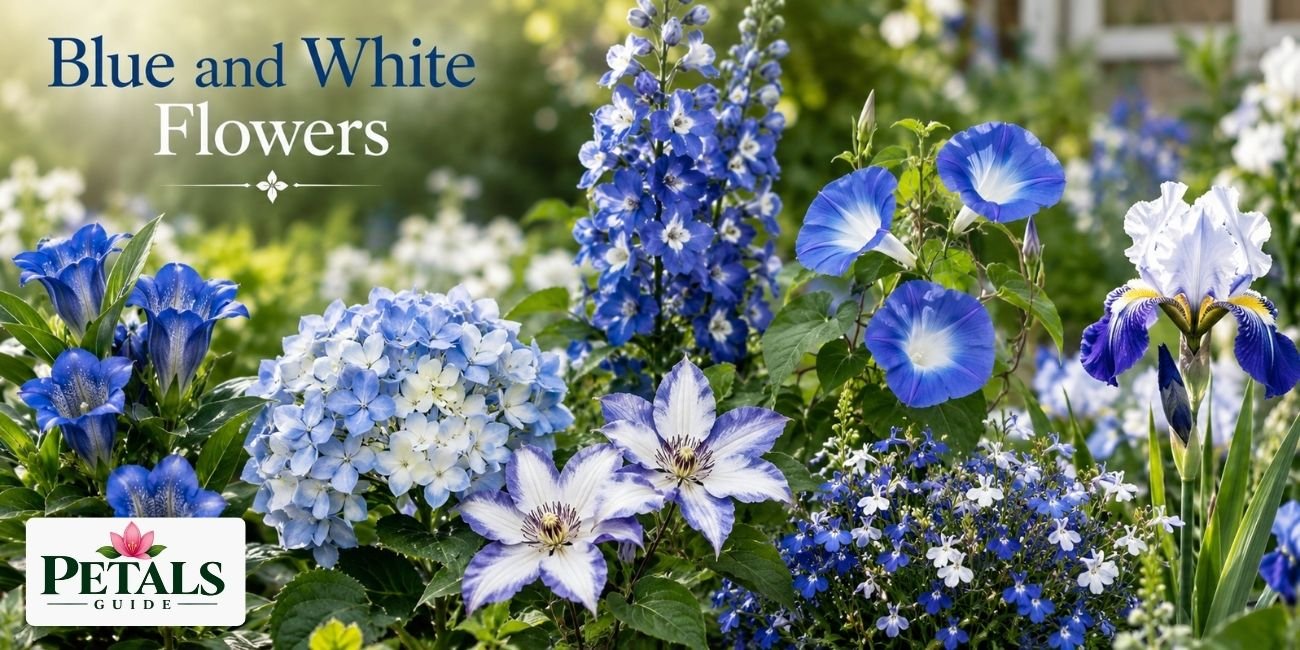
Blue and white flowers mix cool blue tones with bright white details, giving blooms that can appear soft, fresh, or have clear patterns. Depending on the type, you might find blue petals with a white center, a light throat, white edges, or blue-and-white designs on the same flower.
From a gentle blue flower for a garden border to white and blue flowers for bouquets and special events, there’s a lot to discover. Some also suit blue bridal bouquet flowers, while bigger kinds can add height and color to flower beds. In this guide, we’ll explore 20 flowers that show both colors in one bloom and discuss how they look, how to grow them, and the best ways to use them.
What are Blue and White Flowers?
Blue and white flowers refer to blooms that feature both colors within a single flower. This color combination can manifest in various ways, such as blue petals encircling a white center, a white throat within a blue flower, or having contrasting blue and white petals, along with unique stripes, edges, and markings. The specific pattern is influenced by the flower and its type.
Some white and blue flowers naturally exhibit this coloration, while others are particular bicolor cultivars developed for striking contrasts. For instance, Forget-Me-Not may have blue petals paired with a contrasting pale center, whereas Dwarf Morning Glory might display areas of blue, white, and yellow in one bloom. Additionally, Columbine can feature blue outer segments alongside white inner petals.
Recognizing this distinction is helpful when selecting flowers for a garden or arrangement, as a plant offered in distinct blue and white varieties might not necessarily yield a mixed-color bloom.
List of Top 20 Blue and White Flowers
From delicate garden blooms to climbing flowers and showy perennials, blue and white flowers can display their two colors in many different ways. Some have white centers or throats, while others feature contrasting petals, edges, or distinct bicolor patterns. Here is the list of top 20 flowers that include options for gardens, bouquets, and other floral displays, with each one offering its own shape, growing habit, and blooming season.
- Morning Glory (Ipomoea tricolor)
- Delphinium (Delphinium elatum)
- Bearded Iris (Iris × germanica)
- Garden Pansy (Viola × wittrockiana)
- Forget-Me-Not (Myosotis sylvatica)
- Garden Petunia (Petunia × hybrida)
- Mealycup Sage (Salvia farinacea)
- Bellflower (Campanula spp.)
- Sweet Pea (Lathyrus odoratus)
- Clematis (Clematis spp.)
- Anemone (Anemone coronaria)
- Cornflower (Centaurea cyanus)
- Lobelia (Lobelia erinus)
- Hydrangea (Hydrangea macrophylla)
- Hydrangea ‘Tivoli Blue’(Hydrangea macrophylla)
- Agapanthus ‘Silver Baby’
- Colorado Blue Columbine (Aquilegia caerulea)
- Dwarf Morning Glory (Convolvulus tricolor)
- Baby Blue-Eyes (Nemophila menziesii)
- Gentian (Gentiana verna)
- Blue-Eyed Grass (Sisyrinchium spp.)
Morning Glory (Ipomoea tricolor)
Morning Glory is a rapidly growing climbing vine characterized by its heart-shaped leaves and large, funnel-like flowers. The blooms can exhibit a vivid blue-and-white contrast, featuring blue to violet-blue petals that encircle a lighter throat. The cultivar ‘Heavenly Blue’ is particularly recognized for its intense sky-blue flowers with white throats, with individual blossoms measuring approximately 8 cm in diameter.
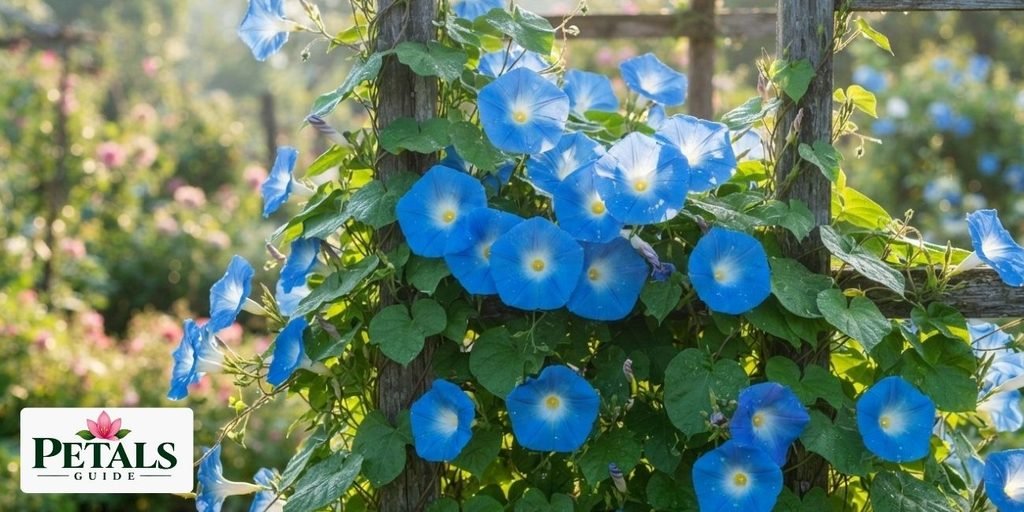
Originally from Mexico, Ipomoea tricolor is typically cultivated as an annual vine in gardens. Its twisting stems can reach between 2.5 to 4 meters when provided with support, making it ideal for adorning trellises, fences, arches, and walls. The flowers bloom in the morning and appear during the summer months when conditions are favorable for growth.
Interesting Fact: In traditional Mexican medicine, the seeds of Ipomoea tricolor have been utilized for their psychoactive effects. The seeds contain ergoline alkaloids, including lysergic acid amide (LSA), which shares a chemical relationship with compounds found in certain ergot fungi.
Delphinium (Delphinium elatum)
Delphinium is a tall herbaceous perennial known for its upright flower spikes covered with individual blooms. Delphinium elatum produces blue to purplish-blue flowers, and several cultivars have the blue-and-white combination suited to this list. For example, ‘Guardian Blue’ has deep blue flowers with contrasting white centers, while ‘Dasante Blue’ produces blue flowers with white centers.
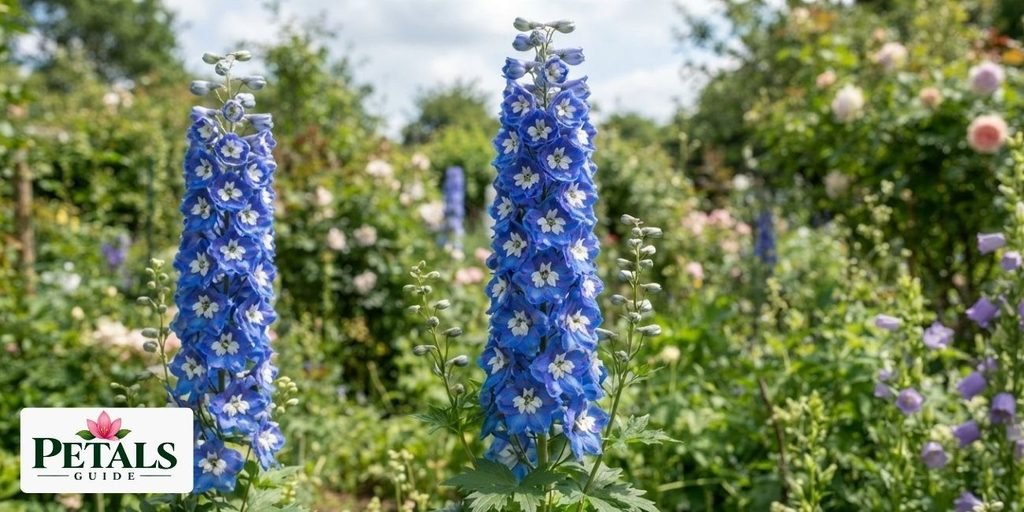
The plant grows best in full sun and fertile, moist but well-drained soil. Depending on the cultivar, it can reach around 1.2 to 1.8 meters or more, making it useful toward the back of flower borders. Its tall stems may need support, especially in exposed locations. These blue and white flowers mainly appear in early summer and are also valued as cut flowers.
Interesting Fact: The name Delphinium comes from the Greek word delphis, meaning “dolphin,” referring to the shape of the developing flower buds.
Bearded Iris (Iris × germanica)
Bearded Iris is a rhizomatous perennial with sword-shaped leaves and large flowers made up of upright standards and drooping falls. Its many cultivars produce different color combinations, including clear blue-and-white patterns. For example, ‘My Lady’s Manor’ has large ruffled blue-and-white flowers, while ‘Joyful Skies’ has soft-blue blooms with white areas around the center of the falls.
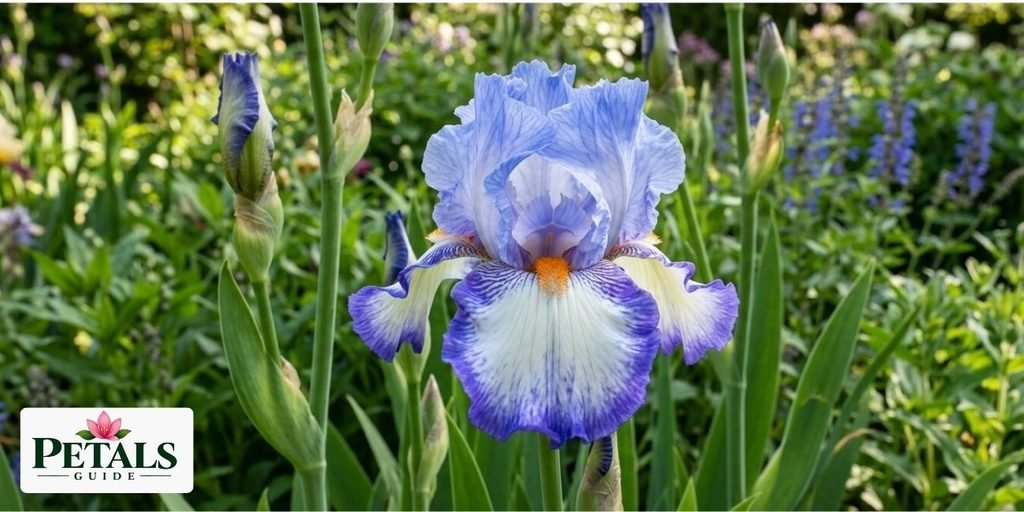
Bearded Iris generally flowers from late spring into early summer and grows best in a sunny position with well-drained soil. The thick rhizomes spread into clumps over time and are usually planted shallowly so that they receive plenty of sunlight. Depending on the cultivar, plants can range from compact forms to tall varieties around 90 cm or more.
Interesting Fact: The name Iris comes from the Greek goddess Iris, who was associated with the rainbow, a reference to the wide range of flower colors found throughout the genus.
Garden Pansy (Viola × wittrockiana)
Garden Pansy is a compact flowering plant with rounded petals and a characteristic dark center that gives many blooms a face-like appearance. Some cultivars combine blue and white in the same flower, creating a clear two-tone pattern. ‘Dynamite Blue & White Shades’, for example, produces blooms with blue shades blending into white areas, while other blue-and-white pansies may have darker blue upper petals and lighter lower petals.
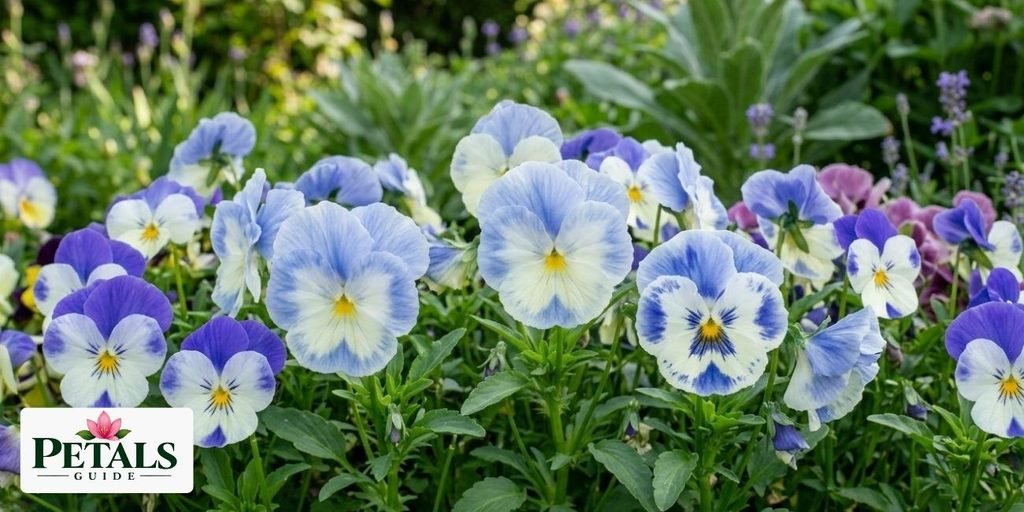
Pansies grow well in full sun or partial shade and prefer fertile, moist but well-drained soil. They are often grown as cool-season flowers, with blooming times varying by climate. Their compact size makes them useful for borders, containers, window boxes, and colorful flower beds.
Interesting Fact: The name “pansy” comes from the French word pensée, meaning “thought,” and the flower became associated with remembrance and thoughts of loved ones.
Forget-Me-Not (Myosotis sylvatica)
Forget-Me-Nots have small, delicate flowers, usually in shades of blue with contrasting yellow or white centers. This color combination gives each bloom a simple blue-and-white appearance, with the blue petals surrounding a light center. Blooming from spring into early summer, these plants form low clumps that can spread naturally through self-seeding.
Thriving in partial shade, Forget-Me-Nots prefer rich, moist, well-drained soil and work well in woodland-style gardens and shaded borders. They are also suitable for containers and naturalized planting, where their gentle growth can create a soft carpet of blue and white flowers. Their ability to self-seed allows them to return in suitable garden conditions.
Interesting Fact: The name “Forget-Me-Not” is linked to a medieval European legend about a knight who picked the flowers for his beloved before being swept away by a river and calling out, “Forget me not.”
Garden Petunia (Petunia × hybrida)
Garden Petunias are popular bedding flowers with soft, trumpet-shaped blooms that can appear in many color patterns. Some cultivars have both blue and white on the same flower. For example, ‘Surfinia Lagoon Blue Star’ produces purple-blue flowers marked with white stripes, creating a clear bicolor pattern. Other forms, such as ‘NightSky’, have blue-purple petals covered with irregular white speckles.
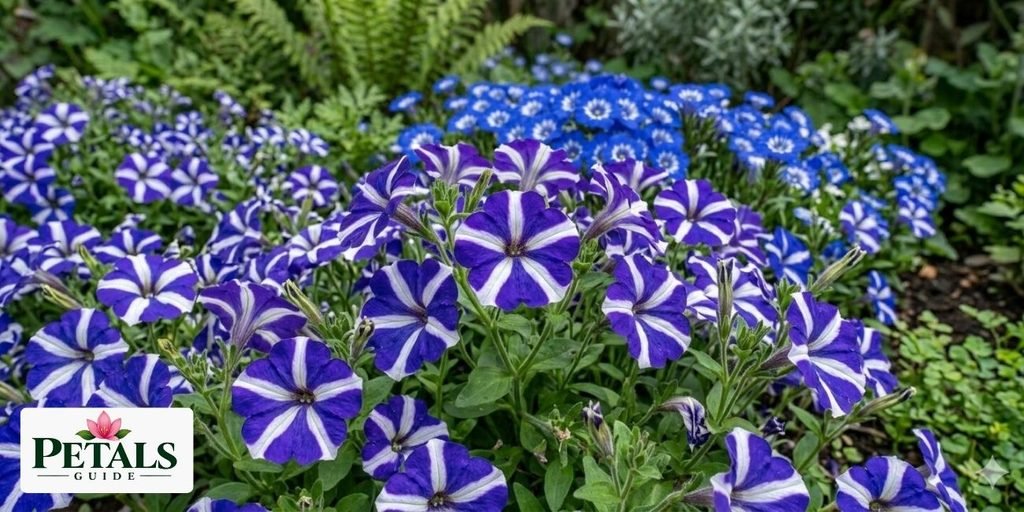
Petunias bloom from late spring or early summer into autumn and grow as compact, mounding, or trailing plants. They prefer full sun and light, well-drained soil. Their trailing forms are especially useful for hanging baskets, containers, window boxes, and flower borders, where the flowers can be displayed throughout the warmer months.
Interesting Fact: Some petunias produce a sweet fragrance that becomes stronger in the evening, helping attract night-flying pollinators such as hawk moths.
Mealycup Sage (Salvia farinacea)
Mealycup Sage is an upright plant with narrow, silvery-green leaves and slender spikes covered with small, two-lipped flowers. The cultivar ‘Farina Bicolor Blue’ produces true blue-and-white flowers, with the contrasting shades appearing within the same bloom. This makes it a useful choice for adding white and blue flowers to borders and containers.
Mealycup Sage usually flowers from summer into autumn and is often grown as an annual in cooler climates. It grows well in full sun or partial shade and prefers moist but well-drained soil. Its upright form works well in flower borders, patio containers, bedding displays, and wildlife gardens.
Interesting Fact: The common name “mealycup sage” refers to the fine, powdery or mealy-looking coating found on the flower calyces and stems.
Bellflower (Campanula spp.)
Bellflowers are recognized for their open, bell-shaped flowers that grow on erect stems. A notable example is Campanula persicifolia ‘Chettle Charm’, which features white blossoms subtly edged with pale blue. This gives the flowers a gentle blue-and-white look without the use of distinct colors.
These plants are herbaceous perennials that typically flower in late spring or summer. They thrive in full sun or partial shade and favor fertile, moist, yet well-drained soil. Various species and cultivars are ideal for cottage gardens, flower borders, wildlife habitats, and cut-flower arrangements. Their upright stems provide vertical interest without the bulk of some taller perennials.
Interesting Fact: The name of the genus Campanula is derived from Latin, meaning “little bell,” which reflects the bell-like shape of many of its blooms.
Sweet Pea (Lathyrus odoratus)
Sweet Pea is a climbing annual with its delicate, butterfly-shaped blossoms that emit a gentle, sweet aroma. Some varieties show a blend of blue and white within a single flower. ‘Minuet Blue’ features white blooms adorned with a picotee edge and subtle purplish-blue speckles, forming an elegant blue-and-white design. The flowers rise above pairs of leaves and curling tendrils, which assist the plant in its upward growth.
Typically, Sweet Peas blossom from early summer through the warmer seasons and thrive best in rich, well-draining soil that receives ample sunlight. Their climbing nature makes them ideal for use on trellises, obelisks, fences, and other supports, while their aromatic stems are highly sought after for cut flower arrangements and bouquets.
Interesting Fact: Sweet Pea seeds can be toxic if eaten in large amounts. The seeds contain a compound called β-ODAP, although poisoning is mainly associated with eating large quantities over time.
Clematis (Clematis spp.)
Clematis is a group of climbing plants known for their bell-shaped, star-like, or open flowers. One good blue-and-white example, ‘Frances Rivis’, has clear blue outer sepals surrounding a cluster of slender white parts called staminodes. This two-color pattern gives each bloom a distinct appearance. The flowers bloom in spring, usually around April and May, and are followed by fluffy seedheads.
This deciduous climber can grow about 1.5 to 2.5 metres tall, making it useful for trellises, fences, and other garden supports. It thrives in full sun or partial shade with moist, well-drained soil. Its roots prefer cool conditions while the stems and flowers can receive sunlight.
Interesting Fact: Clematis seeds are often attached to long, silky tails that catch the wind and help carry the seeds away from the parent plant.
Anemone (Anemone coronaria)
Anemone is a tuberous perennial with delicate, poppy-like flowers held above finely divided foliage. The cultivar ‘Rainbow Blue and White’ is a true blue-and-white form of Anemone coronaria, bringing both shades together in its flowers. Garden anemones generally bloom in spring, with some plantings flowering into early summer depending on when they are grown.
This compact plant usually reaches around 45 cm and grows best in full sun and light, well-drained soil. It works well in flower borders, rock gardens, containers, and cut-flower displays. The plants also die back after flowering and remain dormant for part of the year, which is a normal part of their growth cycle.
Interesting Fact: Anemone flowers do not actually have true petals. What look like petals are modified sepals, while the central stamens form the dark or contrasting center seen in many varieties.
Cornflower (Centaurea cyanus)
Cornflower is an upright annual plant with narrow, grey-green leaves and fluffy flower heads on delicate stems. It is mostly known for its vibrant blue flowers, but the cultivar ‘Classic Fantastic’ produces unique blue-and-white blossoms. These flowers bloom from late spring through summer, making them a lovely choice for adding contrast to bouquets alongside other blue flowers for bouquets.
Cornflower thrives in full sun and prefers well-drained soil. It can grow up to 75 cm or taller, making it a useful addition to cottage gardens, wildflower meadows, and flower borders. Its tall stems also allow it to mix easily with other annuals and meadow plants.
Interesting Fact: Cornflower petals are edible and have a mild, clove-like taste. They are sometimes used as a colorful garnish in dishes and drinks.
Lobelia (Lobelia erinus)
Lobelia is a charming, low-growing plant with tiny, two-lipped flowers on delicate stems. The cultivar ‘Waterfall Light Blue With Eye’ produces pretty mid-blue blooms with a striking large white center, making each flower a clear blue-and-white bloom. These flowers appear from summer into autumn, bringing color to the garden after many spring flowers have faded.
This trailing annual typically grows about 15 cm tall and can spread up to 30 cm wide, making it perfect for hanging baskets, window boxes, containers, or the edges of flower beds. Lobelia grows well in full sun or partial shade and prefers moist, well-drained soil. Its cascading habit creates a gentle, flowing look that contrasts nicely with larger blooms.
Interesting Fact: Lobelia is sometimes called “Indian tobacco” because Indigenous peoples in North America traditionally used related Lobelia species as tobacco substitutes. However, the plant contains the alkaloid lobeline and can be toxic if consumed in large amounts.
Hydrangea (Hydrangea macrophylla)
Hydrangea is a bushy, deciduous shrub known for its large, rounded flowerheads and broad green leaves. The cultivar ‘Tivoli Blue’ produces blue-purple flowers with each petal edged in white, creating a clear blue-and-white pattern on the same bloom. The large flowerheads appear through summer and can bring a soft contrast to garden borders and floral displays.
This hydrangea grows about 1 to 1.5 metres tall and wide and prefers partial shade with moist, well-drained soil. It works well in flower borders, patio containers, cottage gardens, and as a cut flower. Its large flowerheads also make it useful when you want large blue flowers with a contrasting light edge.
Interesting Fact: The blue color of many Hydrangea macrophylla cultivars is linked to soil chemistry. In acidic soil, aluminum becomes more available to the plant and can help produce blue flowers, while less acidic conditions often lead to pinker shades.
Agapanthus ‘Silver Baby’ (Agapanthus africanus)
Commonly called African Lily or Lily of the Nile, Agapanthus forms rounded clusters of trumpet-shaped flowers on sturdy, upright stems above narrow, strap-like leaves. The dwarf cultivar ‘Silver Baby’ is a lovely blue-and-white example, producing small white flowers delicately flushed with pale blue along the edges. Together, these soft shades give the blooms a silvery blue-and-white appearance. The flowers appear in summer and rise above the neat clumps of evergreen foliage.
‘Silver Baby’ is a compact Agapanthus that grows well in full sun and prefers moist but well-drained soil. Its smaller size makes it particularly useful for low borders, edging, containers, and small gardens. The rounded flowerheads also add height without taking up much ground space, making them an attractive choice when you want white and blue flowers in a more compact planting.
Pansy ‘Pure Light Blue’ (Viola × wittrockiana)
Pansy is a compact flowering plant known for its rounded, overlapping petals and distinctive face-like markings. The cultivar ‘Pure Light Blue’ produces light-blue flowers with subtle white edges, giving each bloom a soft blue-and-white appearance. Its flowers can appear from autumn through winter and into spring, making it useful when many summer flowers are no longer blooming.
This compact pansy grows well in full sun or partial shade and prefers fertile, moist but well-drained soil. Its small size makes it suitable for borders, edging, window boxes, containers, and hanging baskets. The flowers also have the characteristic dark markings often seen in garden pansies, adding extra detail to the pale blue and white coloring.
Interesting Fact: The modern garden pansy is a hybrid created from several Viola species, including the wild pansy (Viola tricolor). Its scientific name wittrockiana honors Swedish botanist Veit Brecher Wittrock.
Dwarf Morning Glory (Convolvulus tricolor)
The Dwarf Morning Glory is a short, bushy annual characterized by its delicate stems, green foliage, and trumpeted flowers. Each flower features vivid blue petals adorned with a white throat and a tiny yellow core, creating a striking tri-colored appearance. The blossoms can grow up to 4 cm in diameter and bloom continuously throughout the summer season.
In contrast to its climbing relatives, this variety maintains a low profile, typically reaching heights of 30 to 45 cm. It thrives in sunny spots with well-drained soil, making it ideal for borders, rockeries, containers, and other compact garden areas. Its compact nature makes it a great option for adding blue and white blooms without the climbing aspect.
Fun Fact: Although each bloom lives just one day, the plant generates new flowers in succession, ensuring a prolonged summer display.
Baby Blue-Eyes (Nemophila menziesii)
Baby Blue-Eyes is a compact annual plant featuring soft, lobed green foliage and dainty, cup-shaped blossoms. The vibrant blue petals encircle a lighter blue to white center, resulting in a charming blue-and-white display on each flower. Typically measuring around 4 cm in diameter, these blooms predominantly flourish in spring and early summer, particularly in cooler climates.
Reaching heights of approximately 15 to 30 cm, Baby Blue-Eyes is ideal for applications such as edging, rock gardens, container plantings, hanging baskets, and casual borders. It thrives in either full sunlight or partial shade, provided the soil is fertile, moist, yet well-draining. Its sprawling growth habit enables it to create a delicate carpet of blue and white flowers near the ground.
Gentian (Gentiana verna)
Gentian is a small evergreen perennial that forms a low carpet of slender green leaves. Its trumpet-shaped flowers bloom in a vibrant sky-blue, with a contrasting white throat that gives each bloom a clear blue-and-white appearance. The flowers bloom from late spring to early summer, rising slightly above the foliage.
Spring Gentian typically reaches around 10 cm in height, making it ideal for rock gardens, alpine settings, gravel gardens, containers, and garden borders. It thrives in full sun and prefers moist but well-drained soil, especially where the roots can remain cool while excess moisture drains away. Its compact growth is perfect for introducing blue and white flowers into smaller spaces.
Interesting Fact: In Britain, Gentiana verna is known as “Lucy of Teesdale” and is the county flower of Durham, where it is a rare native species.
Blue-Eyed Grass (Sisyrinchium campestre)
Blue-Eyed Grass is a small perennial in the iris family, despite its grass-like leaves. Its star-shaped flowers can range from pale blue to white, with a yellow center that gives each bloom a soft blue-and-white appearance. The flowers appear in late spring and early summer, rising above the narrow, upright foliage.
Prairie Blue-Eyed Grass usually grows about 10 to 40 cm tall and is well suited to sunny borders, rock gardens, meadow-style planting, and naturalized areas. It prefers well-drained soil and can tolerate relatively dry conditions once established. Its compact, clump-forming growth makes it useful for adding delicate blue and white flowers to smaller garden spaces.
Interesting Fact: Although each flower is only open for a short time, a single plant can produce several flowers over its blooming period, allowing the plant to keep adding new blooms as older ones fade.
Types of Blue and White Flowers Color Patterns
Blue and white flowers can display their two colors in several different patterns. The white may appear in the center, inside the throat, around the edge, or as stripes and markings across the petals. Some patterns occur naturally in a species, while others are found only in particular cultivars.
Blue Flowers With White Centers
Some blue flowers have a lighter or white area in the middle of the bloom. Lobelia cultivars can produce blue flowers with contrasting pale or white centers, creating a clear focal point. Gentian can also have blue flowers with a lighter throat, giving the bloom a similar two-tone effect.
Blue Flowers With White Throats
A white throat is located deeper inside the flower rather than simply covering the center of the petals. Morning Glory ‘Heavenly Blue’ is a clear example. Its large, sky-blue funnel-shaped flowers have distinct white throats that become visible when the bloom opens fully.
Blue and White Bicolor Flowers
Some flowers combine blue and white across the petals or other visible floral parts. Hydrangea ‘Tivoli Blue’, for example, produces blue-purple flowerheads with individual petals edged in white. Anemone cultivars can also produce flowers with contrasting blue and white areas. These patterns are often specific to a named cultivar, so they should not automatically be used to describe every plant of the same species.
Blue Flowers With White Edges and Markings
White can also form edges, stripes, halos, dots, or other markings on blue or bluish petals. Petunia ‘Surfinia Lagoon Blue Star’ produces purple-blue and white striped flowers, while ‘Surfinia Picotee Blue’ has rich purple flowers surrounded by a white halo around the edge. These markings can give white and blue flowers a more detailed and patterned appearance.
These patterns show why blue and white flowers can look so different even when they share the same two main colors. Looking closely at where the white appears can also help distinguish a true bicolor bloom from a plant that simply produces separate blue and white flowers.
Large Blue Flowers s for Your Garden
If you want blue blooms with clearly defined white markings, these flowers can add color and structure to your garden. Some offer large individual blooms, while others provide height through spikes or climbing growth.
- Morning Glory ‘Heavenly Blue’: Large sky-blue funnel-shaped flowers reach up to 8 cm across and have a distinct white throat. They work well on trellises, arches, and fences.
- Delphinium ‘Summer Skies’: Tall spikes carry powder-blue flowers with a contrasting white central eye. The spikes can reach around 1.75 metres, making them useful at the back of borders.
- Hydrangea ‘Tivoli Blue’: Its broad flowerheads contain blue-purple flowers with white margins along the petal edges, creating a fuller garden display.
- Clematis ‘Frances Rivis’: Blue outer sepals surround slender white staminodes at the center of each flower. Its climbing habit suits trellises, fences, and arches.
These blue and white flowers can add focal points, height, and structure to different parts of a garden.
Blue Flowers for Bouquets
Blue-and-white blooms can give bouquets a cool, fresh look, especially when different flower shapes are combined. Some provide height, while others add delicate detail or softer accents.
- Delphinium: Tall blue spikes with white centers add height and structure to bouquets, making them useful as vertical flowers.
- Bearded Iris: Large blue-and-white blooms work well as focal flowers, bringing bold shape and contrast to an arrangement.
- Cornflower ‘Classic Fantastic’: Its blue-and-white blooms have slender stems and a lighter, informal appearance, making them useful as delicate accents in bouquets.
- Sweet Pea ‘Minuet Blue’: Its smaller, fragrant flowers add softness and a gentle blue-and-white pattern to informal arrangements.
- Clematis ‘Frances Rivis’: Its blue flowers with white inner parts can add an airy, trailing effect, making clematis useful around the edges of bouquets.
These blue flowers for bouquets can be combined with white flowers and greenery to create depth without making the arrangement look too uniform. For blue bridal bouquet flowers, taller blooms such as delphinium can also be paired with smaller flowers for a balanced shape.
Blue Bridal Bouquet Flowers
Blue bridal bouquet flowers can be paired with white blooms and greenery for a balanced wedding arrangement. The best choices depend on whether you want large focal flowers, tall accents, delicate details, or a softer garden-style look.
- Bearded Iris: Large blue-and-white blooms can work as focal flowers, adding a bold shape to a bouquet.
- Delphinium: Its tall flower spikes add height and a vertical element. Delphiniums are also widely used as cut flowers.
- Sweet Pea ‘Minuet Blue’: Small, fragrant flowers can add delicate detail and a softer texture to a hand-tied or garden-style bouquet.
- Cornflower ‘Classic Fantastic’: Its blue-and-white flowers and slender stems can add lighter, informal detail among larger blooms.
- Clematis ‘Frances Rivis’: Its blue flowers with white inner parts can be used as a lighter accent, particularly in loose or natural-looking arrangements.
For a simple blue and white flowers theme, combine one larger focal flower with smaller blooms and greenery rather than using several flowers of the same size. This creates differences in shape and texture while keeping the color palette consistent.
How to Use Blue and White Flowers in a Garden
Create a Blue and White Border
To make a blue and white border, use flowers that are different heights and shapes. Place taller flowers like Delphinium in the back and shorter ones like Lobelia and Pansy in the front. Grouping the same plants or colors together can help the design feel more connected.
Add Color to Containers
Small blue and white flowers are great for pots, window boxes, and hanging baskets. You can use Petunia, Lobelia, and Pansy in these containers, adding trailing plants to soften the edges. When choosing plants, pick ones that need the same amount of sunlight and water.
Use Climbers for Vertical Interest
You can add blue and white flowers up high by growing climbers like Morning Glory and Clematis on supports. Trellises, arches, and fences provide the support climbers need and can hide plain vertical areas.
Combine Different Flower Shapes
Mixing different flower shapes can make your garden look more interesting. For instance, pair trumpet-shaped Morning Glory with round flower heads or upright spikes. Different shapes attract a broader range of pollinators.
When choosing blue and white flowers theme, consider their sunlight, soil needs, moisture levels, and available space, along with their colors. This will help you create a garden that is easier to care for and keeps the color scheme consistent.
Selecting Blue and White Flowers
When selecting blue and white flowers, it’s helpful to start by determining the location for planting or displaying them. Factors such as the flowers’ mature size, the amount of space you have, sunlight exposure, soil type, and the purpose of the flowers can influence the best choices for your needs.
How to Choose Blue and White Flowers
When choosing blue and white flowers, consider where you want to grow or use them:
- Garden borders: Use tall flowers such as Delphinium toward the back and shorter choices such as Lobelia or Pansy toward the front.
- Containers: Compact flowers such as Lobelia, Pansy, Petunia, and Baby Blue-Eyes work well in pots, window boxes, and hanging baskets.
- Vertical spaces: Choose Clematis or Morning Glory for trellises, arches, and fences where climbing growth can be supported.
- Bouquets: Delphinium provides tall flower spikes, while Cornflower and Sweet Pea add smaller blooms and finer detail.
- Season: Choose flowers that naturally bloom during the time you need them, particularly when planning a garden display or using fresh stems.
- Foliage: Add suitable greenery to fill gaps and provide contrast while keeping attention on the blue-and-white blooms.
Blue and White Flowers by Season
The blooming season of blue and white flowers varies by species, cultivar, climate, and growing conditions. Choosing flowers from different seasons can help keep this color combination in the garden for longer.
Spring Blooms
Spring brings several early choices, including Forget-Me-Not, Anemone, and Clematis ‘Frances Rivis’. Their blue and white coloring can add detail to borders and other garden spaces as the season begins.
Summer Flowers
Summer offers more options, including Delphinium, Cornflower, Sweet Pea, Hydrangea ‘Tivoli Blue’, and Morning Glory ‘Heavenly Blue’. These range from tall flower spikes and broad flowerheads to large funnel-shaped blooms, giving gardens different forms of blue-and-white color.
Late Summer and Autumn
Lobelia and some Petunia cultivars can continue providing blue-and-white color into the later part of the growing season. Their compact or spreading growth also makes them useful for containers, borders, and other smaller spaces.
Planning for a Longer Display
Blooming times can overlap, so combining flowers from different seasons can extend the overall display. Local climate also matters, as the same flower may bloom earlier or later depending on temperature and growing conditions. Checking the expected flowering period for a particular cultivar is useful when planning a continuous display.
Conclusion
Blue and white flowers bring a special touch to any garden.Their colors remind us of peaceful skies and soft clouds. They create a calming atmosphere, making them perfect for relaxing spaces. Whether you see them in a garden or a bouquet, they can make anyone’s day brighter. Remember to think about blue and white flowers the next time you want to make someone smile!
FAQs
What do blue and white flowers mean?
Blue flowers are commonly linked with calmness, peace, trust, and sincerity, while white flowers are associated with purity, peace, and remembrance. Together, their meaning can vary depending on the flower, culture, and occasion.
What flowers are blue and white?
Examples include Morning Glory ‘Heavenly Blue’, Gentian, Iris, Lobelia, Hydrangea, Clematis, and certain Petunia cultivars. The exact blue-and-white pattern can vary by species or cultivar.
Do cross flowers rebloom?
It depends on which plant is meant by “cross flower,” as this common name can refer to different plants. The exact species is needed to give a reliable answer.
Do star flowers rebloom?
“Star flower” is also used for several different plants. Some can rebloom under suitable conditions, but the flowering habit depends on the particular species.