
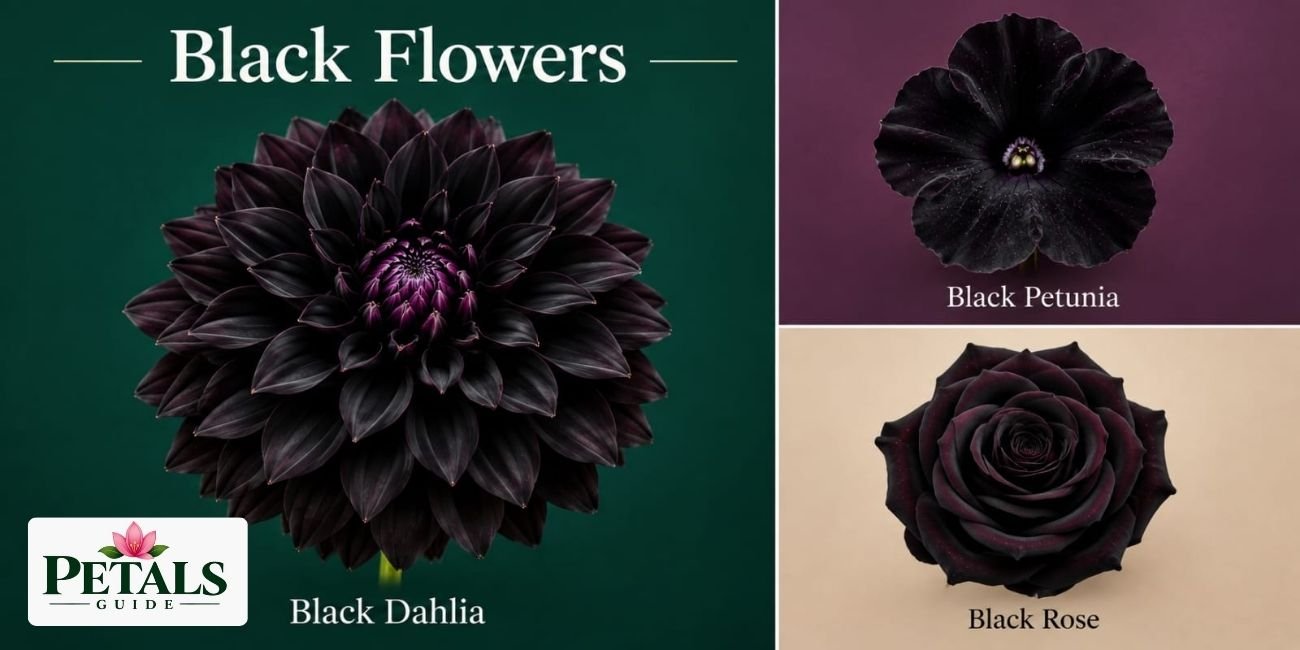
Black flowers are some of the rarest and most mysterious plants you can find in gardens. These unique blooms come in deep shades like purple, burgundy, and maroon, making them stand out in any setting. In this article, we’ll explore the top 30 black flowers, show you their beautiful images, and explain why they’re a great choice for your garden. You’ll learn how to care for them and where to find these amazing black plants.
List of the Top 30 Black Flowers-Too Dark to Be Real
Black flowers are known for their dramatic dark colors, but most are not truly jet black. Many have deep purple, burgundy, maroon, brown, or violet petals that can appear almost black. Here is a list of 30 popular black and near-black flowers, arranged from the darkest-looking blooms to those with lighter near-black shades.
| Black Flowers | Common Name | Scientific/Botanical Name | Type | Flower Color |
|---|---|---|---|---|
| 1 | Black Velvet Petunia | Petunia ‘Black Velvet’ | Cultivar | Deep black to near-black |
| 2 | Black Pansy | Viola ‘Black Devil’ | Cultivar | Velvety black to very dark purple |
| 3 | Black Viola | Viola ‘Molly Sanderson’ | Cultivar | Almost black, very dark purple |
| 4 | Black Hollyhock | Alcea rosea ‘Nigra’ | Cultivar | Deep maroon-purple to near-black |
| 5 | Black Bat Flower | Tacca chantrieri | Species | Dark purple to black |
| 6 | Onyx Odyssey Hellebore | Helleborus ‘Onyx Odyssey’ | Cultivar | Very dark purple-black |
| 7 | Black Tulip ‘Queen of Night’ | Tulipa ‘Queen of Night’ | Cultivar | Deep purple-plum to almost black |
| 8 | Black Barlow Columbine | Aquilegia vulgaris var. stellata ‘Black Barlow’ | Cultivar | Dark purple-black |
| 9 | Black Persian Lily | Fritillaria persica ‘Adiyaman’ | Cultivar | Deep purple-brown |
| 10 | Penny Black Nemophila | Nemophila menziesii ‘Penny Black’ | Cultivar | Deep purple to almost black with white edges |
| 11 | Black Iris | Iris chrysographes | Species | Deep violet to blackish-purple |
| 12 | Black Cosmos | Cosmos atrosanguineus | Species | Dark chocolate-brown to maroon |
| 13 | Black Scabiosa | Scabiosa atropurpurea ‘Black Knight’ | Cultivar | Deep burgundy to nearly black |
| 14 | Black Sweet Pea | Lathyrus odoratus ‘Black Knight’ | Cultivar | Very dark maroon-purple |
| 15 | Black Calla Lily | Zantedeschia ‘Edge of Night’ (syn. ‘Black Star’) | Cultivar | Dark maroon-red to almost black |
| 16 | Black Beauty Lily | Lilium ‘Black Beauty’ | Cultivar | Deep reddish-purple to dark burgundy |
| 17 | Black Tree Peony | Paeonia × suffruticosa ‘Hei Hua Kui’ | Cultivar | Deep Maroon |
| 18 | Black Hyacinth | Hyacinthus orientalis ‘Midnight Mystique’ | Cultivar | Purple-black |
| 19 | Black Bachelor’s Button | Centaurea cyanus ‘Black Ball’ | Cultivar | Deep burgundy to almost black |
| 20 | Black Peony Poppy | Papaver somniferum (Paeoniiflorum Group) ‘Black Beauty’ | Cultivar/Group | Very dark burgundy-purple |
| 21 | Black Morning Glory | Ipomoea purpurea ‘Kniola’s Black Night’ | Cultivar | Extremely deep purple |
| 22 | Black Bellflower | Campanula ‘Black Knight’ | Cultivar | Deep purple-blue |
| 23 | Black Charm Gladiolus | Gladiolus ‘Black Charm’ | Cultivar | Deep burgundy to dark red |
| 24 | Black Dahlia | Dahlia ‘Black Knight’ | Cultivar | Deep burgundy-red |
| 25 | Black Monkshood | Aconitum ‘Black Knight’ | Cultivar | Very dark purple |
| 26 | Black Love-in-a-Mist | Nigella papillosa ‘Midnight’ | Cultivar | Deep dark blue |
| 27 | Black Magic Rose | Rosa ‘Black Magic’ | Cultivar | Deep burgundy-red |
| 28 | Black Baccara Rose | Rosa ‘Black Baccara’ | Cultivar | Very dark burgundy-red |
| 29 | Black Kalmia / Mountain Laurel | Kalmia latifolia ‘Mitternacht’ | Cultivar | Dark red to nearly black |
| 30 | Black Knight Delphinium | Delphinium ‘Black Knight’ | Cultivar/Group | Deep purple-blue |
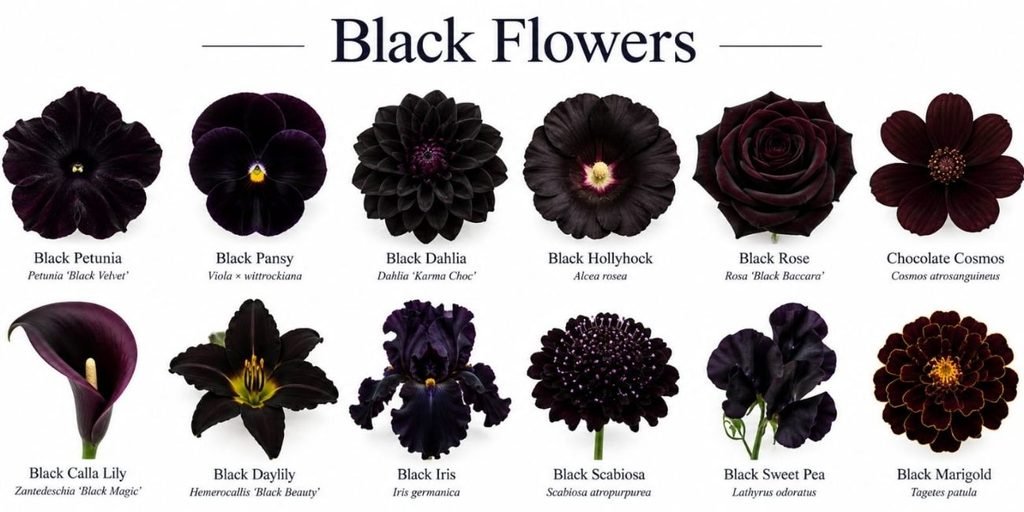
Black Velvet Petunia (Petunia ‘Balpevec’)
- Genus: Petunia
- Native Range: South America
- USDA Hardiness Zone: 10–11
- Plant Height: 10–12 inches
- Soil Type: Well-draining, fertile soil
- Water Needs: Moderate
- Sun Requirement: Full sun to partial shade
- Bloom Time: Late spring to frost
- Fragrance: Light
The Black Velvet Petunia has deep, velvety petals that can appear almost black, although the flowers are actually an extremely dark shade of purple. Its compact growth and green foliage strongly contrast with the dark blooms, which can look nearly black in certain light.
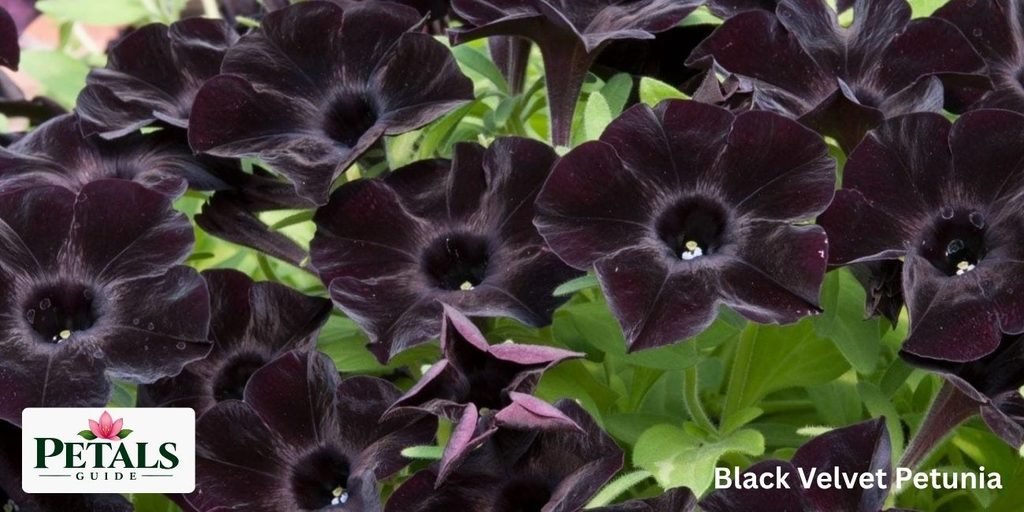
In the garden, this petunia works well in flower beds, borders, containers, and hanging baskets. Its compact habit makes it useful along edges or in small spaces, while planting this black flower beside white, pink, yellow, or other light-colored flowers can make the dark blooms stand out more clearly.
Black Pansy (Viola ‘Black Devil’)
- Genus: Viola
- Native Range: Europe and western Asia
- USDA Hardiness Zone: 6–10
- Plant Height: 6–8 inches
- Soil Type: Well-drained, fertile soil
- Water Needs: Moderate; keep soil evenly moist
- Sun Requirement: Full sun to partial shade
- Bloom Time: Spring to early summer, with possible fall blooms in milder climates
- Fragrance: Lightly scented
The Black Pansy, known scientifically as Viola ‘Black Devil,’ features velvety petals that give the flowers a deep, almost black appearance. The blooms have an intensely dark hue that leans more toward deep purple than true black, giving them a distinct look in the garden. This compact plant has green foliage and typically grows around 6 to 8 inches tall, forming a rounded, tidy shape that works well in borders or containers.
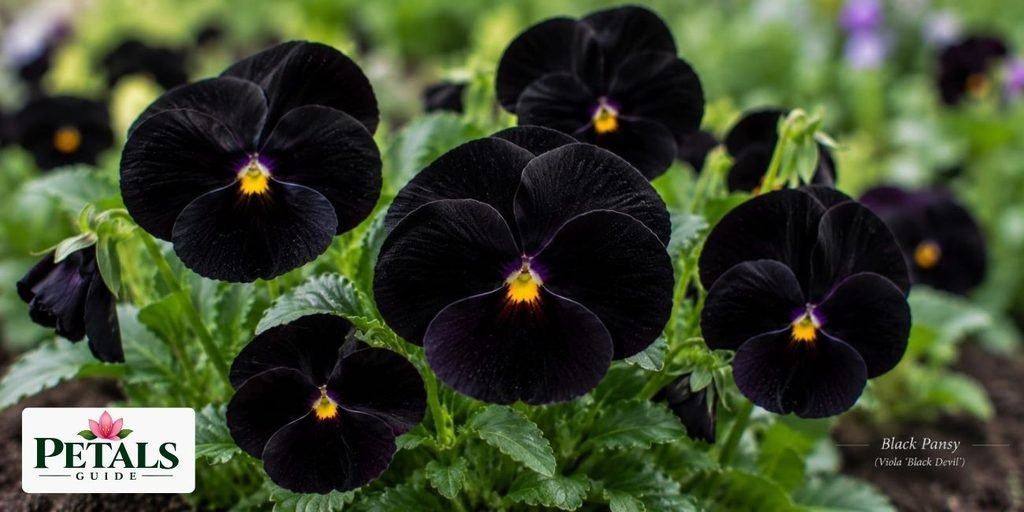
Originating in Europe and now grown in gardens worldwide, the Black Pansy is valued for its resilience and versatility. It grows well in both sunny and partially shaded spots and can produce flowers during spring and, in suitable climates, fall. Use it as a border plant, in window boxes, or as an accent in rock gardens, especially alongside lighter-colored flowers that bring out the depth of its dark blooms.
Black Viola (Viola ‘Molly Sanderson’)
- Genus: Viola
- Native Range: Europe
- USDA Hardiness Zone: 5–9
- Plant Height: 6–10 inches
- Soil Type: Well-drained, fertile soil
- Water Needs: Moderate
- Sun Requirement: Partial to full sun
- Bloom Time: Early spring to early summer
- Fragrance: Lightly fragrant
With its velvety petals, Viola ‘Molly Sanderson’ stands out for its exceptionally dark blooms, which can appear almost black at first glance. The flowers are about 1–2 inches across, with rounded petals set against dark green foliage. They are not truly black; instead, their deep purple coloration creates a near-black effect, especially in certain light.
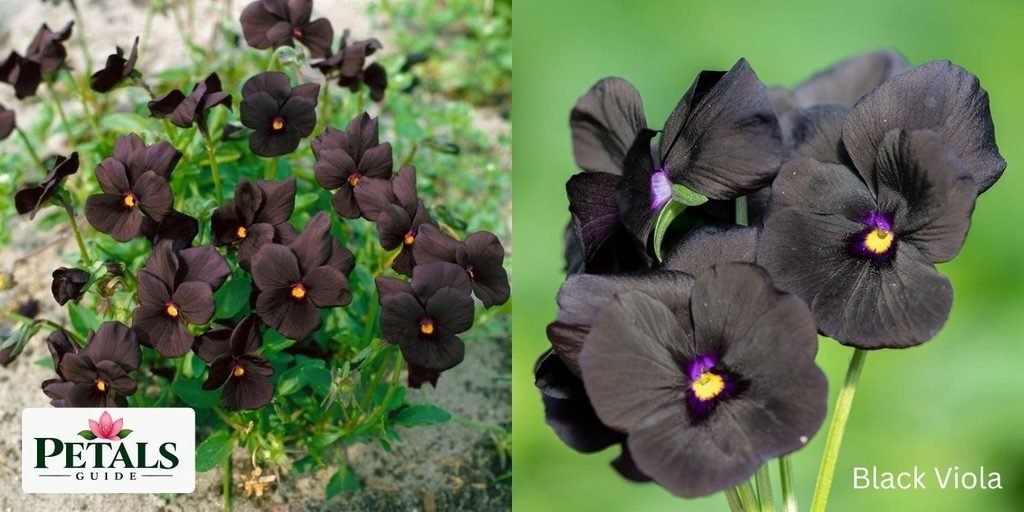
Originating from Europe, ‘Molly Sanderson’ is a compact viola that works well in a range of garden settings. Its small size makes it suitable for borders, flower beds, containers, and window boxes, while planting it near white or other light-colored flowers can create a strong contrast. Like other violas, it performs best in cooler conditions and can be useful for adding dark-toned flowers to seasonal plantings.
Black Hollyhock (Alcea rosea ‘Nigra’)
- Genus: Alcea
- Native Range: Eurasia
- DA Hardiness Zone: 3–9
- Plant Height: 5–7 feet
- Soil Type: Well-drained, loamy or sandy soil
- Water Needs: Moderate
- Sun Requirement: Full sun
- Bloom Time: Summer
- Fragrance: Lightly fragrant
Black Hollyhock grows on tall flower spikes lined with dark blooms that can appear almost black from a distance. Its petals range from deep maroon to very dark purple, rather than true black, and have a slightly crinkled texture typical of hollyhocks. The broad green leaves form a dense base, while the upright flower stems can reach five to seven feet, giving the plant a strong vertical presence in the garden.
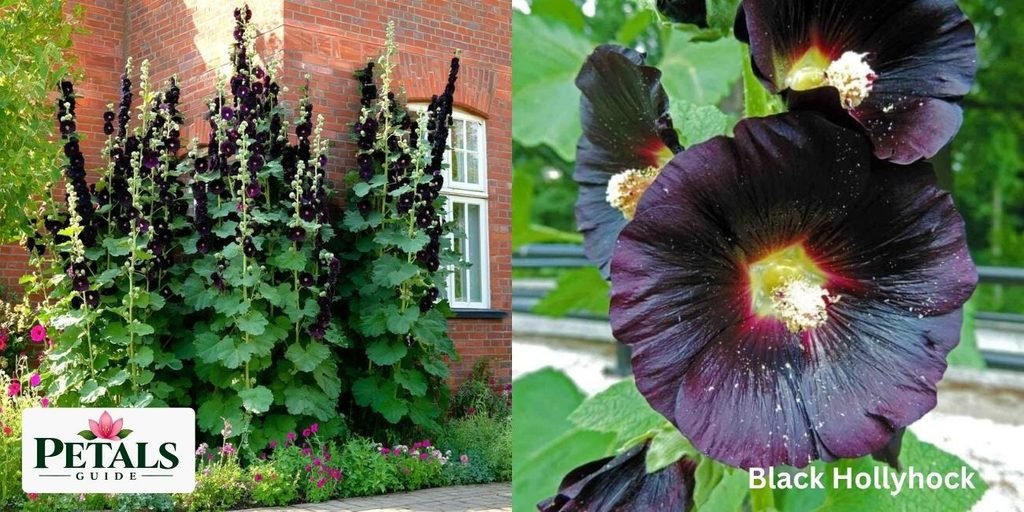
A familiar choice for cottage-style gardens, Black Hollyhock works well against walls and fences or at the back of flower borders, where its height can be fully appreciated. It can also be planted in groups to create a bold vertical display, while its open flowers provide a useful source of nectar for bees and other pollinators.
Black Bat Flower (Tacca chantrieri)
- Genus: Tacca
- Native Range: Southeast Asia
- USDA Hardiness Zone: 10–11
- Plant Height: 2–3 feet
- Soil Type: Rich, well-drained soil with plenty of organic matter
- Water Needs: Moderate to high; prefers consistently moist soil
- Sun Requirement: Partial shade to filtered light
- Bloom Time: Summer to early fall
- Fragrance: Little, often unnoticeable
The Black Bat Flower has dark purple to nearly black bracts surrounding small flowers, with long, whisker-like filaments extending beneath the bloom cluster. These unusual features give it its bat-like appearance. Its large, glossy green leaves form a broad base around the flowers.
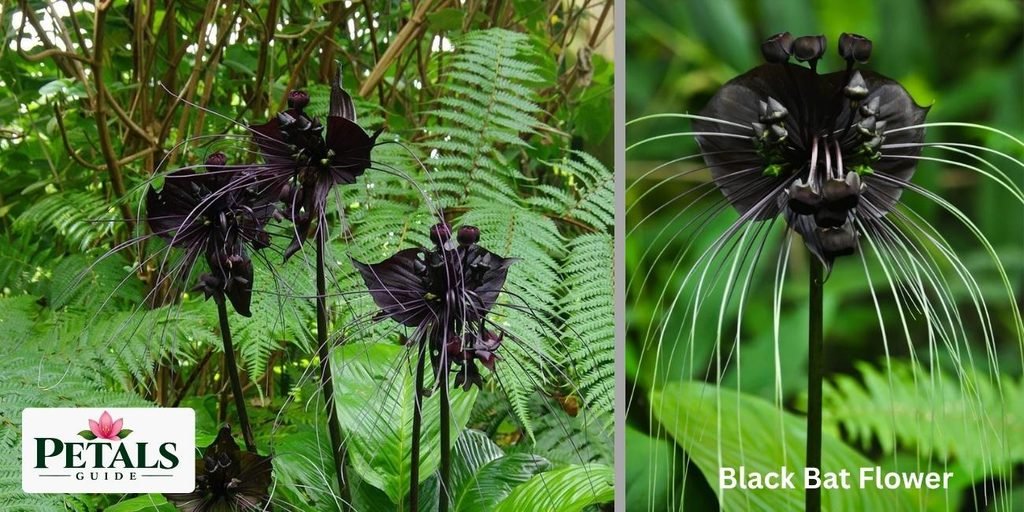
Native to tropical Southeast Asia, Tacca chantrieri prefers warm, humid conditions similar to a forest understory. It works well in containers or sheltered tropical gardens with filtered light and moist soil, where its unusual flowers can provide a strong focal point.
Onyx Odyssey Hellebore (Helleborus ‘Onyx Odyssey’)
- Genus: Helleborus
- Native Range: Hybrid origin, derived from several species primarily native to Europe and Asia
- USDA Hardiness Zone: 4 to 9
- Plant Height: 18 to 24 inches
- Soil Type: Well-draining, rich in organic matter
- Water Needs: Moderate; prefers consistent moisture without sogginess
- Sun Requirement: Part shade to full shade
- Bloom Time: Late winter to early spring
- Fragrance: Slightly fragrant, though not strongly aromatic
The Onyx Odyssey Hellebore produces deep maroon to near-black blooms with a rounded, cup-like form. The flowers stand above dark green, leathery foliage, creating a strong contrast between the deep blooms and surrounding leaves. Depending on the light, the petals can appear almost black, while subtle variations in their dark coloration add depth to the flowers.
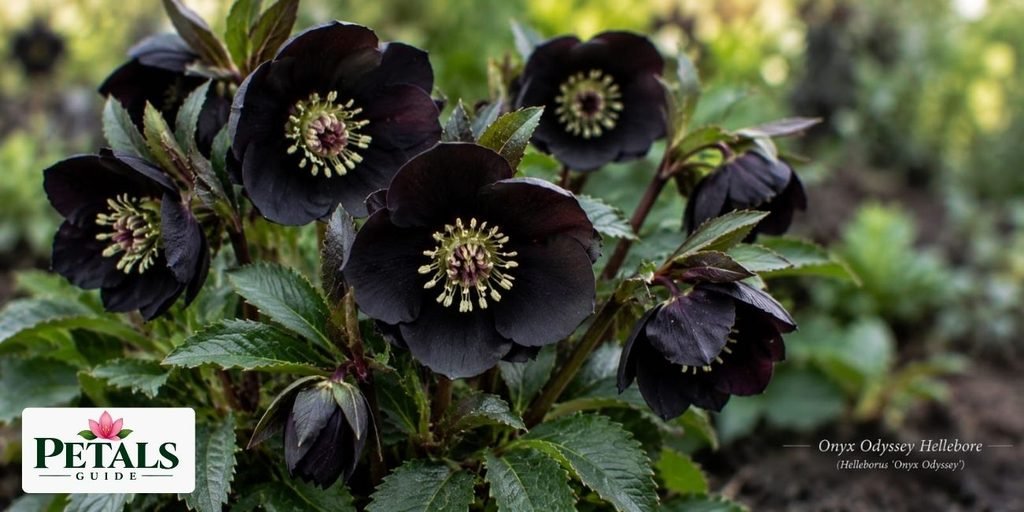
As a shade-loving perennial, ‘Onyx Odyssey’ works particularly well in woodland gardens, shaded borders, and underplanting areas. Its dark blooms can be paired with lighter hellebores or other shade-tolerant plants to create contrast. The plant can remain in the garden for many years when grown in suitable conditions.
Black Tulip ‘Queen of Night’ (Tulipa ‘Queen of Night’)
- Genus: Tulipa
- Native Range: Cultivar; tulips are native mainly to Central Asia and surrounding regions
- USDA Hardiness Zone: 3–7
- Plant Height: 12–18 inches
- Soil Type: Well-drained, loamy soil
- Water Needs: Moderate; avoid waterlogged soil
- Sun Requirement: Full sun to partial shade
- Bloom Time: Mid to late spring
- Fragrance: Little to none
The Black Tulip ‘Queen of Night’ features cup-shaped blooms that can appear almost black, though they are generally a deep purple or plum shade. The petals have a smooth texture and a velvety appearance, contributing to their rich color. Standing upright on sturdy stems, the flowers typically measure around 4-5 inches across and are complemented by narrow, green foliage that remains uneventful when not in bloom.
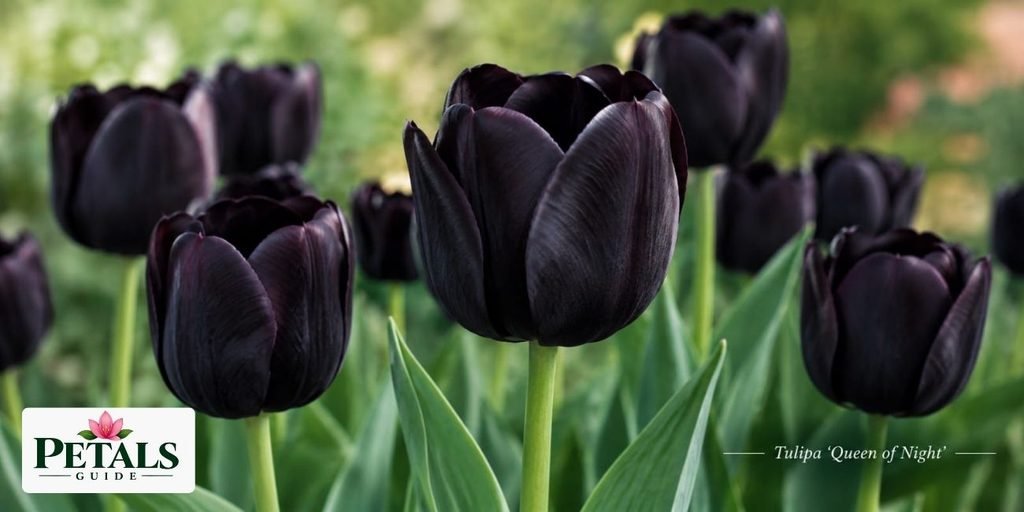
‘Queen of Night’ is a well-known tulip cultivar that has been grown in gardens for many years. It works well in borders, containers, and group plantings, especially when combined with white, cream, pink, or other light-colored spring flowers. Planting several bulbs together can create a fuller display while keeping the dark blooms as a strong feature of the planting.
Black Barlow Columbine (Aquilegia vulgaris var. stellata ‘Black Barlow’)
- Genus: Aquilegia
- Native Range: Europe
- USDA Hardiness Zone: 3–8
- Plant Height: 24–30 inches
- Soil Type: Loamy, well-draining soil
- Water Needs: Moderate
- Sun Requirement: Partial shade to full sun
- Bloom Time: Early summer
- Fragrance: Lightly scented
The Black Barlow Columbine features unique, dark purple petals that can appear nearly black, forming a distinctive double, spurless flower. Each bloom measures about 2-3 inches across and stands out against bright green foliage. The upright stems provide a sturdy structure for these striking flowers, creating an interesting visual texture in the garden.
This cultivar typically flowers in early summer and has a clumping growth habit, making it suitable for areas such as borders, cottage gardens, or even containers. Its moderate height allows it to fit well among other perennials, adding depth and contrast to established plantings. Black Barlow works well in partially shaded spots, where the darker tones can be appreciated without harsh sunlight washing out their color.
Black Persian Lily (Fritillaria persica ‘Adiyaman’)
- Genus: Fritillaria
- Native Range: Western Asia
- USDA Hardiness Zone: 5–8
- Plant Height: 24–36 inches
- Soil Type: Well-drained, loamy or sandy
- Water Needs: Moderate
- Sun Requirement: Full sun to partial shade
- Bloom Time: Spring
- Fragrance: Mildly scented
Deep purple-brown flowers appear along the upper part of the tall stems, giving the Black Persian Lily its dark, almost black appearance. The bell-shaped blooms are about 2–3 inches long and hang downward in a loose cluster. Narrow, lance-shaped leaves grow along the stems and provide a green contrast to the dark flowers.
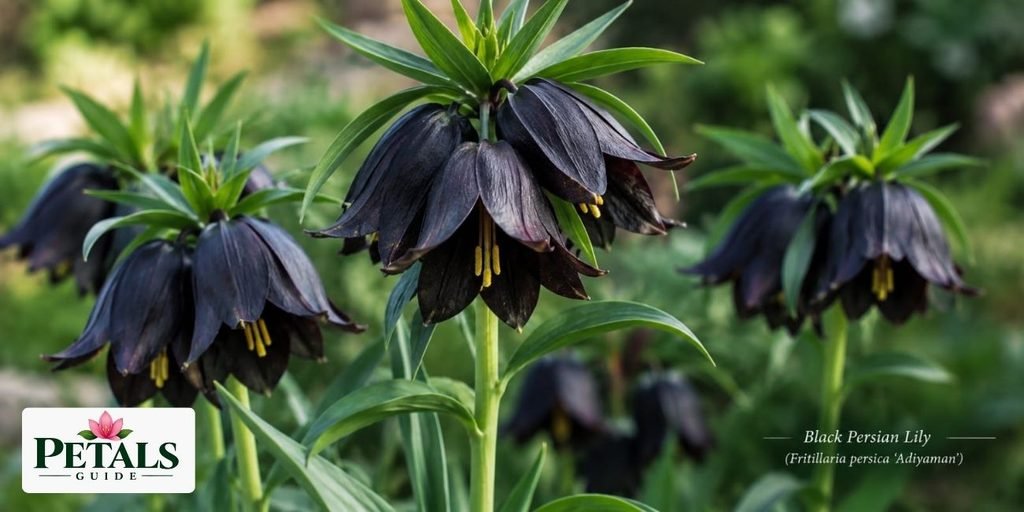
‘Adiyaman’ blooms in spring and grows from a bulb in well-drained soil. These black flowers can be planted in borders, rock gardens, and naturalized areas where the soil does not stay wet. Its tall stems also allow the flowers to rise above shorter plants, making it useful when combined with low-growing perennials.
Penny Black Nemophila (Nemophila menziesii ‘Penny Black’)
- Genus: Nemophila
- Native Range: Western United States
- USDA Hardiness Zone: 5-10
- Plant Height: 6-12 inches
- Soil Type: Well-drained, loamy soil
- Water Needs: Moderate
- Sun Requirement: Full sun to partial shade
- Bloom Time: Spring to early summer
- Fragrance: Lightly fragrant
The Penny Black Nemophila is noted for its small, dark purple flowers, which can appear nearly black with distinct white margins. Each rounded blossom features five petals and typically measures about 1 inch across, set against soft green foliage that provides a gentle contrast. This combination renders the plant visually interesting in various garden settings.
As a hardy cultivar, the ‘Penny Black’ blooms from spring to early summer, displaying a compact growth habit ideal for borders, containers, and rock gardens. It thrives in well-drained soil and can tolerate varying light conditions, making it versatile for ground-level plantings. Originally native to the Western United States, this plant not only adds color but can also help attract pollinators to your garden.
Black Iris (Iris chrysographes)
- Genus: Iris
- Native Range: China, Tibet, and the Himalayas
- USDA Hardiness Zone: 5 to 8
- Plant Height: 24 to 36 inches
- Soil Type: Moist, well-drained
- Water Needs: Moderate
- Sun Requirement: Full sun to partial shade
- Bloom Time: Late spring to early summer
- Fragrance: Lightly fragrant
Deep violet to almost blackish-purple petals give the Black Iris its dark appearance, while golden markings near the base add a distinct detail to each bloom. The iris-shaped flowers have three upright standards and three drooping falls, with slender, grass-like foliage forming a green backdrop around the flowering stems.
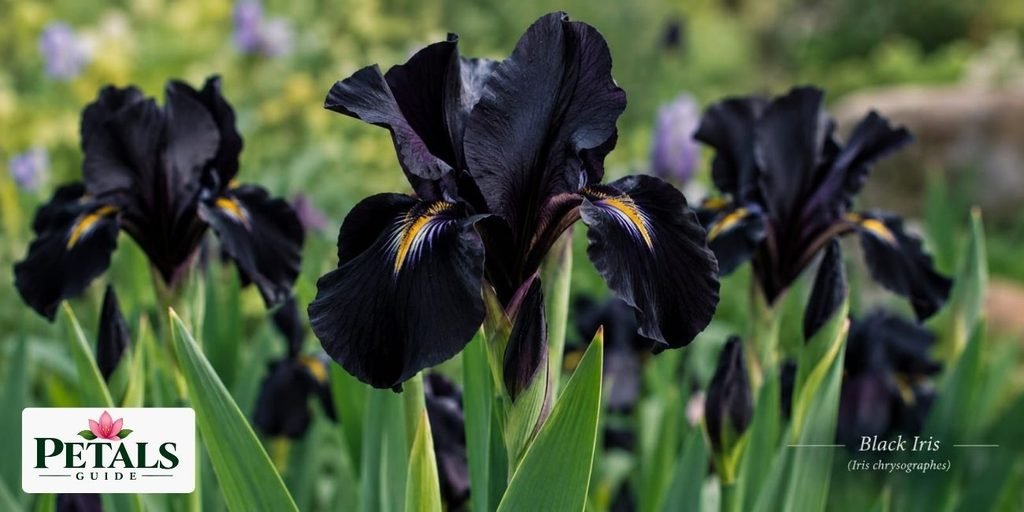
Dark flowers such as the Black Iris create strong contrast when planted with white or yellow flowers. Its golden markings also stand out more clearly against the dark petals when the blooms are surrounded by green foliage or lighter-colored plants.
Black Cosmos (Cosmos atrosanguineus)
- Genus: Cosmos
- Native Range: Mexico
- USDA Hardiness Zone: 9-11
- Plant Height: 2-3 feet
- Soil Type: Well-drained soil
- Water Needs: Moderate
- Sun Requirement: Full sun
- Bloom Time: Summer to fall
- Fragrance: Chocolate
Velvety petals give Black Cosmos its dark chocolate-brown to deep maroon color, forming daisy-like flowers about 2–3 inches across. A small cluster of yellow disk florets sits at the center, while finely divided foliage gives the plant a soft, feathery appearance.
Known for its faint chocolate aroma, Black Cosmos is not only a floral treat but also attracts beneficial insects like bees and butterflies, making it suitable for gardens aiming to enhance biodiversity. Additionally, these flowers can serve as cuttings in vases, providing unique color contrasts and scents to indoor arrangements.
Black Scabiosa (Scabiosa atropurpurea ‘Black Knight’)
- Genus: Scabiosa
- Native Range: Mediterranean region
- USDA Hardiness Zone: 5-9
- Plant Height: 18-30 inches
- Soil Type: Well-drained, sandy to loamy
- Water Needs: Moderate
- Sun Requirement: Full sun to partial shade
- Bloom Time: Late spring to early fall
- Fragrance: Mildly sweet
With deep, dark purple to almost black flowers, Black Scabiosa features a unique, round shape that draws attention in any garden. The blossoms grow atop sturdy, tall stems and are often complemented by finely divided, green foliage that adds texture to the overall appearance. The flowers measure around two to three inches across and bloom in clusters, creating a dense visual impact.
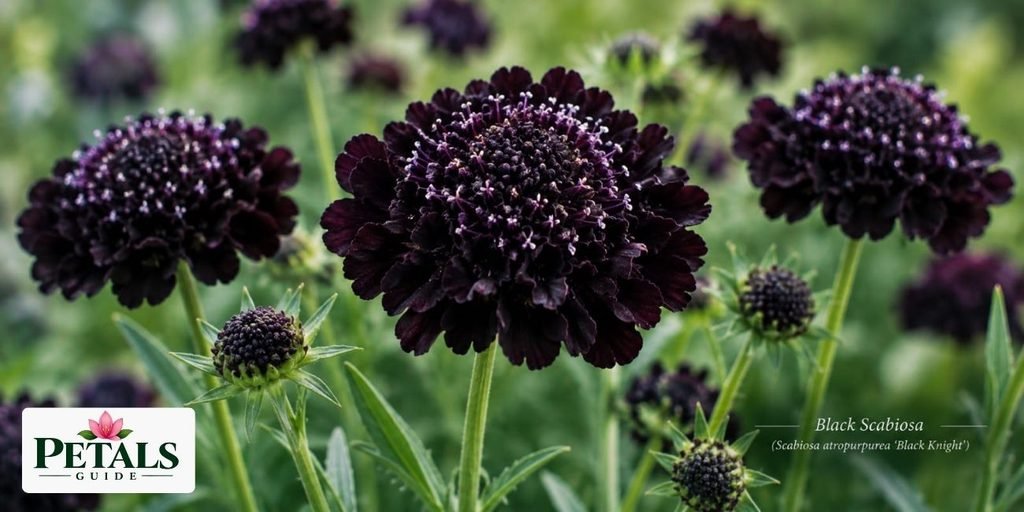
The flower heads are useful in cut-flower arrangements and can also remain attractive after drying. Their dark color works well beside white, pale pink, or soft yellow flowers, while the rounded blooms add a different shape to mixed plantings.
Black Sweet Pea (Lathyrus odoratus ‘Black Knight’)
- Genus: Lathyrus
- Native Range: Mediterranean regions
- USDA Hardiness Zone: 7-10
- Plant Height: 4 to 6 feet
- Soil Type: Well-drained, fertile soil
- Water Needs: Moderate
- Sun Requirement: Full sun to partial shade
- Bloom Time: Late spring to summer
- Fragrance: Sweetly aromatic
Dark maroon to almost black flowers give ‘Black Knight’ its characteristic color. The pea-like blooms have broad, rounded petals and are about 1 to 2 inches across, growing among green foliage on twining stems. The stems use nearby supports to climb as the plant develops.
Like other sweet peas, ‘Black Knight’ is commonly grown for its fragrant flowers and is well suited to trellises, arches, fences, and other supports. These black flowers can also be cut for indoor arrangements, where their dark color provides contrast with lighter-colored sweet pea varieties.
Black Calla Lily (Zantedeschia ‘Edge of Night’)
- Genus: Zantedeschia
- Native Range: Southern Africa
- USDA Hardiness Zone: 8-10
- Plant Height: 24-36 inches
- Soil Type: Well-drained, rich soil
- Water Needs: Moderate
- Sun Requirement: Partial shade to full sun
- Bloom Time: Late spring to early summer
- Fragrance: Mild
Deep maroon-red color gives the Black Calla Lily a near-black appearance, especially in low or indirect light. The smooth spathe curls around the central spadix, forming the characteristic funnel-like shape of a calla lily. Arrow-shaped green leaves surround the flowering stems and provide a clear contrast with the dark spathe.
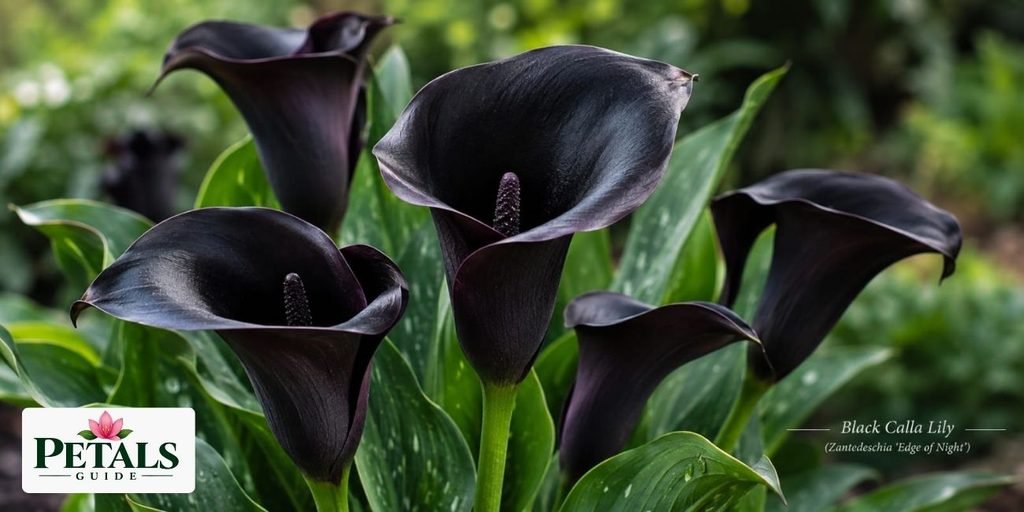
Beyond its visual appeal, the Black Calla Lily is often associated with themes of mystery and introspection, making it a popular choice for floral arrangements and black flower bouquet that evoke depth and contemplation. Additionally, while many people are drawn to its allure for decorative purposes, this black flower plant also possesses qualities that support pollinators, contributing positively to local ecosystems when grown in gardens.
Black Beauty Lily (Lilium ‘Black Beauty’)
- Genus: Lilium
- Native Range: Hybrid, derived from various species
- USDA Hardiness Zone: 3 to 9
- Plant Height: 3 to 4 feet
- Soil Type: Well-drained, fertile soil
- Water Needs: Moderate; avoid waterlogging
- Sun Requirement: Full sun to partial shade
- Bloom Time: Mid-summer to late summer
- Fragrance: Lightly sweet, noticeable scent
The Black Beauty Lily is a hybrid with deep burgundy to dark red petals that can appear nearly black, often marked with darker spots and edges. Its recurved petals give the flowers a distinctive turk’s-cap shape, while prominent stamens extend from the center.
Individual blooms can reach around 6 inches across, and the tall stems carry narrow, green leaves along their length. The dark flowers work well with pale-colored lilies, white flowers, or silver-leaved plants, creating a clear color contrast in mixed borders and cut-flower arrangements.
Black Tree Peony (Paeonia × suffruticosa ‘Hei Hua Kui’)
- Genus: Paeonia
- Native Range: China
- USDA Hardiness Zone: 4-8
- Plant Height: 2-3 feet
- Soil Type: Deep, fertile, well-drained soil
- Water Needs: Moderate
- Sun Requirement: Full sun to partial shade
- Bloom Time: Spring
- Fragrance: Light
Black Tree Peony is known for its deep maroon flowers that can look almost black. The semi-double blooms have several layers of petals around yellow stamens, while the deeply divided green leaves grow around the woody stems. The flowers can reach about 6 inches across.
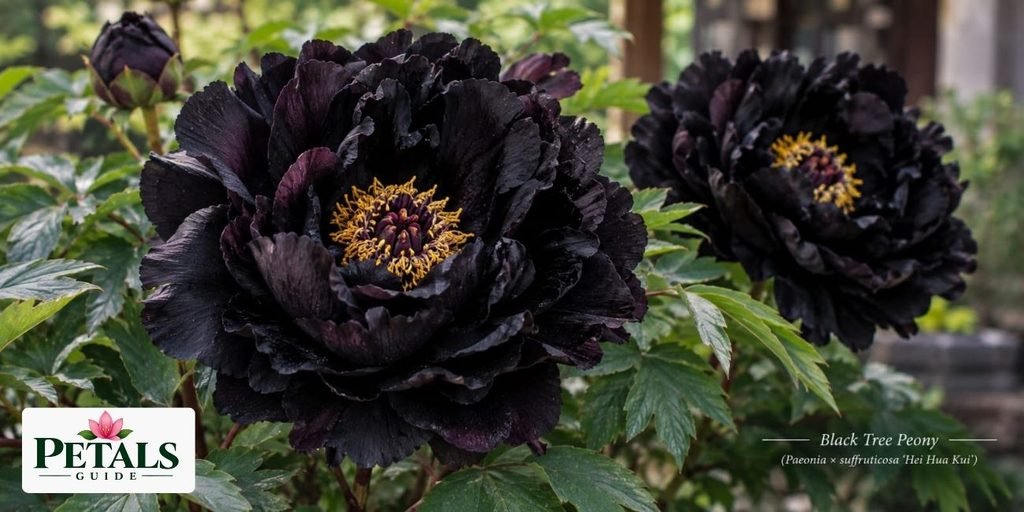
The name ‘Hei Hua Kui’ means “King of Black Flowers,” referring to its unusually dark flower color. This tree peony grows as a small, spreading shrub and can be used as a specimen plant or in flower borders.
Black Hyacinth (Hyacinthus orientalis ‘Midnight Mystique’)
- Genus: Hyacinthus
- Native Range: Eastern Mediterranean USDA Hardiness Zone: 4-9
- Plant Height: 10-12 inches
- Soil Type: Well-drained, loamy soil
- Water Needs: Moderate
- Sun Requirement: Full sun to partial shade
- Bloom Time: Early spring
- Fragrance: Sweetly scented
The Black Hyacinth, with its deep, dark hue, creates a striking presence in any garden. The dense, upright flower spike is adorned with individual star-shaped florets, each contributing to the overall bold appearance of the plant. Its broad, green foliage serves as a lush backdrop, framing the clusters of flowers. Each bloom can grow up to an inch wide, and the growth form is compact, making it suitable for various planting schemes.
This hyacinth works well in containers and can be combined with spring bulbs such as daffodils and tulips for contrasting colors and flower shapes. Its strong fragrance also makes it useful near patios, entrances, or other areas where the scent can be enjoyed.
Black Bachelor’s Button (Centaurea cyanus ‘Black Ball’)
- Genus: Centaurea
- Native Range: Europe and Western Asia
- USDA Hardiness Zone: 3 to 9
- Plant Height: 24 to 36 inches
- Soil Type: Well-draining, average soil
- Water Needs: Moderate
- Sun Requirement: Full sun
- Bloom Time: Late spring to early summer
- Fragrance: Mild
The Black Bachelor’s Button produces deep burgundy to almost black flower heads made up of many narrow, fringed florets. The blooms have a rounded shape and are held on upright, branching stems, while narrow, lance-shaped leaves cover the lower portions of the plant. Individual flower heads are about 1–2 inches across, giving the plant a loose, natural appearance rather than the dense form of many garden flowers.
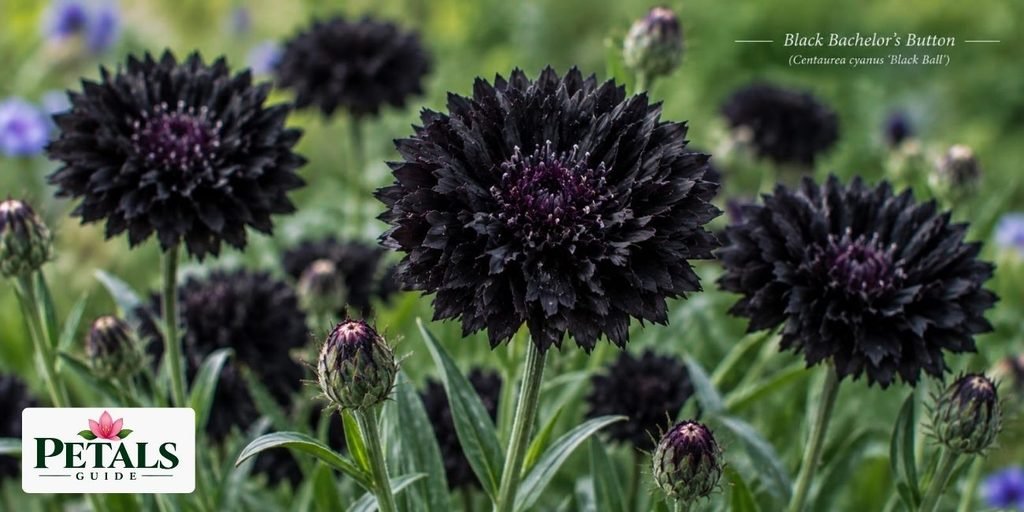
The cultivar is useful as a cut flower because its upright stems are easy to work into bouquets and mixed arrangements. Its dark blooms can also be combined with white, pink, or pale-blue flowers to create color contrast, while the open flower heads provide a food source for bees and other pollinating insects.
Black Peony Poppy (Papaver somniferum ‘Black Beauty’)
- Genus: Papaver
- Native Range: Mediterranean region
- USDA Hardiness Zone: 3-9
- Plant Height: 2-3 feet
- Soil Type: Well-drained, fertile soil
- Water Needs: Moderate
- Sun Requirement: Full sun
- Bloom Time: Late spring to early summer
- Fragrance: Mildly sweet
The Black Peony Poppy has large, densely packed double flowers resembling peony blooms, with dark maroon to deep burgundy petals arranged in multiple layers. The ruffled petals give each flower a full, rounded form, while the upright stems rise above deeply lobed, gray-green foliage. After the flowers fade, rounded seed capsules develop at the tips of the stems, giving the plant a recognizable appearance even after blooming.
The dried seed capsules are commonly retained for ornamental arrangements and can remain useful after the petals have fallen. Like other Papaver somniferum cultivars, ‘Black Beauty’ is also an annual poppy that grows from seed rather than returning from established perennial roots, so plants are normally renewed each growing season.
Black Morning Glory (Ipomoea purpurea ‘Kniola’s Black Night’)
- Genus: Ipomoea
- Native Range: Central America and Mexico
- USDA Hardiness Zone: 3-10
- Plant Height: 6-10 feet
- Soil Type: Well-drained, loamy soil
- Water Needs: Moderate
- Sun Requirement: Full sun
- Bloom Time: Summer to fall
- Fragrance: Mildly fragrant
Kniola’s Black Night produces very dark purple to near-black, funnel-shaped flowers about 3–5 inches across. The petals have a smooth surface and a lighter purple throat, while heart-shaped leaves grow along the twining stems. These black flowers are held among the foliage as the vine climbs, giving the cultivar its characteristic dark-flowered appearance.
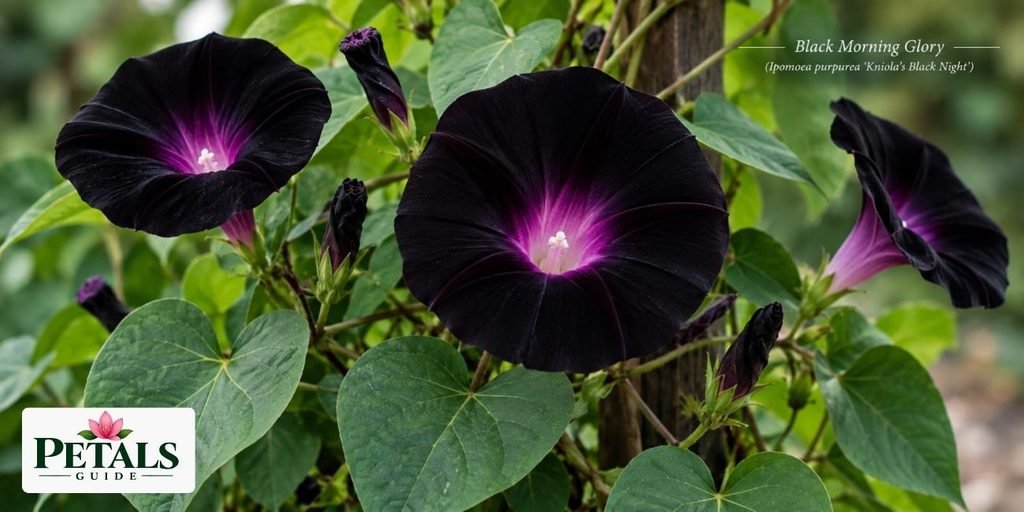
The flowers typically open in the morning and close later in the day, following the light cycle characteristic of morning glories. Its climbing stems make the cultivar useful for growing over trellises, fences, and other vertical supports, where the dark flowers stand out against the green leaves.
Black Bellflower (Campanula ‘Black Knight’)
- Genus: Campanula
- Native Range: Europe
- USDA Hardiness Zone: 4-8
- Plant Height: 12-18 inches
- Soil Type: Well-drained, fertile soil
- Water Needs: Moderate
- Sun Requirement: Full sun to partial shade
- Bloom Time: Late spring to early summer
- Fragrance: Lightly scented
Black Bellflower is known for its deep purple, nearly black blooms that hang like small bells. Each flower has flared petals that open outward, giving it a soft, drooping shape. The dark blooms stand out against the plant’s green foliage and give the flowers a distinct look.
Black Bellflower can attract bees and other pollinating insects. Its dark blooms pair well with white, pale pink, or yellow flowers, creating a clear contrast in mixed plantings. The flowers can also be used in containers or along garden borders where their hanging form is easy to notice.
Black Charm Gladiolus (Gladiolus ‘Black Charm’)
- Genus: Gladiolus
- Native Range: South Africa
- USDA Hardiness Zone: 8-10
- Plant Height: 3-4 feet
- Soil Type: Well-drained, fertile soil
- Water Needs: Moderate
- Sun Requirement: Full sun
- Bloom Time: Late summer to early fall
- Fragrance: None
Black Charm Gladiolus is known for its deep burgundy to almost black flowers arranged along tall, upright spikes. The funnel-shaped blooms open outward from the stems, while sword-shaped green leaves grow from the base and around the lower part of the plant. The dark petals can show slightly lighter tones toward the center, giving each flower a rich, layered look.
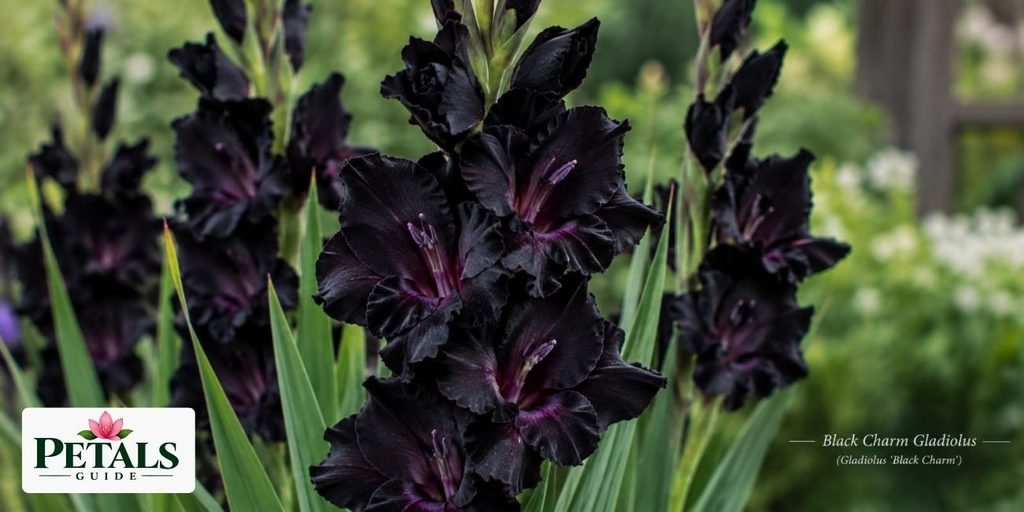
The tall flower spikes make Black Charm Gladiolus useful for cut-flower arrangements, where individual blooms open gradually along the stem. Its dark flowers also pair well with white, cream, or pale-pink gladioli and other light-colored flowers, creating a clear contrast in bouquets and mixed plantings.
Black Dahlia (Dahlia ‘Black Knight’)
- Genus: Dahlia
- Native Range: Mexico
- USDA Hardiness Zone: 8-10
- Plant Height: 30-36 inches
- Soil Type: Well-draining
- Water Needs: Moderate
- Sun Requirement: Full sun
- Bloom Time: Summer to fall
- Fragrance: Mild
The Black Dahlia is known for its deep burgundy to nearly black color, giving its flowers a darker look than most garden blooms. Its petals are arranged in many layers, forming a full, rounded flower head, while the green foliage provides a clear contrast. Depending on the flower form, the petals may have pointed or rounded tips, adding variety to its appearance.
Black Dahlias are also popular as cut flowers because their full blooms add volume to bouquets and centerpieces. Their dark color works well with white, cream, pink, or yellow flowers, creating a clear contrast in mixed arrangements.
Black Monkshood (Aconitum ‘Black Knight’)
- Genus: Aconitum
- Native Range: Europe and Asia
- USDA Hardiness Zone: 3-7
- Plant Height: 3-5 feet
- Soil Type: Moist, well-drained soil
- Water Needs: Moderate
- Sun Requirement: Partial shade
- Bloom Time: Late summer to fall
- Fragrance: None
Black Monkshood is known for its deep blue-purple to almost black flowers, which have a distinctive hooded shape. The flowers grow closely along tall stems, while deeply divided green leaves fill out the lower part of the plant. Each hood-like bloom has two upper petals that form a cap over the smaller inner petals, giving the flower its unusual shape.
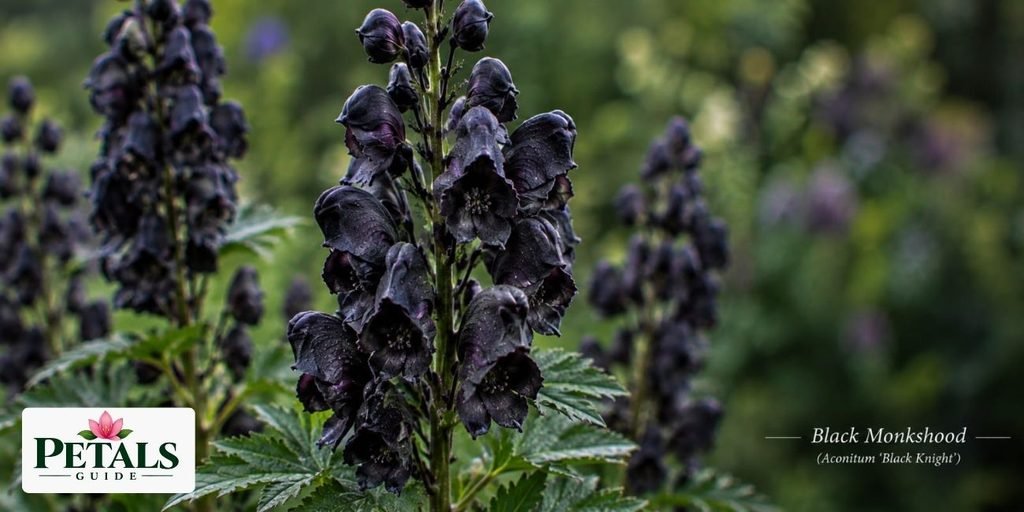
One important fact about Monkshood is that all parts of the plant are highly poisonous if eaten. It should be handled carefully and kept away from children and pets. Its unusual hooded flowers are also visited by bees and other pollinators.
Black Love-in-a-Mist (Nigella papillosa ‘Midnight’)
- Genus: Nigella
- Native Range: Western and Central Mediterranean
- USDA Hardiness Zone: 3-9
- Plant Height: 18-35 inches
- Soil Type: Well-drained soil
- Water Needs: Moderate
- Sun Requirement: Full sun
- Bloom Time: Summer
- Fragrance: None
Black Love-in-a-Mist has velvety dark purple flowers with a group of nearly black stamens at the center. Fine, feathery leaves surround the blooms, giving the flowers their misty appearance. The flowers are followed by unusual dark purple seed pods with horn-like points, which make the plant easy to recognize even after flowering.
The flowers and seed pods can both be used in fresh and dried floral arrangements. The dark seed pods keep much of their color after drying, making them useful for adding darker tones to bouquets and other dried displays.
Black Magic Rose (Rosa ‘Black Magic’)
- Genus: Rosa
- Native Range: Cultivated hybrid, bred in Germany
- USDA Hardiness Zone: 7-10
- Plant Height: 5-7 feet
- Soil Type: Moist, well-drained, loamy soil
- Water Needs: Moderate
- Sun Requirement: Full sun
- Bloom Time: Early to late summer
- Fragrance: Little to none
The Black Magic Rose is a hybrid tea rose with deep red, velvety petals that can appear almost black, especially in the darker stages of the flower. Its pointed buds slowly open into high-centered blooms with many thick petals, while the outer petals often have an even darker edge. The dark green, glossy leaves provide a clear contrast to the flowers.
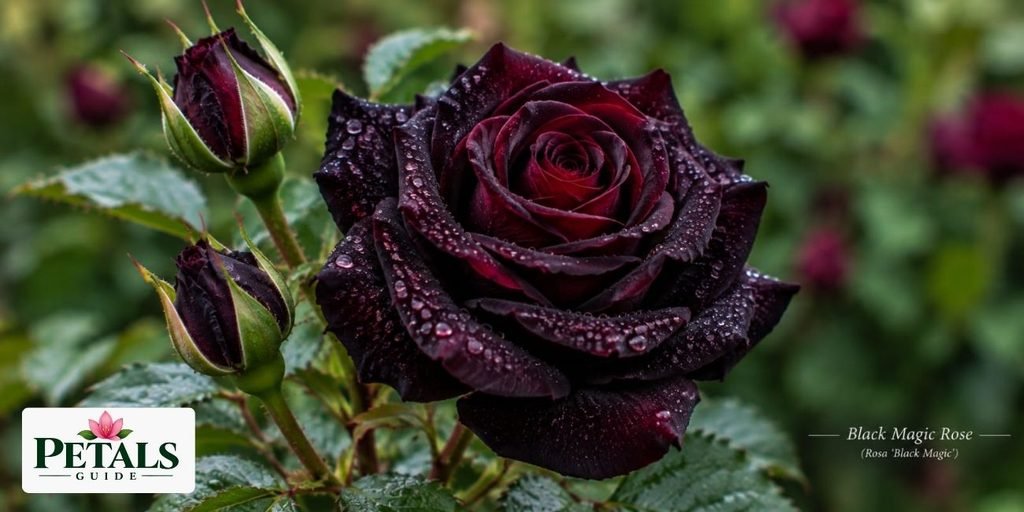
Black Magic Rose is widely used as a cut flower because its long, strong stems and long-lasting blooms work well in bouquets. The flower color can become slightly lighter and redder as the buds open, while cooler conditions can help produce deeper tones.
Black Baccara Rose (Rosa ‘Black Baccara’)
- Genus: Rosa
- Native Range: Cultivated hybrid, bred in France
- USDA Hardiness Zone: 7-10
- Plant Height: 4-6 feet
- Soil Type: Well-drained, fertile soil
- Water Needs: Moderate
- Sun Requirement: Full sun
- Bloom Time: Summer to fall
- Fragrance: Little to none
Black Baccara Rose is known for its deep burgundy-red petals, which can look almost black in certain light. The flowers have a velvety texture and a high-centered shape, with many closely packed petals forming a full bloom. The dark green, glossy leaves provide a clear contrast to the deep color of the flowers.
Black Baccara was first developed for the cut-flower trade and is still widely used in bouquets and floral arrangements because of its long, strong stems and well-formed blooms. Its flower color can become darker in cooler weather, sometimes showing deep brown or dark purple-red tones.
Black Kalmia (Kalmia latifolia ‘Mitternacht’)
- Genus: Kalmia
- Native Range: Eastern United States
- USDA Hardiness Zone: 4-9
- Plant Height: 4-6 feet
- Soil Type: Moist, well-drained, acidic soil
- Water Needs: Moderate
- Sun Requirement: Full sun to partial shade
- Bloom Time: Late spring to early summer
- Fragrance: None
Black Kalmia is a mountain laurel variety known for its very dark burgundy flowers that can look almost black. The small flowers have a light-colored edge, creating a clear contrast with the dark center. Its evergreen leaves are dark green, glossy, and oval-shaped.
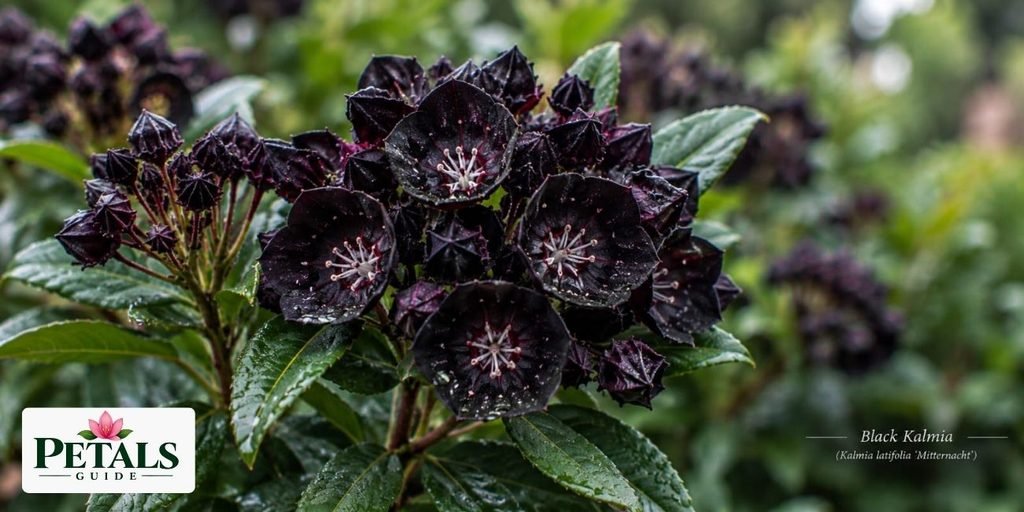
The flowers appear in clusters above the foliage and open from lighter-colored buds. Black Kalmia grows as a compact shrub and works well in acidic woodland gardens or mixed plantings with other plants that prefer similar soil conditions.
Black Knight Delphinium (Delphinium ‘Black Knight’ Group)
- Genus: Delphinium
- Native Range: Europe and Asia
- USDA Hardiness Zone: 3-7
- Plant Height: 5-8 feet
- Soil Type: Fertile, well-drained soil
- Water Needs: Moderate
- Sun Requirement: Full sun
- Bloom Time: Early to midsummer
- Fragrance: None
Black Knight Delphinium has tall spikes covered with deep blue-purple flowers and dark, almost black centers. The flowers are semi-double and grow above deeply divided green leaves, giving the plant its tall, upright form.
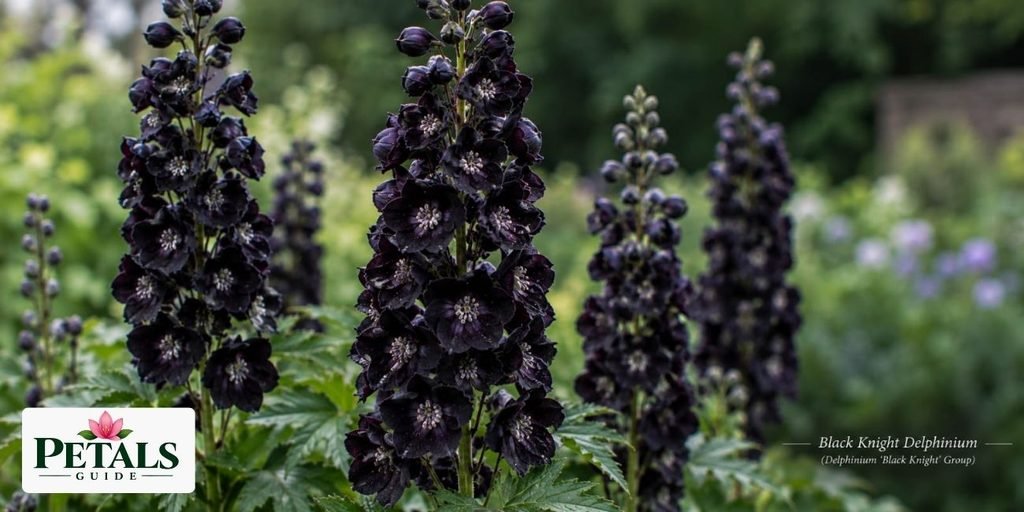
The tall stems make Black Knight Delphinium useful at the back of flower borders and in cottage-style gardens. It is also a good cut flower, but the plant is harmful if eaten, so it should be handled with care around children and pets.
Why Choose Black Flowers for Your Garden?
Black flowers may seem unusual, but they add a unique charm to your garden that other colors can’t match. They create a striking contrast against green leaves and lighter blooms, making your garden stand out even more. A garden filled with rich dark hues is like painting a canvas where the black flowers act as bold strokes that draw the eye.
Using black flowers can also bring a touch of mystery to your outdoor space. They can symbolize elegance and sophistication, making your garden feel more refined. Plus, they can attract unique insects and butterflies that are drawn to their darker shades. When you plant these flowers, you’re not just adding beauty; you’re also creating an inviting space full of life and character.
Black Flowers Starting With Different Letters
- Flowers Starting With A — Black Anemone, Arabian Night Dahlia
- Flowers Starting With B — Black Barlow Columbine, Black Bat Flower, Black Bachelor’s Button
- Flowers Starting With C — Black Calla Lily, Black Cosmos, Chocolate Cosmos
- Flowers Starting With D — Black Dahlia, Dark Dahlia
- Flowers Starting With F — Black Persian Lily (Fritillaria)
- Fritillaria)
- Flowers Starting With G — Black Gladiolus
- Flowers Starting With H — Black Hollyhock, Black Hellebore, Onyx Odyssey Hellebore
- Flowers Starting With I — Black Iris
- Flowers Starting With L — Black Lily, Black Lisianthus
- Flowers That Start With M — Black Magic Rose, Black Monkshood
- Flowers That Start With N — Nigra Hollyhock, Nigella ‘Midnight’
- Flowers That Start With O — Onyx Odyssey Hellebore
- Flowers Starting With P — Black Pansy, Black Petunia, Black Peony Poppy
- Flowers That Start With R — Black Magic Rose, Black Baccara Rose
- Flowers That Start With S — Black Scabiosa, Black Snapdragon, Black Sweet Pea
- Flowers That Start With T — Black Tulip, Black Trillium
- Flowers That Start With V — Black Viola
Conclusion
Black flowers can add a unique touch to any garden or bouquet. They bring an air of mystery and elegance that few other colors can match. From the rich petals of the black tulip to the dramatic look of the black calla lily, there are many options to choose. These flowers can also make special occasions feel even more significant.
FAQs
What are black flowers?
Black flowers are blooms that exhibit a very dark hue, often appearing black but typically are deep maroon, purple, or brown.
What are some popular types of black flowers?
Some popular types include black roses, black calla lilies, and black tulips.
Are there any black flowers truely existing?
True black flowers are very rare; however, some varieties, like the Black Rose and Black Petunia, come very close by having deep, rich colors.
What is a black flower about?
Black flowers often symbolize mystery, elegance, strength, and farewell. Their meaning depends on the culture and occasion, and they are also popular in gardens for their dramatic, dark appearance.
What plant says “I love you”?
Red roses are the most widely recognized flowers associated with romantic love. However, some dark-flowered plants, such as black tulips, can add a distinctive touch to romantic bouquets and floral arrangements.
Do Black-Eyed Susans come back every year?
Yes, most Black-Eyed Susans (Rudbeckia hirta) are short-lived perennials or biennials, although they are often grown as annuals. Other species, such as Rudbeckia fulgida, are reliable perennials that return each year. They may also spread through self-seeding.