
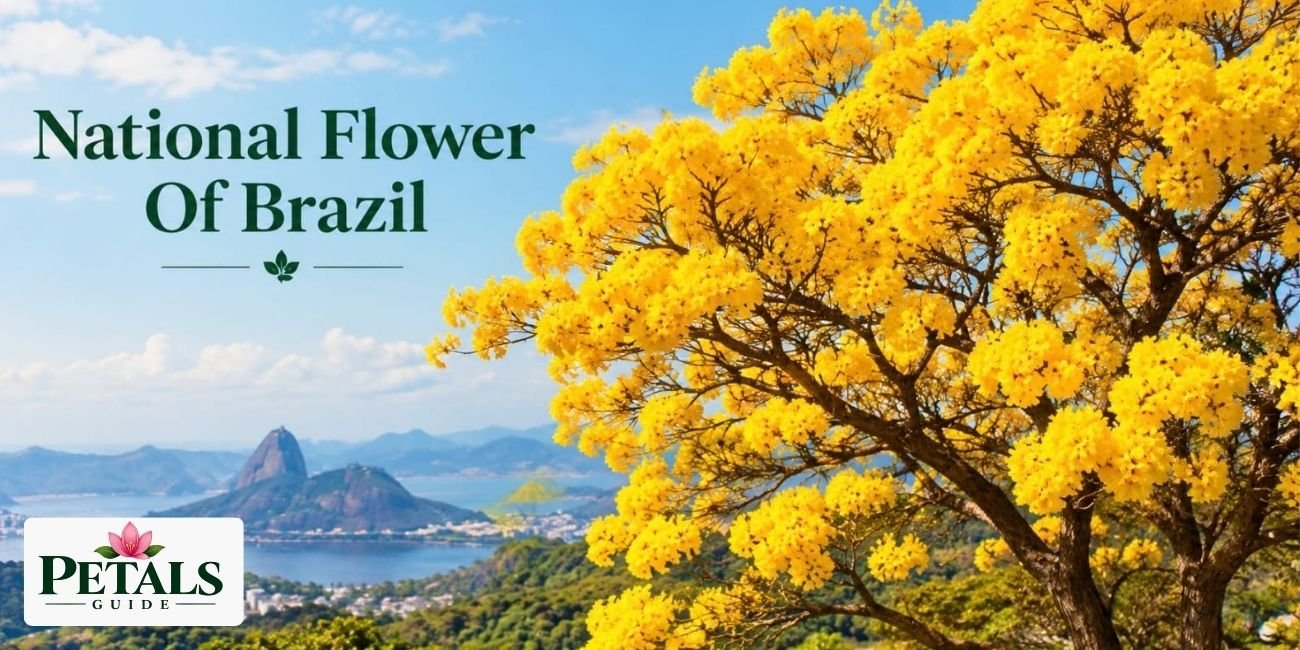
Brazil does not have an official national flower, but many people associate the colorful ipê-amarelo, or golden trumpet tree flower, with the beauty of Brazil. In this article, we’ll explore the significance of the Brazil National Flower and how the gorgeous ipê-amarelo symbolizes the country’s vibrant culture and natural beauty. By the end, you’ll understand why this Brazilian National Flower holds a special place in the hearts of many people.
What Is the National Flower of Brazil?
The national flower of Brazil is commonly associated with the Ipê-Amarelo, or Golden Trumpet Tree, a name used for several yellow-flowering ipê species. Its vivid yellow blooms have made it one of the flowers most often linked with Brazil. The name “Ipê-Amarelo” simply means “yellow ipê” in Portuguese, while “Golden Trumpet” refers to the trumpet-like shape of its flowers.
The reason the Ipê-Amarelo is often described as Brazil’s national flower is largely its strong public recognition rather than a formal national designation. Brazil’s federal law on national symbols identifies the national flag, anthem, arms, and seal, but does not list a national flower. An earlier 1974 bill proposed making the ipê-amarelo Brazil’s national flower, but that proposal did not establish it as an official national symbol.
What is the Golden Trumpet Flower?
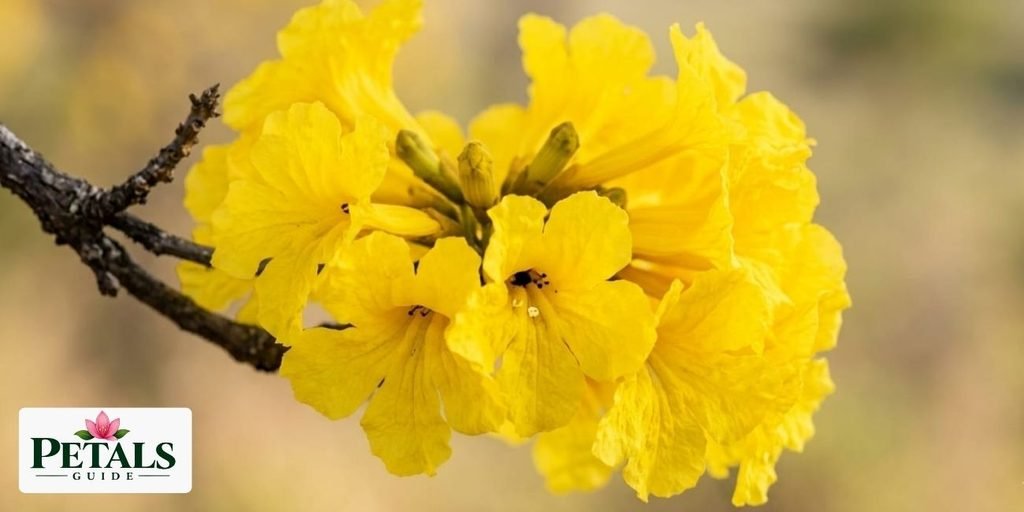
The Golden Trumpet Flower, scientifically known as Handroanthus chrysotrichus and commonly referred to as Ipê-Amarelo in Brazil, is known for its bright yellow to golden-yellow blooms. The flowers have a distinct trumpet-shaped or tubular form and usually appear in clusters, creating a strong contrast when the tree has shed most of its leaves. With little foliage surrounding the flowers, the yellow blooms become the most noticeable feature of the tree.
The name Ipê-Amarelo combines “ipê,” the Portuguese common name for these trees, with “amarelo,” meaning “yellow.” The flowers produce nectar that can attract pollinators such as bees and hummingbirds, adding an ecological role to their seasonal display. It is also useful to distinguish the flower from the plant itself: the Golden Trumpet Flower refers to the yellow bloom, while the Golden Trumpet Tree is the tree that produces it.
Botanical Marvel: The Golden Trumpet Tree
The Golden Trumpet Tree (Handroanthus chrysotrichus, formerly Tabebuia chrysotricha) is a small to medium-sized tree with a spreading growth habit. Its trunk develops a gray to brown bark that becomes rougher with age. Like other members of its group, the tree has a woody trunk and branches that support its seasonal growth and flowering.
The leaves are palmately compound, with several leaflets attached to a common point. The leaflets are generally green and oval to elliptic in shape. The tree is deciduous, meaning it sheds its leaves during part of the year. This leaf loss can occur before flowering, leaving the yellow flowers more exposed on the branches.
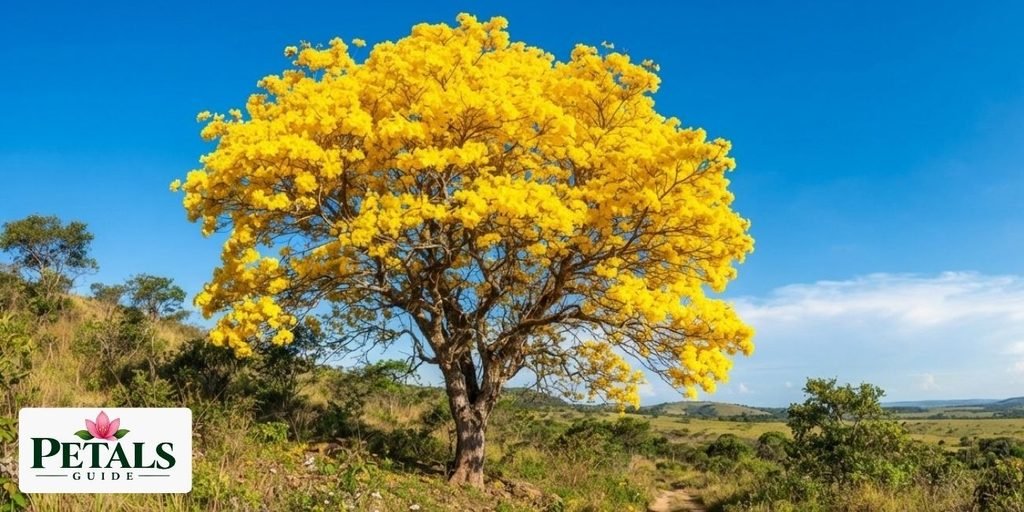
The flowers are produced in clusters and have the tubular, trumpet-like form associated with the tree’s common name. They are bright yellow and can appear in large numbers across the branches. The fruit develops as a long, narrow capsule that eventually dries and opens to release its seeds. The species belongs to the Bignoniaceae family and is accepted botanically as Handroanthus chrysotrichus, while Tabebuia chrysotricha is its former scientific name.
One of the tree’s useful botanical features is its ability to grow in a range of conditions within its natural distribution. Its deciduous growth pattern also helps it cope with seasonal changes in moisture availability. Together, these characteristics make the Golden Trumpet Tree a distinctive member of Brazil’s native tree flora.
Where Does the Golden Trumpet Flower Grow?
Handroanthus chrysotrichus, also known as the Golden Trumpet Tree or Ipê-Amarelo, is native to Brazil, with its natural range extending into northeastern Argentina. In Brazil, the species occurs mainly in the Northeast, South, and Southeast regions. It has been recorded in several states, including Bahia, Minas Gerais, and São Paulo, where it grows in a range of natural and modified landscapes.
The Golden Trumpet Tree is associated with the Atlantic Forest and Cerrado, two of Brazil’s major biomes. It can also occur in secondary vegetation and other altered formations, showing that the species is not limited to undisturbed forests. It is associated with seasonally dry tropical environments and can grow on well-drained soils, including hillside and sloping areas.
The Brazil national flower is also widely planted in urban areas as an ornamental tree. It can be found along streets and avenues, as well as in parks and gardens, where its yellow flowers add seasonal color to the surroundings. These cultivated plantings are separate from the species’ natural distribution but have helped make the Golden Trumpet Tree familiar in Brazilian cities.
What Is the Cultural Significance of the Golden Trumpet?
The Golden Trumpet, flower of Brazil has become closely connected with Brazilian identity and the country’s natural heritage. Its yellow flowering has given the tree a strong presence in Brazilian cities, streets, parks, and public spaces, where it is widely recognized as a symbol of the country. The Ipê-Amarelo is often associated with the colors of Brazil, especially because its yellow flowers appear against green landscapes.
The cultural importance of the tree also comes from its long recognition in Brazil. Brazilian public institutions and municipalities commonly describe the Ipê-Amarelo as a national or Brazilian floral symbol, reflecting how deeply it has become part of the country’s cultural identity. Historical records show that efforts were made in the 1960s and 1970s to recognize the ipê-amarelo as a national floral symbol, although this history does not mean that it is currently established as a formal national flower under Brazil’s federal national-symbols law.

The name Ipê itself has Indigenous roots. Brazilian municipal sources explain that the word comes from Tupi and means “árvore cascuda,” commonly translated as “thick-barked tree.” This Indigenous connection adds another layer to the tree’s place in Brazilian history and language.
Because of its widespread recognition and cultural presence, the Ipê-Amarelo is often described as Brazil National Flower in popular writing, even though its formal legal status is more complicated. For many Brazilians, its yellow blossoms have become a familiar representation of the country’s natural beauty and identity.
What Are the Other National Symbols of Brazil?
Here are some of the other symbols of the country, in addition to the national flower of Brazil.
National Flag of Brazil: The Brazilian flag features a green field, a yellow diamond, and a blue celestial globe crossed by a white band bearing the motto “Ordem e Progresso” (“Order and Progress”). The globe contains 27 white stars representing the sky over Brazil, with the stars arranged to correspond to constellations.
National Anthem of Brazil: Known as “Hino Nacional Brasileiro” (Brazilian National Anthem), it is performed at important national ceremonies, civic events, and official occasions. The anthem is an important expression of Brazil’s national identity.
National Coat of Arms of Brazil: The coat of arms is an official emblem of the Brazilian Republic and is used by federal government institutions. Its design includes a blue circular field with stars, surrounded by branches of coffee and tobacco, with a blue ribbon displaying the country’s official name and the national motto.
National Seal of Brazil: The National Seal is used to authenticate official documents and other acts issued by the federal government. Its design incorporates elements and colors associated with Brazil’s national identity.

National Motto of Brazil: “Ordem e Progresso”, meaning “Order and Progress,” is Brazil’s national motto. It appears on the white band across the blue globe on the national flag and expresses an ideal of social order and progress.
National Bird of Brazil: The Rufous-bellied Thrush (Turdus rufiventris) is recognized as Brazil’s national bird. It is widely known for its distinctive song and is found across much of the country.
National Tree of Brazil: The pau-brasil, or Brazilwood (Paubrasilia echinata), has a special place in Brazil’s history and is legally recognized as the country’s national tree. The species is also closely connected to the origin of the name “Brazil.”
National Colors of Brazil: Green, yellow, blue, and white are the colors that appear on Brazil’s national flag and are widely used to represent Brazilian national identity. The green, yellow, and blue are especially recognizable in Brazil’s national imagery.
The Ipê-Amarelo, or Golden Trumpet Tree, is also deeply associated with Brazil because of its cultural importance and widespread recognition. However, it should be distinguished from the country’s formally established national symbols. Its status as Brazil’s national flower does not place it in the same legal category as the official national symbols listed above.
The Orchid Rivalry: Cattleya Labiata
While the Ipê-Amarelo has long been associated with Brazil, the history surrounding its recognition as the Brazil national flower is not completely straightforward. Some historical accounts connect a 1961 decision during President Jânio Quadros’ administration with recognition of the Ipê-Amarelo. However, later records and discussions show that Brazil’s national floral status has not always had a clear legal standing. For this reason, the Ipê-Amarelo is best described as a widely recognized Brazilian floral symbol rather than an officially established Brazil National Flower.
Another flower often mentioned in discussions of Brazil’s floral identity is Cattleya labiata, a member of the Orchidaceae family. Endemic to Brazil, this orchid occurs naturally in parts of northeastern Brazil and the Atlantic Forest. Its colorful flowers have made it popular among orchid growers, while its long history in cultivation has given it an important place in Brazil’s horticultural heritage.
Although Cattleya labiata is sometimes discussed alongside the Ipê-Amarelo, reliable historical evidence does not show that it was formally placed in a competition with the Ipê-Amarelo for the title of national flower. The “orchid rivalry” is therefore better understood as a comparison between two flowers strongly connected with Brazil rather than an official contest. Cattleya labiata remains an important part of Brazil’s native flora and horticultural history, but it is not formally designated as the country’s national flower.
Conclusion
In conclusion, the Brazil National Flower, the ipê-amarelo, is more than a symbol of the country’s natural beauty. Its brilliant yellow blooms reflect Brazil’s rich biodiversity and have become a familiar sight across its landscapes. The tree also carries cultural meaning, representing ideas such as resilience and unity while reminding us of the importance of protecting Brazil’s natural ecosystems.
Whether seen along streets, in gardens, or across Brazil’s diverse landscapes, the ipê-amarelo remains a memorable part of the country’s identity. Its beauty offers a simple reminder of the natural treasures that make Brazil unique and worth preserving for future generations. if you want to learn about national flowers of different countries then you shoul read our following articles.
National flower of Ireland
National flower of cambodia
National flower of New Zealand
National flower of Austria
FAQs
What is Brazil’s national flower?
Brazil has no official national flower. The ipê-amarelo (golden trumpet tree) is popularly regarded as a symbol of Brazil.
Which animal symbolizes Brazil?
The jaguar is widely regarded as an important animal symbol of Brazil, reflecting the country’s rich wildlife and biodiversity.
What is Brazil’s national tree?
Brazil’s national tree is pau-brasil (Paubrasilia echinata). It was officially declared the national tree under Law No. 6,607 of 1978.
What flowers do Brazilians like?
Popular flowers in Brazil include roses, orchids, lilies, and tropical flowers, while the ipê-amarelo has strong cultural and visual associations with the country.
Is cherry blossom Brazil’s national flower?
No. Cherry blossom is not Brazil’s national flower. Brazil does not have an officially designated national flower, and the ipê-amarelo is the flower most commonly associated with the country