
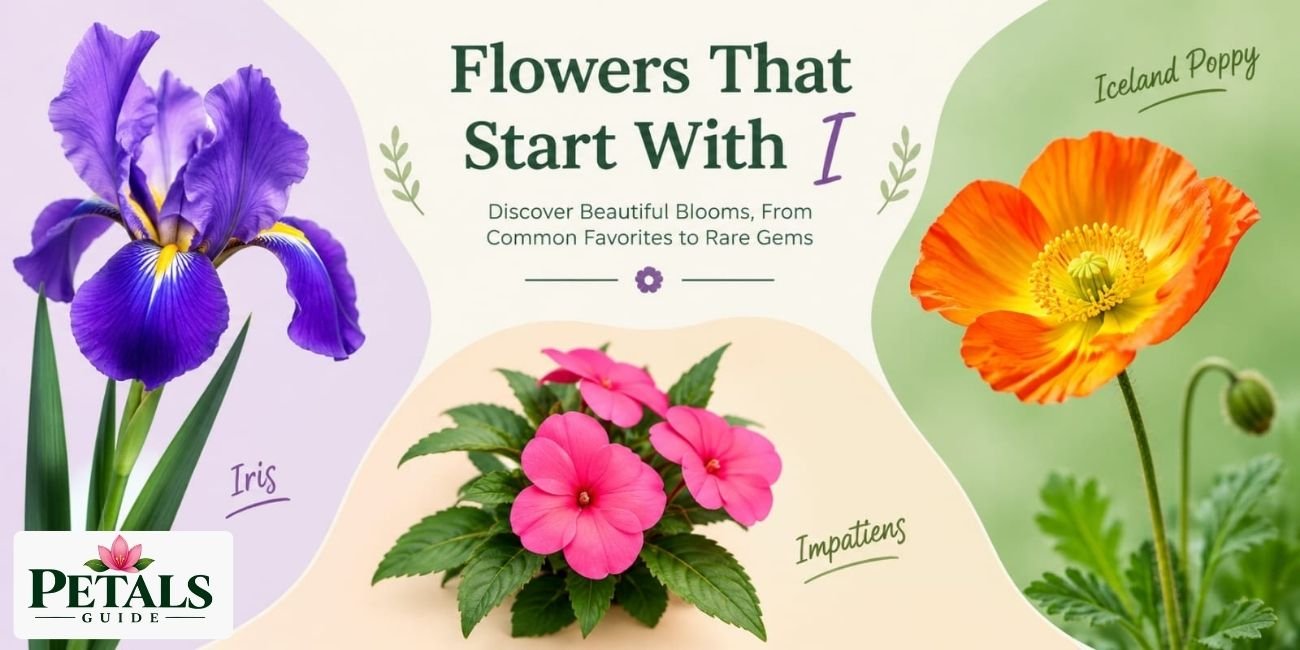
From the delicate Iris to the captivating Impatiens, the world of flowers that start with I is more diverse than you might think. This article uncovers the top 18 beautiful flowers starting with I, highlighting their unique features and care tips. By the end, you’ll be equipped with knowledge to effectively incorporate these stunning plants that start with I into your floral arrangements or landscaping projects.
Full List of Flowers That Start With I
Here is the list of flowers that start with I. First 36 entries are of those flowers/flowering plants whose common names start with I while next entries are those having botanical names starting with the letter I .
- Iris
- Impatiens
- Ice Plant
- Iceland Poppy
- Inca Lily
- Ixora
- Ixia
- Ivy Geranium
- Indian Paintbrush
- Indian Blanket
- Indian Pink
- Indian Cress
- Indian Shot
- Indian Balsam
- Ironweed
- Italian Aster
- Italian Arum
- Italian Bugloss
- Ivy-leaved Toadflax
- Indian Hawthorn
- Indian Mallow
- Indian Senna
- Indian Lily
- Indian Turnip
- Indian Tobacco
- Indian Pipe
- Indian Strawberry
- Indian Rhododendron
- Indian Lotus
- Irish Heath
- Ithuriel’s Spear
- Irish Moss
- Italian Bellflower
- Indigo Bush
- Ivy-leaved Cyclamen
- Indigo
Now further list is of those plants whose botanical names start with I.
- Candytuft — Iberis
- Hardy Gloxinia — Incarvillea
- Elecampane — Inula
- Spring Starflower — Ipheion
- Morning Glory — Ipomoea
- Scarlet Gilia — Ipomopsis
- Bloodleaf — Iresine
- Peruvian Daffodil — Ismene
- Starflower — Isotoma
- Virginia Sweetspire — Itea
- Mountain Lily — Ixiolirion
- Drumsticks — Isopogon
- Holly — Ilex
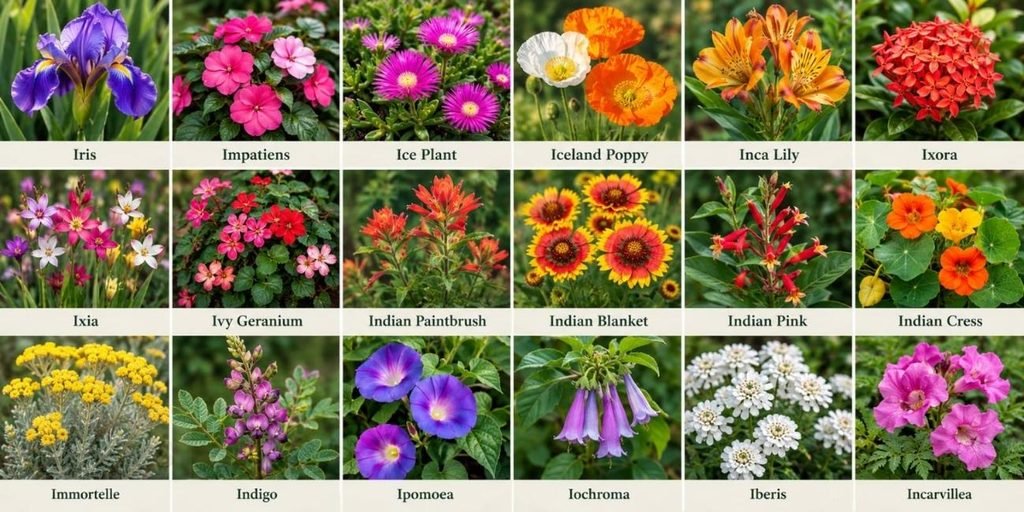
Flowers Whose Common Names Start With I
The following flowers have common names that start with the letter I. The list includes popular garden flowers as well as flowering shrubs, wildflowers, and other flowering plants.
| Common Name | Scientific Name | Plant Type | Flower Colors |
|---|---|---|---|
| Iris | Iris spp. | Perennial | Blue, purple, yellow, white, pink |
| Impatiens | Impatiens spp. | Annual/Perennial | Pink, red, orange, purple, white |
| Ice Plant | Delosperma spp. | Succulent perennial | Pink, purple, yellow, orange, white |
| Iceland Poppy | Papaver nudicaule | Short-lived perennial | Yellow, orange, pink, white |
| Inca Lily | Alstroemeria spp. | Perennial | Pink, orange, yellow, red, white, purple |
| Ixora | Ixora spp. | Flowering shrub | Red, pink, orange, yellow, white |
| Ixia | Ixia spp. | Cormous perennial | Pink, purple, yellow, red, white |
| Ivy Geranium | Pelargonium peltatum | Perennial | Pink, red, purple, white |
| Indian Paintbrush | Castilleja spp. | Wildflower/Perennial | Red, orange, yellow, pink |
| Indian Blanket | Gaillardia pulchella | Annual/Perennial | Red, orange, yellow |
| Indian Pink | Spigelia marilandica | Perennial | Red, yellow |
| Indian Cress | Tropaeolum majus | Annual | Yellow, orange, red |
| Indian Shot | Canna indica | Perennial | Red, orange, yellow, pink |
| Indian Balsam | Impatiens glandulifera | Annual | Pink, purple, white |
| Ironweed | Vernonia spp. | Perennial | Purple, pink |
| Italian Aster | Aster amellus | Perennial | Purple, blue, pink, white |
| Italian Arum | Arum italicum | Perennial | Greenish-white |
| Italian Bugloss | Anchusa azurea | Perennial | Blue |
| Ivy-leaved Toadflax | Cymbalaria muralis | Perennial | Purple, yellow |
| Indian Hawthorn | Rhaphiolepis indica | Flowering shrub | White, pink |
| Indian Mallow | Abutilon indicum | Shrub/Perennial | Yellow |
| Indian Senna | Senna auriculata | Flowering shrub | Yellow |
| Indian Lily | Crinum asiaticum | Bulbous perennial | White |
| Indian Turnip | Arisaema triphyllum | Perennial | Green, purple, brown |
| Indian Tobacco | Lobelia inflata | Annual | Pale blue, white |
| Indian Pipe | Monotropa uniflora | Wildflower/Perennial | White to pinkish-white |
| Indian Strawberry | Potentilla indica | Ground-cover perennial | Yellow |
| Indian Rhododendron | Rhododendron arboreum | Shrub/Tree | Red, pink, white |
| Indian Lotus | Nelumbo nucifera | Aquatic perennial | Pink, white |
| Irish Heath | Daboecia cantabrica | Evergreen shrub | Pink, purple, white |
| Ithuriel’s Spear | Triteleia laxa | Bulbous perennial | Blue, purple, white |
| Irish Moss | Sagina subulata | Ground-cover perennial | White |
| Italian Bellflower | Campanula isophylla | Perennial | Blue, violet, white |
| Indigo Bush | Amorpha fruticosa | Flowering shrub | Purple |
| Ivy-leaved Cyclamen | Cyclamen hederifolium | Tuberous perennial | Pink, white |
Flowers Whose Botanical Names Start With I
Some flowers have botanical names beginning with I, even though their common names may start with a different letter. These plants are included separately to make the list more complete.
| Botanical Name | Common Name | Plant Type | Flower Colors |
|---|---|---|---|
| Iberis spp. | Candytuft | Annual/Perennial | White, pink, purple |
| Incarvillea spp. | Hardy Gloxinia | Perennial | Pink, rose, white |
| Indigofera spp. | Indigo | Shrub/Perennial | Pink, purple |
| Inula spp. | Elecampane | Perennial | Yellow |
| Ipheion spp. | Spring Starflower | Bulbous perennial | Blue, white |
| Ipomoea spp. | Morning Glory | Annual/Perennial vine | Blue, purple, pink, white |
| Ipomopsis spp. | Scarlet Gilia | Biennial/Perennial | Red, pink, orange |
| Iresine spp. | Bloodleaf | Annual/Perennial | White, greenish-white |
| Ismene spp. | Peruvian Daffodil | Bulbous perennial | White, yellow |
| Isotoma spp. | Starflower | Perennial/Annual | Blue, lavender, white |
| Itea spp. | Virginia Sweetspire | Flowering shrub | White |
| Ixiolirion spp. | Mountain Lily | Bulbous perennial | Blue, violet |
| Isopogon spp. | Drumsticks | Shrub | Pink, yellow, cream |
| Ilex spp. | Holly | Shrub/Tree | White, greenish-white |
Top 18 Flowers That Start With I – Closer Look
Here is the details discussion about top 18 flowers that start with I.
Iris (Iris spp.)
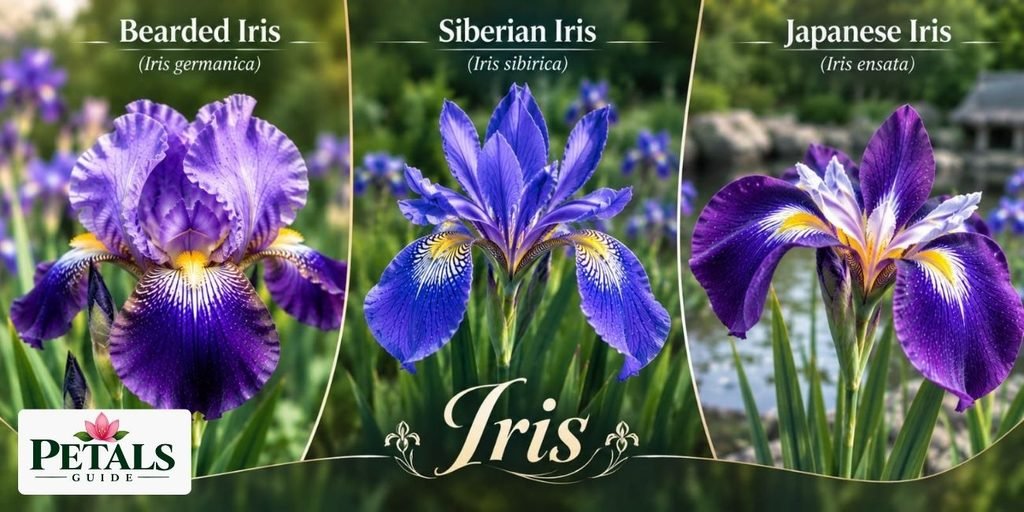
The Iris, named after the Greek goddess of the rainbow, is known for its wide range of colors, including blue, purple, yellow, white, and pink. The flower has a distinctive structure with three upright petals and three spreading or drooping petals. Irises also have sword-like leaves that give them a recognizable appearance in gardens. In floral symbolism, Iris is often associated with hope, faith, wisdom, and courage.
Common types of Iris:
- Bearded Iris
- Siberian Iris
- Japanese Iris
- Dutch Iris
Irises have also held cultural importance in different parts of the world. In Japan, the flower is associated with Children’s Day, traditionally known as Boys’ Day, where iris leaves and flowers have been used in customs connected with protection and strength. Most garden Irises grow well in full sun and well-drained soil, while some types tolerate wetter conditions. They are commonly planted in flower borders, garden beds, cottage gardens, and containers.
Impatiens (Impatiens spp.)
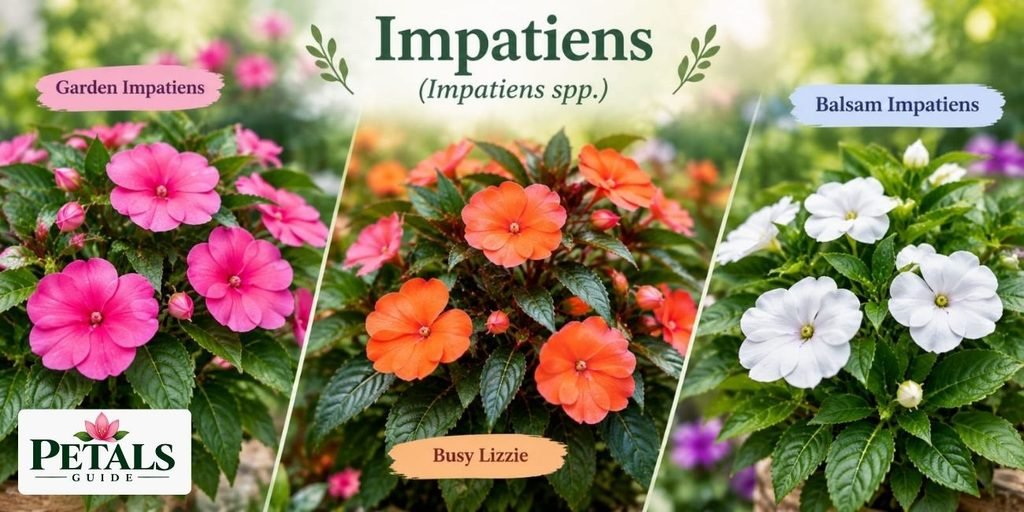
Impatiens are known for their flat, colorful flowers, fleshy stems, and soft green foliage, with blooms commonly appearing in pink, red, orange, purple, and white. Different species and cultivars vary in size, flower form, and growth habit. Many are called touch-me-nots because their mature seed capsules spring open when touched, scattering seeds. The genus is native mainly to tropical and subtropical parts of Africa, Asia, and North America, and the name “Impatiens” refers to the plant’s rapid seed dispersal.
Common types of Impatiens:
- Garden Impatiens
- New Guinea Impatiens
- Busy Lizzie
- Himalayan Balsam
Most cultivated Impatiens grow best in partial shade, moist but well-drained soil, and regular watering. New Guinea Impatiens generally tolerate more sun than traditional garden types when moisture is sufficient. Depending on the species or cultivar, flowering can continue through much of the growing season. They are widely used in flower beds, borders, containers, hanging baskets, and shade gardens, while Himalayan balsam differs from many cultivated types because it can spread aggressively in suitable environments.
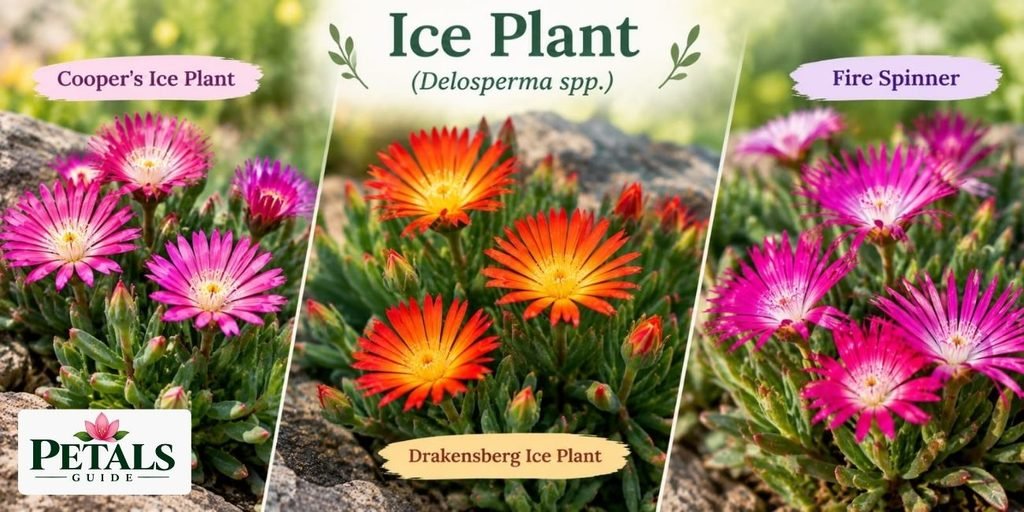
Ice Plant (Delosperma spp.)
The Ice Plant gets its unusual name from the tiny, glistening structures on its fleshy leaves, which can make them look covered with ice crystals. It includes a range of low-growing succulent plants that form spreading mats and produce daisy-like flowers in pink, purple, yellow, red, orange, and white. These plants are native mainly to southern and eastern Africa, where many species have adapted to dry, rocky environments. Their succulent leaves store water, helping them survive periods of limited rainfall.
Common types of Ice Plant:
- Cooper’s Ice Plant
- Drakensberg Ice Plant
- Fire Spinner
- Ruby Coral
Ice Plants grow best in full sun and sharply drained, gritty or sandy soil, and excess moisture can cause problems, particularly in winter. They are useful in rock gardens, gravel beds, slopes, borders, containers, and as low ground cover. Flowering periods vary among types, with many producing blooms from late spring through summer. Some cultivars are also valued for their ability to tolerate drought once established.
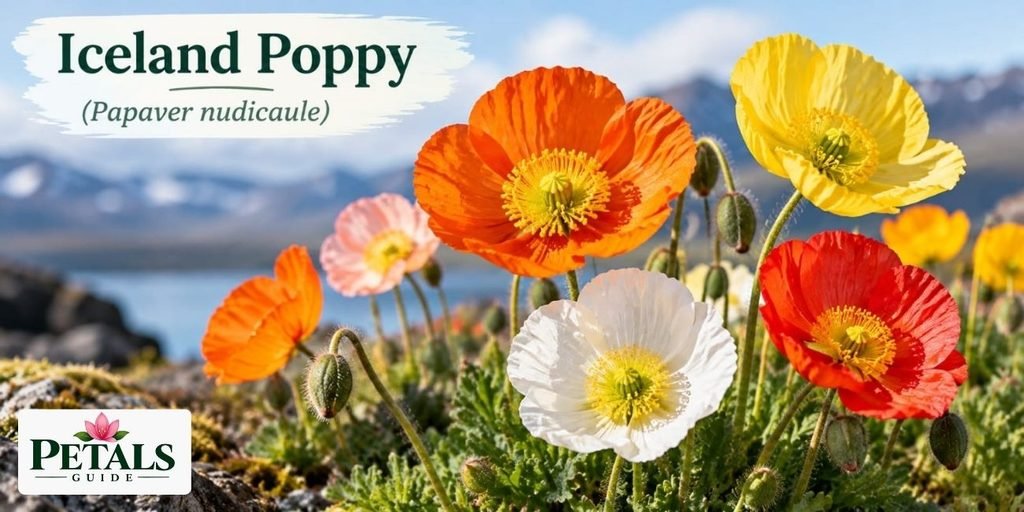
Iceland Poppy (Papaver nudicaule)
The Iceland Poppy is adapted to cool climates and short growing seasons, producing delicate, papery flowers on slender, leafless stems. Its blooms appear in yellow, orange, pink, red, and white, while its foliage forms a low clump close to the ground. Despite its common name, it is not native to Iceland; its natural range extends across northern Europe and parts of northern Asia. The species is valued for its ability to flower during the cooler part of the year, when many other garden flowers are not yet blooming.
Common colors and cultivars:
- Yellow forms
- Orange forms
- Pink forms
- White forms
- ‘Champagne Bubbles’ series
Iceland Poppies grow best in full sun and fertile, well-drained soil with regular moisture. Depending on the climate, they may be grown as annuals, biennials, or short-lived perennials. They are suitable for flower beds, borders, cottage gardens, and containers, and their long stems make them useful as cut flowers. They generally bloom from spring into early summer, with cooler conditions often favoring their flowering.
Inca Lily (Alstroemeria spp.)
The Inca Lily, also known as Alstroemeria, is native to South America, with different species growing naturally in countries such as Chile and Brazil. Its flowers are known for their colorful petals, often decorated with contrasting streaks or spots, and can appear in shades of pink, orange, yellow, red, purple, and white. The plant has narrow, lance-shaped leaves and upright stems that give the flowers a neat appearance. In the language of flowers, Inca Lily is commonly associated with friendship, devotion, and mutual support, making it a popular choice for bouquets and gifts.
Common types of Inca Lily:
- Alstroemeria aurea
- Alstroemeria ligtu
- Alstroemeria pelegrina
- Hybrid Alstroemeria
Inca Lilies grow well in sun or partial shade, preferring fertile, well-drained soil with regular moisture. They generally bloom from late spring through summer, depending on the type and climate. These flowers are commonly grown in garden beds, borders, and containers, while their long-lasting blooms make them especially useful as cut flowers. Many cultivated varieties can return year after year when grown in suitable conditions, providing flowers for both gardens and floral arrangements.
Ixora (Ixora spp.)
Ixora is recognized for its dense clusters of small, tubular flowers, which open into four-lobed shapes and appear in colors ranging from red and orange to pink, yellow, and white. These evergreen shrubs have glossy leaves and a naturally bushy growth habit, making them useful for adding structure and color to warm-climate gardens. Ixora species are native mainly to tropical and subtropical regions of Asia and Africa. The plant is particularly associated with tropical landscapes, where its flower clusters can appear throughout much of the year under suitable conditions.
Common types of Ixora:
- Ixora coccinea
- Ixora chinensis
- Ixora javanica
- Ixora ‘Nora Grant’
Ixora grows best in warm conditions, full sun to partial shade, and fertile, well-drained, slightly acidic soil with regular moisture. It can be used as a hedge, border plant, foundation shrub, or container plant in suitable climates. Regular pruning can help maintain a compact shape and encourage branching, while cold temperatures can damage the foliage and flowers. Its dense flower clusters also provide nectar for various insects, including butterflies, making Ixora useful in pollinator-friendly gardens.
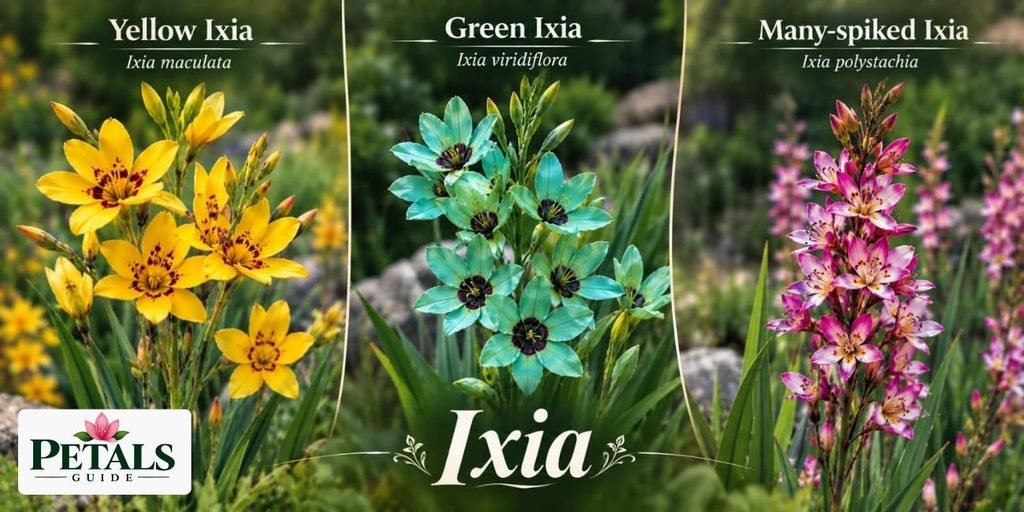
Ixia (Ixia spp.)
Ixia, often called African corn lily, is a group of flowering plants native mainly to southern Africa, particularly South Africa. Its slender stems carry star-shaped flowers in shades of pink, purple, red, yellow, orange, and white, with some species showing contrasting markings around the center. The plants grow from underground corms and have narrow, grass-like leaves. One of their distinctive features is that the flowers often open widely in bright sunlight and close when the light is low, giving the plant a noticeably different appearance throughout the day.
Common types of Ixia:
- Ixia maculata ( Yellow Ixia)
- Ixia viridiflora (Green Ixia)
- Ixia polystachya (Many Spiked Ixia)
- Ixia paniculata (Butt Ixia or Tubular Corn Lily)
Ixia can bring a seasonal display to sunny borders, rock gardens, containers, and cut-flower plantings. The corms are planted in well-drained soil, with watering increased while the plants are actively growing and reduced during dormancy. In regions with cold winters, the corms may need protection from prolonged frost or can be lifted and stored after the foliage dies back. Flowering generally occurs in spring or early summer, depending on the species and growing conditions.
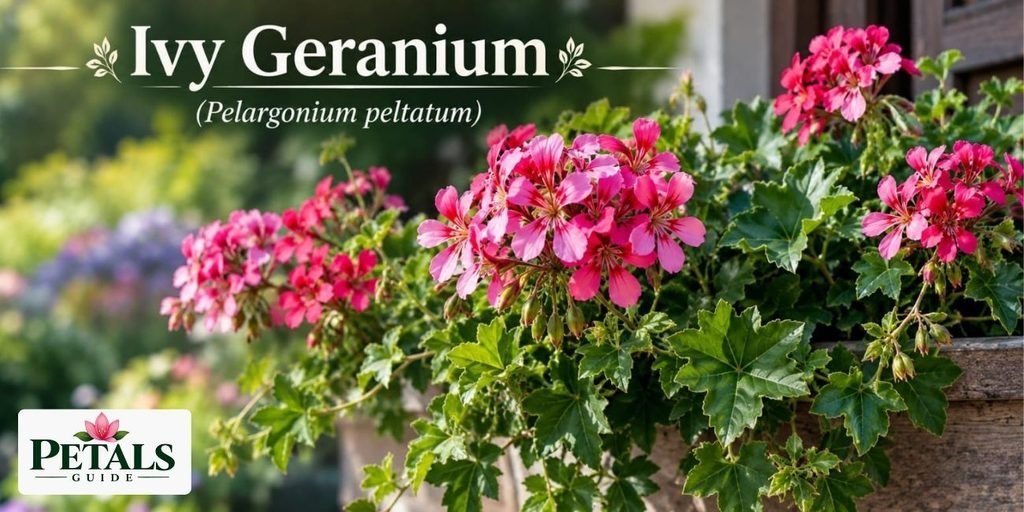
Ivy Geranium (Pelargonium peltatum)
The Ivy Geranium gets its name from its fleshy, ivy-like leaves and trailing stems, which allow the plant to cascade naturally over the edges of containers and hanging baskets. Native to South Africa, it produces rounded clusters of flowers in pink, red, purple, mauve, and white. Its leaves may also have a glossy appearance, helping distinguish it from many other types of Pelargonium. The name “geranium” can be confusing because Ivy Geranium belongs to the genus Pelargonium, not Geranium, the group commonly known as hardy geraniums.
Common forms of Ivy Geranium:
- Single-flowered types
- Double-flowered types
- Variegated-leaved types
- Trailing hybrid cultivars
The trailing habit makes Ivy Geranium particularly useful for hanging baskets, window boxes, balconies, and containers, where its stems can spill over the sides. It flowers mainly from spring into summer and performs best in a sunny, sheltered position with well-drained soil. Regular watering is useful during active growth, but the soil should not remain wet, while trimming the stems can encourage branching and keep the plant compact. In colder regions, it is often protected from frost or overwintered indoors.
Indian Paintbrush (Castilleja spp.)
Indian Paintbrush is recognized by its brightly colored bracts, which surround the small flowers and create the paintbrush-like appearance behind its common name. Different Castilleja species produce red, orange, yellow, and pink shades and grow naturally across North America, especially in meadows, grasslands, prairies, and other open habitats. Their colorful flower spikes also provide nectar for hummingbirds and insects.
Common types of Indian Paintbrush:
- Scarlet Paintbrush (Castilleja coccinea)
- Wyoming Indian Paintbrush (Castilleja linariifolia)
- Harsh Paintbrush (Castilleja hispida)
- Downy Paintbrush (Castilleja sessiliflora)
One unusual feature of Indian Paintbrush is its hemiparasitic growth habit. It can photosynthesize on its own but also connects its roots with nearby plants to obtain additional water and nutrients. This makes some species difficult to establish in ordinary gardens. Scarlet Paintbrush prefers full sun and well-drained soil with moderate moisture, while other species are adapted to drier habitats. Flowering varies by species but generally occurs from spring into summer.
Indian Blanket (Gaillardia pulchella)
Indian Blanket is a colorful flower that starts with I, recognized by its daisy-like blooms with red, orange, and yellow petals. The petals often have darker red or reddish-brown bases with yellow tips, creating the flower’s characteristic pattern. Native to parts of the central and southern United States, Mexico, and nearby regions, it commonly grows in prairies, meadows, roadsides, sandy areas, and open fields. Its narrow leaves and branching stems give it a light, natural appearance among grasses and other wildflowers.
Common forms of Indian Blanket:
- Single-flowered forms
- Double-flowered forms
- Red-centered forms
- Yellow-tipped forms
The flowers provide nectar for bees, butterflies, and other pollinators, making Indian Blanket useful in wildlife-friendly plantings. It performs well in full sun and well-drained soil and can tolerate heat and dry conditions once established. Unlike some perennial Gaillardia species, Gaillardia pulchella is generally an annual or short-lived perennial, depending on the climate. It blooms mainly from late spring through summer and is commonly planted in wildflower gardens, borders, meadows, and naturalized areas.
Indian Pink (Spigelia marilandica)
Indian Pink is known for its bright red, tubular flowers with yellow interiors, which open above its upright green foliage in late spring and early summer. As the flower opens, its yellow center forms a star-like shape that contrasts with the red outer petals. Native to the southeastern United States, this herbaceous perennial naturally grows in moist woodlands, along streambanks, and in other shaded habitats. Its tubular flowers are particularly attractive to hummingbirds, making it a useful addition to wildlife-friendly gardens.
Indian Pink prefers partial shade to full shade and moist, organically rich, well-drained soil. It works well in woodland gardens, shaded borders, native plant gardens, and naturalized areas, especially where the soil does not dry out quickly. The plant usually forms a compact clump and can return each year when growing conditions are suitable. Its flowers are most abundant in late spring and early summer, adding color to shaded parts of the garden when fewer flowering plants are in bloom.
Indian Cress (Tropaeolum majus)
Indian Cress, also known as Nasturtium, is a fast-growing annual with round, shield-like leaves and long-spurred, funnel-shaped flowers in shades of red, orange, and yellow. Native to South America, it can trail along the ground or climb over supports, while its long leaf stalks give the foliage an umbrella-like appearance. The flowers are also useful to pollinators, including bees, and can remain in bloom from summer into autumn under suitable conditions.
Beyond its role as an ornamental plant, Indian Cress is also valued as an edible flower. The flowers, leaves, seeds, and young flower buds can be eaten, with the flowers and leaves having a characteristic peppery flavor that works well in salads and other dishes. It grows best in full sun and well-drained, relatively poor soil, as overly rich soil encourages leaves rather than flowers. Its trailing forms are well suited to hanging baskets, containers, borders, and cottage gardens, while some cultivars can be trained to climb.
Immortelle (Helichrysum italicum)
Immortelle, also known as the curry plant, is a Mediterranean subshrub with narrow, silvery leaves and clusters of small yellow flower heads. Native to Mediterranean regions of southern Europe, North Africa, and Turkey, it is well adapted to sunny, dry landscapes. Its flower heads are surrounded by papery bracts and can retain their shape and color after drying, which is why Helichrysum plants are associated with names such as “everlasting” and “immortelle.”
Immortelle grows best in full sun and well-drained, relatively poor to moderately fertile soil, particularly soil that does not remain wet. Its aromatic foliage has a strong scent when rubbed, while the yellow flowers appear mainly from early to late summer. It can be grown in rock and gravel gardens, Mediterranean-style borders, containers, and other sunny areas. The dried flower heads are also useful in dried-flower arrangements because they retain their form well.
Indigo (Indigofera spp.)
Indigo refers to a group of flowering plants which produce small, pea-shaped flowers arranged in slender clusters. The blooms are commonly pink, purple, reddish, or sometimes white, and their shape is typical of plants in the pea family. Depending on the species, Indigo plants can grow as herbs, shrubs, or small trees, with pinnate leaves that provide a leafy backdrop for the flower clusters. They are native to regions across Africa, Asia, Australia, and parts of the Americas, with different species adapted to different habitats.
Common types of Indigo:
- Indigofera tinctoria – True Indigo
- Indigofera suffruticosa – Guatemalan Indigo
- Indigofera australis – Australian Indigo
- Indigofera heterantha – Himalayan Indigo
The flowers usually appear during the warmer months, although the timing varies by species and climate. Many Indigofera plants prefer full sun and well-drained soil, and their flowers can be useful in borders, shrub plantings, and wildlife-friendly gardens. Some species attract bees and other insects to their nectar-rich blooms. Indigofera tinctoria is particularly well known for its historical use as a source of natural blue dye, but its pinkish flower clusters also give the plant ornamental value.
Ipomoea (Ipomoea spp.)
Ipomoea is a large genus that includes many flowers commonly known as Morning Glory. Its funnel- or trumpet-shaped flowers appear in blue, purple, pink, red, and white, while many species have twining stems and heart-shaped leaves. Native mainly to tropical and warm temperate regions, the genus includes annual and perennial plants with different growth habits.
Common types of Ipomoea:
- Ipomoea purpurea — Common Morning Glory
- Ipomoea tricolor — Mexican Morning Glory
- Ipomoea alba — Moonflower
- Ipomoea quamoclit — Cypress Vine
Most species prefer full sun, well-drained soil, and regular moisture during active growth. Their climbing habit makes them useful for trellises, fences, arches, and containers. Many Morning Glory flowers open in the morning and close later in the day, while Moonflower produces fragrant white blooms that open in the evening.
Iochroma (Iochroma spp.)
Iochroma is known for its long, narrow, tubular flowers that hang from the branches in clusters. The blooms can be blue, purple, red, pink, orange, or other shades depending on the species, and their tubular shape makes them attractive to hummingbirds. The genus includes flowering shrubs native mainly to tropical America, particularly parts of South America.
Common types include:
- Iochroma cyaneum — Blue Iochroma
- Iochroma fuchsioides — Red-flowered Iochroma
- Iochroma arborescens — A shrub or small tree species
Iochroma species are generally suited to warm climates, with many growing well in moist conditions and fertile, well-drained soil. Their unusual hanging flowers make them useful as ornamental shrubs or container plants where the climate is suitable. Iochroma cyaneum, for example, is native to Ecuador and Peru and grows in wet tropical habitats.
Iberis (Iberis spp.)
Iberis is a group of flowering plants best known for their small flowers arranged in dense, flat or rounded clusters. The blooms are commonly white, pink, or purple, with some species producing flowers that change in appearance as they open. Candytufts range from low-growing perennials to annuals and small subshrubs.
Common types include:
- Iberis sempervirens — Evergreen Candytuft
- Iberis umbellata — Garden Candytuft
- Iberis amara — Wild Candytuft
Iberis generally grows well in full sun and well-drained soil. Evergreen Candytuft is especially useful for rock gardens, borders, edging, gravel gardens, and containers, while annual types are often grown in flower beds and informal gardens. Many species bloom from spring into summer.
Incarvillea (Incarvillea spp.)
Incarvillea has large, trumpet-like blooms with five spreading lobes, usually carried on slender stems above deeply divided leaves. Pink and rose are the most familiar colors, although some species produce white flowers. The blooms are often marked with a contrasting yellow throat, adding detail to the center of each flower.
Common types include:
- Incarvillea delavayi – Hardy Gloxinia
- Incarvillea mairei – Himalayan Gloxinia
- Incarvillea sinensis – Chinese Incarvillea
It prefers a sunny to partly shaded position with fertile, well-drained soil and moderate moisture. The large flowers make it suitable for borders, rock gardens, and containers, while the finely divided foliage provides interest before and after flowering. In suitable climates, the plant can remain in the garden for several years.
Creating a Color Palette with I Blooms
Flowers Starting With I offer a wide range of colors, making it possible to create different garden palettes using flowers with naturally complementary shades.
The Sunset Palette: Iceland Poppy, Indian Blanket, Inca Lily, and Indian Shot – warm orange, yellow, red, and pink tones.
The Royal Palette: Iris, Ixia, Italian Aster, and Impatiens – blue, purple, violet, and deep pink shades.
The Midnight Palette: Deep-purple Iris, purple Ixia, and dark Impatiens cultivars – deep purple and blue balanced with white accents.
The Soft Pastel Palette: Pink Inca Lily, pink or white Impatiens, white Iris, and pink Iceland Poppy – soft pink and white tones.
The Golden Palette: Yellow Iris, Iceland Poppy, Indian Cress, and Indian Mallow – yellow, golden, and orange shades.
The Warm Contrast Palette: Red Impatiens, Indian Blanket, orange Iceland Poppy, and pink Inca Lily – strong red, orange, and pink contrasts.
The Significance of Symbolism of I Flowers
Flowers have long been given meanings based on their appearance, blooming habits, folklore, and traditional language of flowers. Some I blooms have developed particularly recognizable associations:
- Iris: Traditionally represents wisdom, faith, hope, trust, and courage. In Greek mythology, Iris was associated with the connection between heaven and earth, which contributed to some of the flower’s traditional symbolism.
- Impatiens: Commonly associated with impatience, inspired by its seed capsules that burst open when touched. Some traditional flower-language sources also connect it with motherly love.
- Iceland Poppy: Often associated with consolation and remembrance, giving it a place in traditional sympathy and remembrance arrangements.
- Ipomoea (Morning Glory): Traditionally linked with affection and love. Its short-lived flowers have also been used to represent the fleeting nature of life.
- Iberis (Candytuft): Associated in traditional flower language with indifference and sweetness, although its meaning can vary between sources.
- Indian Cress (Nasturtium): Has been associated with victory, conquest, and patriotism in traditional flower symbolism.
These meanings belong to flower folklore and traditional symbolism rather than scientific classifications, so interpretations can differ across cultures and sources.
Conclusion
Incorporating flowers that start with the letter “I” can add color and diversity to your garden. Options like the Iris, with its wide range of colors, and Impatiens, valued for their colorful blooms, can suit different garden styles and growing conditions. Exploring these “I” flowers can also help you discover a variety of flower forms, colors, and seasonal blooms for gardens and floral arrangements.
FAQs
What are some popular flowers that start with the letter “I”?
Some popular flowers include Iris, Impatiens, Iberis, and Indian Paintbrush.
What flower means “I love you”?
The red rose is commonly associated with the phrase “I love you,” symbolizing deep love and passion.