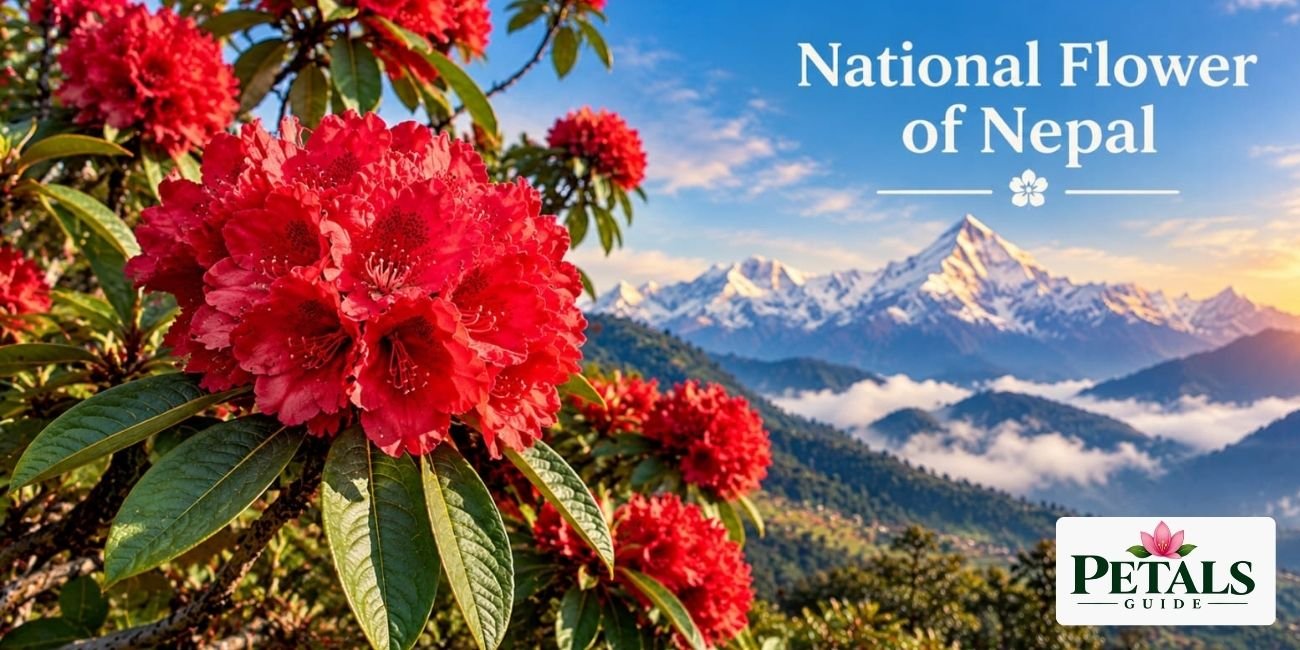
The national flower of Nepal is Lali Gurans, which is the rhododendron called Rhododendron arboreum. This flower is linked to Nepal’s hilly areas and is well-known for its bright blooms. It plays a significant role in the country’s natural identity.
The national flower of Nepal can also be seen often in the Himalayan region, where rhododendrons thrive in forested mountains. Being chosen as a national symbol makes it an important part of understanding Nepal’s native plants.
What Is the National Flower of Nepal?
The national flower of nepal is Rhododendron arboreum, a type of plant within the Ericaceae family. In Nepali, it is called Lali Gurans (लाली गुराँस). Nepal’s Department of Plant Resources recognizes this species as the national flower.
While the term rhododendron nepali is often used for Lali Gurans, it is important to note that Nepal has several species of rhododendrons. The national flower specifically refers to Rhododendron arboreum, not to all rhododendron types.
Quick facts about Nepal’s national flower
- Common name: Rhododendron, Lali Gurans
- Scientific name: Rhododendron arboreum
- Plant type: Flowering tree
- Family: Ericaceae
- Flower colors: Mainly crimson red; also pink and white forms
- Blooming season: Late winter to spring, depending on altitude
- Native region: Himalayan region, including Nepal
- Official status: National flower of Nepal
History of National Flower of Nepal
The history of Nepal’s national flower goes beyond its official recognition. In 1796, Captain Thomas Hardwicke, a British army officer, discovered a large tree blanketed in bright red flowers while exploring the Himalayan foothills. This tree, which would later be known as Rhododendron arboreum, caught his attention so much that he documented it and had illustrations made. This marked the beginning of the plant’s journey from a little-known species to a beloved symbol.
In 1805, English botanist James Edward Smith officially named the plant in his book “Exotic Botany”, using Hardwicke’s notes. Interest in “Rhododendron arboreum” grew, and it soon made its way into gardens and botanical collections in Europe, far from its home in the Himalayas.
By 1962, “Rhododendron arboreum” was recognized as the national flower of Nepal, although records about the exact selection process are not easy to find. Today, it stands proudly in Article 9 of Nepal’s 2015 Constitution, representing the spirit of the nation alongside the cow and the Lophophorus. This journey, from discovery to national symbol, shows how a simple flower can connect cultures and histories.
Botanical Profile of Rhododendron arboreum
The scientific name for Nepal’s national flower is Rhododendron arboreum Sm. It is part of the Ericaceae family, which includes plants like heathers and blueberries. The genus “Rhododendron” has many types, but “R. arboreum” is the one that is recognized as the national flower.
National Flower of Nepal, Lali Gurans, is an evergreen tree that can reach heights of about 10–12 meters when conditions are right, but its height can change based on its surroundings. Its branches hold groups of stiff, thick leaves that are dark green on the top. The underside of the leaves often has soft, fine hair that can look silvery, light brown, or rusty.
The flowers grow in tight, round clusters at the tips of the branches. Each flower is bell-shaped or tubular, with five parts and noticeable stamens. After the flowers bloom, the tree produces narrow, woody pods that contain many tiny seeds. These flowers are usually deep red or crimson, but they can also be pink or white. Some flowers have darker spots or patterns on the inside of the petals, which makes them look special. These natural differences let the plant be varied while still being recognized as the same species.
Botanical sources mention different forms within “Rhododendron arboreum”, such as “Rhododendron arboreum” var. “album”, which has white flowers, and var. “roseum”, known for its pink to rose-colored flowers. Different plant experts may classify these forms in various ways. The phrase rhododendron national flower of Nepal refers to the species Rhododendron arboreum, and not just one flower color.
Where Do Lali Gurans Grow in Nepal?
Lali Gurans, the national flower of Nepal, thrives in the lush hilly and mountainous regions of the country, primarily in temperate forests along the Himalayan slopes. It prefers areas where moisture, moderate temperatures, and well-drained soil come together, flourishing at elevations between 1,200 to 3,600 meters. In some western parts of Nepal, its growth can be limited to lower elevations, especially where rainfall is not abundant.
The beauty of Lali Gurans also lies in its association with the local ecosystem, often found growing alongside oak and other temperate trees. This plant is not exclusive to Nepal; it spans across the Himalayas into regions of India, Bhutan, Pakistan, and southern Tibet, symbolizing a shared Himalayan heritage. Each bloom adds vibrancy to the forests, serving as a reminder of the natural diversity within the region and the cultural significance it holds for the people of Nepal.
When Does Nepal’s National Flower Bloom?
The national flower of Nepal, Rhododendron arboreum, paints the landscape with vibrant colors from late winter to spring. Typically, the blooming period stretches from February to April, but the flowers’ arrival can vary based on location and altitude. In lower regions, such as Kathmandu, the blooms might emerge as early as mid-February, while higher areas like the Langtang region may not see their blossoms until late March or early April.
Interestingly, a study in the Kanchenjunga Conservation Area showed that although flowering tends to start later at higher elevations, the peak bloom across various sites happens at roughly the same time. Checking local flowering reports before travelling can help visitors choose the right time.
Meaning and Cultural Significance of Lali Gurans
Lali Gurans blooms each spring in Nepal, unveiling a vibrant red that transforms the hills into a canvas of color. This flower symbolizes not just the change of seasons but also the renewal of life, as communities celebrate its arrival. Its petals weave through the fabric of everyday life, seen in traditional songs and poems that honor the beauty of the land. These expressions highlight not only the flower itself but also the deep connection people feel to their environment.
Wearing Lali Gurans in hair or using it for home decorations creates a sense of unity among families and neighbors during this blooming season. This simple act reinforces local customs, reminding everyone of the shared experiences tied to the landscape. As a permanent fixture in cultural gatherings and rituals, Lali Gurans becomes a living testament to the strong bond between nature and community, echoing the feelings of joy and hope each spring brings.
Traditional Uses of Lali Gurans
In Nepal, the flowers of Lali Gurans, bring vibrant flavors to local cuisine. Their unique sweet-and-sour taste makes them an excellent ingredient in pickles and refreshing drinks, allowing people to savor the beauty of the blooms long after their season. Many communities take it a step further by preserving the petals into jellies, jams, or syrups, turning short-lived blossoms into lasting delicacies that can be enjoyed throughout the year.
Beyond their culinary uses, Lali Gurans play a role in traditional medicine. Some local healers have relied on the flowers for various remedies, though it’s essential to approach these practices with caution. Ongoing research into the plant’s properties may one day validate some of these uses, but as of now, the flowers must be handled responsibly. It’s crucial to ensure proper identification of the flowers, as some rhododendron species can be toxic. Misidentifying can lead to severe health risks, highlighting the importance of knowledge and safety when exploring this beloved floral treasure.
Ecological Importance of Rhododendrons
Rhododendron arboreum interacts with several bird species in Nepal’s Himalayan forests. Research in Langtang National Park recorded birds such as the fire-tailed sunbird and white-throated laughingthrush visiting its flowers for nectar. These visits may help transfer pollen between flowers, although the role of each bird species in pollination depends on its behavior and contact with the flower’s reproductive parts.
The flowers of Lali Gurans also provide a seasonal nectar source in early spring, when other foods, including insects and seeds, may be less available. This can help birds meet their energy needs during a period when food resources are limited.
A 2024 study found that the pollinators of Rhododendron arboreum vary with elevation. Birds were important pollinators for the red-flowered form at lower elevations, while honeybees and hoverflies played a greater role at higher elevations. These findings show how the tree’s reproduction is connected to local pollinator communities and changing conditions across the Himalayan landscape.
Conservation of Rhododendrons in Nepal
While the national flower of Nepal is listed as Least Concern on the IUCN Red List, its forests still encounter local challenges. This species thrives across a wide range in the Himalayas, but the health of individual populations relies on how forests are utilized and managed. Safeguarding Nepal’s rhododendron forests is crucial for protecting the nation’s natural heritage and ensuring the long-term survival of Lali Gurans.
A significant issue is the use of rhododendron wood for fuel. Studies in eastern Nepal’s Kanchenjunga Conservation Area reveal that Rhododendron arboreum is gathered for firewood, putting stress on local tree populations. Clearing forests for farming and other activities can also decrease suitable habitats. If trees are removed more quickly than new ones can grow, natural regeneration may have a hard time catching up.
Climate change adds another layer of difficulty. A distribution-modelling study from 2023 indicated that suitable habitats for Lali Gurans in Nepal might shrink under future climate scenarios, with some areas moving to higher altitudes. These findings do not necessarily predict outcomes for every forest, but they emphasize the importance of observing changes in the species’ distribution and growth conditions.
Protected areas, such as the Kanchenjunga and Annapurna conservation zones, play a key role in preserving vital Himalayan habitats. Community forest management can also make a difference by controlling wood collection, protecting young trees, and promoting sustainable forest use.
To conserve Lali Gurans, it is essential to do more than just protect mature flowering trees. Reducing excessive wood cutting, maintaining connected forest ecosystems, preventing destructive forest fires, and promoting natural growth can keep rhododendron forests thriving for future generations.
Where to See Rhododendrons in Nepal
Nepal’s spring trekking routes offer some of the best opportunities to see rhododendrons, national flower of Nepal, blooming across its hills and Himalayan forests. Some of these are:
- Ghorepani and Poon Hill: Located in the Annapurna region, these destinations are known for trails through rhododendron forests. Routes around Ghorepani, Tadapani, and Ghandruk offer spring blossoms, usually in March and April, along with views of the Annapurna and Dhaulagiri ranges.
- Langtang National Park: North of Kathmandu, this park has rhododendron forests growing alongside oak and other mountain trees. The Langtang Valley and trails near Dhunche are good places to explore, with flowering generally occurring from March to May.
- Tinjure–Milke–Jaljale: This eastern Nepal region is known for its diversity of rhododendron species. Its forested ridges and mountain trails are particularly suitable for visitors interested in seeing different types of rhododendrons, usually from March to May.
- Kanchenjunga Conservation Area: This remote eastern Himalayan region supports diverse rhododendron forests. Visitors can see flowering trees along mountain trails, but the journey requires more travel and trekking preparation than routes such as Ghorepani.
The best time to see rhododendrons in Nepal is generally March to May, although flowering varies with elevation and weather. Flowers often open earlier at lower elevations and later in colder, higher areas. Check local flowering reports before travelling. Nepal has several rhododendron species, so not every rhododendron seen on these trails is Rhododendron arboreum, the national flower.
How to Grow Rhododendron arboreum
Growing the national flower of Nepal, requires a cool climate, acidic soil, and steady moisture. This Himalayan tree may struggle in gardens with hot summers, alkaline soil, or poor drainage.
Climate and Sunlight Requirements
- Climate: Choose a cool, temperate location similar to the Himalayan conditions where Rhododendron arboreum grows naturally.
- Sunlight: Plant it in partial shade or filtered sunlight, with protection from strong afternoon sun.
- Temperature: Avoid locations with prolonged summer heat, which can stress the tree and affect its growth.
- Shelter: Protect young plants from drying winds and harsh afternoon conditions.
Soil and Watering
- Soil type: Use acidic, humus-rich soil that retains moisture but drains well.
- Soil pH: A pH of approximately 5.0–6.0 is generally suitable.
- Watering: Keep the soil consistently moist, particularly during dry periods and while the plant is establishing.
- Drainage: Avoid waterlogged soil, which can damage the roots.
- Mulching: Add leaf mould or suitable bark mulch around the root zone to conserve moisture and keep the soil cool. Keep mulch away from the trunk.
Propagation and Care
- Propagation: Grow Lali Gurans from fresh seeds. Scatter them on the surface of suitable acidic seed compost because the seeds need light to germinate.
- Seedling care: Keep the compost moist but not saturated, and protect seedlings from direct sunlight.
- Pruning: Remove dead or damaged branches as needed. Avoid heavy pruning.
- Fertilising: Use fertiliser formulated for acid-loving plants only when necessary.
- Patience: Seedlings grow slowly and may take several years to develop into substantial plants.
Cool growing conditions, acidic soil, good drainage, and consistent moisture are essential for growing Nepal’s National Flower successfully.
Other National Symbols of Nepal
Nepal’s national symbols represent its wildlife, cultural heritage, and national identity. The Constitution of Nepal identifies several of these symbols in Article 9.
| National Symbol | Name or Description | Key Fact | Significance |
| National Animal of Nepal | Cow (Bos taurus) | Protected under Nepalese law. | Holds religious importance in Hinduism. |
| National Bird of Nepal | Himalayan monal (Lophophorus impejanus), known as Danphe | A colorful pheasant native to the Himalayas. | Represents Nepal’s mountain wildlife. |
| National Flag | Crimson flag with a blue border and two triangular pennants | Has a distinctive double-pennant shape. | Reflects Nepal’s national identity. |
| National Emblem | Coat of arms featuring the Himalayas, green hills, and the national flag | Includes Mount Everest and other national elements. | Represents Nepal’s geography and national unity. |
| National Colour | Crimson | Featured prominently on Nepal’s national flag. | Reflects Nepal’s national identity and traditions. |
| National Flower | Rhododendron (Rhododendron arboreum), known as Lali Gurans | Produces bright red flowers and grows in Himalayan regions. | Represents Nepal’s native flora and natural heritage. |
Conclusion
The National Flower of Nepal, Lali Gurans (Rhododendron arboreum), serves as a vivid emblem of the nation’s rich ecological and cultural heritage. Its vibrant blossoms enhance the beauty of the Himalayan landscape and have a vital role in local ecosystems. The profound connection between this remarkable flower and the communities surrounding it underscores its importance beyond mere aesthetics. Ensuring the preservation of its habitat is essential for maintaining the biodiversity that makes Nepal unique.
FAQs
Does Nepal Have a National Flower?
Yes. The national flower of Nepal is Rhododendron arboreum, commonly known as Lali Gurans (लाली गुराँस). It is officially recognized as a national symbol under Article 9 of Nepal’s Constitution.
What Is Nepal’s National Fruit?
Nepal’s national fruit is the mandarin orange, locally known as Suntala (सुन्तला). It was declared the national fruit in 2024 in recognition of its agricultural and cultural importance.
What Is the Jasmine Flower Called in Nepali?
Jasmine is commonly called Chameli (चमेली) in Nepali. Its fragrant flowers are popular in gardens, floral decorations, and traditional offerings.
What Is the Nepali National Bird?
National bird of Nepal is the Himalayan monal (Lophophorus impejanus), locally known as Danphe (डाँफे). This colourful pheasant lives in Himalayan mountain habitats and is officially recognized under Article 9 of Nepal’s Constitution