
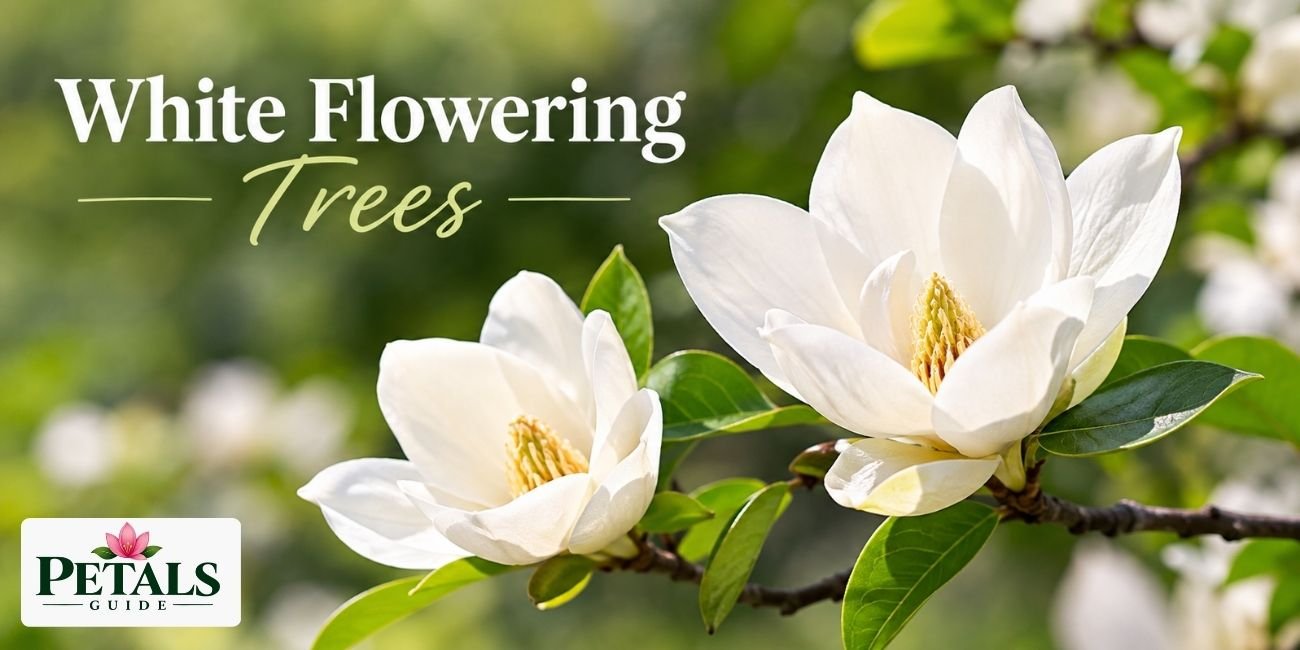
White flowering trees can bring a fresh and peaceful look to a garden. When their branches fill with white blooms, they can brighten the landscape and create a beautiful contrast against green leaves and darker backgrounds. There are many different types of trees with white flowers. Some produce large, fragrant blooms, while others have small flowers arranged in clusters. Some bloom in early spring before their leaves appear, while others wait until summer or fall.
In this guide, we look at 18 beautiful white flowering trees, including their flowers, blooming seasons, sizes, origins, and the features that make each one different.
Quick Comparison of White Flowering Trees
| Tree | Scientific Name | Blooming Season | Type |
|---|---|---|---|
| White Champaca | Magnolia × alba | Year-round in suitable climates | Evergreen tree |
| Sweet Olive | Osmanthus fragrans | Varies by climate | Evergreen small tree |
| Southern Magnolia | Magnolia grandiflora | Late spring to summer | Evergreen tree |
| Star Magnolia | Magnolia stellata | Late winter to spring | Deciduous small tree |
| Kobus Magnolia | Magnolia kobus | Early spring | Deciduous tree |
| White Magnolia | Magnolia denudata | Early spring | Deciduous tree |
| Flowering Dogwood | Cornus florida | Spring | Deciduous tree |
| Kousa Dogwood | Cornus kousa | Late spring to early summer | Deciduous tree |
| Japanese Snowbell | Styrax japonicus | Late spring | Deciduous tree |
| White Fringetree | Chionanthus virginicus | Spring | Deciduous small tree |
| Black Locust | Robinia pseudoacacia | Late spring to early summer | Deciduous tree |
| Wild Cherry | Prunus avium | Spring | Deciduous tree |
| Lily of the Valley Tree | Clethra arborea | Early to mid-summer | Evergreen small tree |
| Franklin Tree | Franklinia alatamaha | Summer to early fall | Deciduous small tree |
| Downy Serviceberry | Amelanchier arborea | Early to mid-spring | Deciduous small tree |
| Carolina Silverbell | Halesia carolina | Spring | Deciduous small tree |
| Northern Catalpa | Catalpa speciosa | Late spring to early summer | Deciduous tree |
| Seven-Son Flower | Heptacodium miconioides | Late summer to early fall | Deciduous small tree |
White Champaca
Scientific name: Magnolia × alba
White champaca is a warm-climate evergreen tree best known for its sweet, powerful fragrance. Its flowers may not be as enormous as those of southern magnolia, but their scent can make the tree noticeable from a distance. The glossy green foliage also gives it an attractive appearance outside the flowering period. In tropical and subtropical gardens, it can provide greenery throughout the year rather than losing its leaves during winter.
Quick Facts:
- Flower Color: Creamy white
- Flower Type: Fragrant magnolia-like blooms
- Plant Type: Evergreen tree
- Best Feature: Strong fragrance
- Climate: Warm climates
The flowers are particularly valued for their perfume. Their creamy-white color works nicely against the dark foliage, and the fragrance makes this tree especially suitable for areas near patios, entrances, and seating spaces. White champaca is a better choice for warm regions than areas with regular freezing temperatures. Give it a sunny location and enough room to develop naturally.
Sweet Olive
Scientific name: Osmanthus fragrans
Sweet olive is a small evergreen tree or large shrub with a secret weapon: its fragrance. The flowers are tiny and easy to overlook, but their sweet scent can be surprisingly strong. Its dense foliage also makes it useful when you want a plant that remains green after flowering has finished. It can be grown as a small tree or trained into a more compact shape.
Quick Facts
- Flower Color: White to creamy white
- Plant Type: Evergreen small tree or shrub
- Best Feature: Very fragrant flowers
- Native Range: East Asia
The small flowers generally appear in clusters among the leaves. Rather than creating a bold visual display, they add small spots of white while filling the surrounding area with fragrance. For this reason, sweet olive is particularly useful near walkways, windows, patios, and garden entrances. It is a good example of a tree where fragrance matters more than flower size.
Southern Magnolia
Scientific name: Magnolia grandiflora
If your idea of a white flowering tree involves enormous blooms, southern magnolia is hard to overlook. This large evergreen tree combines huge white flowers with thick, glossy leaves that remain on the branches year-round. It is not a tree for a cramped garden. A mature southern magnolia needs considerable room, but when planted in the right location, it can become a major feature of the landscape.
Quick Facts
- Flower Color: White
- Plant Type: Evergreen tree
- Best Feature: Very large fragrant flowers
- Native Range: Southeastern United States
The flowers can reach roughly 8 to 12 inches across. They have broad, thick tepals and a central cone-like structure. The dark foliage makes the flowers look even brighter. Many leaves also have a brown, velvety underside, adding another interesting detail to the tree.
Star Magnolia
Scientific name: Magnolia stellata
Star magnolia is a much more manageable option for smaller gardens. One of its most appealing features is its timing. The tree can flower in late winter or early spring, sometimes before the leaves have opened. This means its white flowers are displayed clearly against the bare branches instead of being hidden among dense summer foliage.
Quick Facts
- Flower Color: White
- Plant Type: Deciduous small tree
- Best Feature: Star-shaped flowers
- Native Range: Japan
The flowers are made up of numerous narrow tepals that spread outward like the points of a star. They have a soft, delicate appearance compared with the huge blooms of southern magnolia. One thing to remember is that early flowers can be vulnerable to late frosts. A sheltered position can help protect the blooms when temperatures suddenly drop.
Kobus Magnolia
Scientific name: Magnolia kobus
Kobus magnolia is another early-blooming magnolia, but it eventually develops into a much larger tree than star magnolia. It is native to Japan and is valued for its white spring flowers and attractive branching structure. The flowers often appear before the tree becomes fully covered with leaves, giving the branches a clean and open appearance during flowering.
Quick Facts
- Flower Color: White
- Plant Type: Deciduous tree
- Blooming: Early spring
- Best Feature: Fragrant early blooms
- Native Range: Japan
The flowers are broad and cup-shaped, with white tepals that can have a subtle pinkish tint near the base. They are also lightly fragrant. Kobus magnolia can eventually become a substantial landscape tree, so it is better suited to a larger garden. It can also take several years to reach flowering maturity when grown from seed.
White Magnolia
Scientific name: Magnolia denudata
White magnolia, also called Yulan magnolia, is a deciduous Chinese tree known for its large, upright white flowers. It has been cultivated as an ornamental plant for a very long time. Its early flowering habit gives it a particularly elegant appearance because the blooms can open while the branches are still mostly bare.
Quick Facts
- Flower Color: White
- Plant Type: Deciduous tree
- Blooming: Early spring
- Best Feature: Large upright flowers
- Native Range: China
The flowers have thick, white tepals that give them a tulip-like shape. Their size makes them easy to notice even when the tree is viewed from a distance. This magnolia works especially well as a specimen tree. Give it an open position where its spring flowers can be seen rather than placing it among taller trees.
Flowering Dogwood
Scientific name: Cornus florida
Flowering dogwood is one of the best-known white-flowering trees in North America. Its spring display looks like a mass of four-petaled white flowers, but there is an interesting botanical detail behind that appearance. The large white parts are actually bracts, not petals. The tiny true flowers sit together in the center.
Quick Facts
- Flower Color: White
- Plant Type: Deciduous tree
- Blooming: Spring
- Best Feature: Showy white bracts
- Native Range: Eastern North America
After flowering, flowering dogwood develops red fruits that can be useful to birds. Its foliage can also develop attractive reddish tones in autumn. So although spring is its main flowering season, the tree can contribute to the garden for much longer than the few weeks when the white bracts are visible.
Kousa Dogwood
Scientific name: Cornus kousa
Kousa dogwood is closely related to flowering dogwood but has several features that make it easy to distinguish. It generally flowers later, after its leaves have emerged, and its white bracts have noticeably pointed tips. The tree also develops unusual fruits later in the year, giving it another reason to remain interesting after the flowers disappear.
Quick Facts
- Flower Color: White
- Plant Type: Deciduous tree
- Blooming: Late spring
- Best Feature: Pointed bracts and colorful fruit
- Native Range: East Asia
The four white bracts surround the small true flowers in the center. From a distance, they look like simple white flowers scattered throughout the green canopy. Later, rounded red or pinkish fruits appear. This combination of flowers and fruit makes Kousa dogwood useful when you want more than a short spring display.
Japanese Snowbell
Scientific name: Styrax japonicus
Japanese snowbell has a very different flowering style from the magnolias and dogwoods above. Its small white flowers hang beneath the branches instead of facing upward. The tree develops a graceful form with spreading branches, making it an attractive specimen for a garden where you can view the flowers from underneath.
Quick Facts
- Flower Color: White
- Plant Type: Deciduous small tree
- Blooming: Late spring
- Best Feature: Hanging bell-shaped flowers
- Native Range: Japan, China, and Korea
The flowers are bell-shaped and appear in clusters along the branches. Their delicate form works especially well against the green foliage. Japanese snowbell is a good choice when you want a smaller flowering tree that doesn’t have the bold, oversized flowers associated with magnolias.
White Fringetree
Scientific name: Chionanthus virginicus
White fringetree is one of the easiest trees on this list to recognize once you have seen it in bloom. Its flowers have long, narrow petals that hang in clusters, giving the branches a fringe-like appearance. It is a relatively small tree, making it much easier to fit into many home landscapes than larger flowering species.
Quick Facts
- Flower Color: White
- Plant Type: Deciduous small tree
- Blooming: Spring
- Best Feature: Fringe-like fragrant flowers
- Native Range: Eastern and southeastern United States
The flowers can create a soft, almost cloud-like effect when many clusters open together. They also have a pleasant fragrance. White fringetree is a particularly good choice if you want something unusual. Instead of large round flowers, you get long, narrow petals that give the whole tree a different texture.
Black Locust
Scientific name: Robinia pseudoacacia
Black locust is a large, fast-growing tree that produces fragrant white flowers in late spring. The flowers hang in clusters from the branches and can attract bees and other insects. Its attractive flowering display is one reason it has been planted outside its original range, but that same vigorous growth can become a problem in some areas.
Quick Facts
- Flower Color: White
- Plant Type: Deciduous tree
- Blooming: Late spring
- Best Feature: Fragrant flower clusters
- Native Range: Eastern United States
The individual flowers have the typical pea-family shape and are grouped into hanging clusters. Their fragrance is strongest when the tree is in full bloom. Black locust should be planted thoughtfully because it can spread by suckers and become difficult to manage in certain regions. Check local recommendations before choosing it for your garden.
Wild Cherry
Scientific name: Prunus avium
Wild cherry is a large deciduous tree that puts on a simple but attractive display of white flowers in spring. It is also known as sweet cherry and is native to Europe and parts of western Asia. Unlike magnolias, its flowers are relatively small, but the large number of blooms across the canopy can create an impressive effect.
Quick Facts
- Flower Color: White
- Plant Type: Deciduous tree
- Blooming: Spring
- Best Feature: Flowers followed by cherries
- Native Range: Europe and western Asia
The five-petaled flowers appear in clusters as the new foliage develops. Once flowering is over, cherries begin to form and gradually change color as they mature. Because it can become a large tree, wild cherry is better suited to spacious gardens and open landscapes. Its flowers and fruit also give it value beyond its appearance during spring.
Lily of the Valley Tree
Scientific name: Clethra arborea
Lily of the valley tree is an unusual choice for this list and should not be confused with the small ground-covering lily of the valley plant. It is a woody evergreen plant from Madeira that can grow into a small tree. Its flowers arrive during summer, which makes it useful when many spring-flowering trees have already finished blooming.
Quick Facts
- Flower Color: White
- Plant Type: Evergreen tree
- Blooming: Summer
- Best Feature: Fragrant bell-shaped flowers
- Native Range: Madeira
The flowers are small and bell-shaped, appearing in elongated clusters. Their form is responsible for the plant’s common name. Its evergreen foliage is another useful feature. In a mild climate, it can provide a combination of year-round greenery and seasonal white flowers.
Franklin Tree
Scientific name: Franklinia alatamaha
Franklin tree is a small deciduous tree with large white flowers that look somewhat like camellias. It is especially valuable for gardens that need flowers in summer because its blooming period comes later than that of many familiar spring trees. The tree also has attractive fall foliage, so its interest does not end when the flowers disappear.
Quick Facts
- Flower Color: White
- Plant Type: Deciduous small tree
- Blooming: Summer to fall
- Best Feature: Camellia-like fragrant flowers
- Native Range: Southeastern United States
The flowers have white petals surrounding a center packed with yellow stamens. They can reach around 3 inches across and have a pleasant fragrance. Franklin tree prefers moist, well-drained, acidic soil and can be somewhat demanding about its growing conditions. It is worth choosing the planting site carefully rather than moving an established tree later.
Downy Serviceberry
Scientific name: Amelanchier arborea
Downy serviceberry brings delicate white flowers to the garden early in spring. It is a smaller tree with a naturally graceful appearance and is also useful for wildlife. Its flowering display is softer than that of magnolia, with many small flowers distributed along the branches.
Quick Facts
- Flower Color: White
- Plant Type: Deciduous small tree
- Blooming: Early spring
- Best Feature: Flowers, fruit, and fall color
- Native Range: Eastern North America
The five-petaled flowers appear in loose clusters, often just before or as the leaves begin to emerge. After flowering, the tree produces small fruits that are eaten by birds and other wildlife. This makes serviceberry a good option if you want a flowering tree that also contributes to a wildlife-friendly garden.
Carolina Silverbell
Scientific name: Halesia carolina
Carolina silverbell gets its common name from the shape of its flowers. The small white blooms hang from the branches like tiny bells and are particularly attractive when viewed from underneath the canopy. It has a natural woodland character, so it can fit especially well into gardens designed around native or woodland plants.
Quick Facts
- Flower Color: White, sometimes pink-tinged
- Plant Type: Deciduous small tree
- Blooming: Spring
- Best Feature: Hanging bell-shaped flowers
- Native Range: Southeastern United States
The flowers appear in clusters along the branches and contrast nicely with the fresh green foliage. Carolina silverbell is a useful choice if you want a white flowering tree with a softer, less formal appearance than a magnolia. It also provides a different flower shape from the rounded or star-like blooms found elsewhere on this list.
Northern Catalpa
Scientific name: Catalpa speciosa
Northern catalpa is not a small ornamental tree. It can become a large landscape tree with a broad crown and enormous heart-shaped leaves. Its white flowers are just one part of its unusual appearance. The flowers usually arrive in late spring or early summer, followed by long, narrow seed pods that can remain on the tree.
Quick Facts
- Flower Color: White with purple and orange markings
- Plant Type: Deciduous large tree
- Blooming: Late spring to early summer
- Best Feature: Large leaves, flowers, and seed pods
- Native Range: Central United States
The flowers grow in upright clusters and have purple and orange markings inside. Because of these markings, the blooms are not completely pure white. Northern catalpa is best planted where there is plenty of space. Its large leaves can create useful shade, but fallen leaves and seed pods can also mean more garden cleanup.
Seven-Son Flower
Scientific name: Heptacodium miconioides
Seven-son flower is one of the most useful choices on this list if you want to extend the flowering season into late summer and fall. It grows as a small tree or large shrub and produces clusters of fragrant white flowers when many spring-flowering trees have finished. It also offers a second color display after the white flowers fade.
Quick Facts
- Flower Color: White
- Plant Type: Small tree or large shrub
- Blooming: Late summer to fall
- Best Feature: Late flowers and colorful sepals
- Native Range: China
The flowers are small but appear in clusters, making them easy to see across the branches. They attract bees, butterflies, and other pollinators. After the white petals fall, the sepals remain and turn pink to reddish. This gives the plant another burst of color and helps keep it attractive well beyond its main flowering period.
How to Choose the Right White Flowering Tree
Choosing a white flowering tree is not just about finding the prettiest flowers. Think about the tree’s mature size, climate, sunlight, soil, fragrance, and the season when you want it to bloom.
A small garden may be better suited to star magnolia, Japanese snowbell, white fringetree, or Franklin tree. Large properties can accommodate trees such as southern magnolia, northern catalpa, wild cherry, or Kobus magnolia.
You should also consider whether you want fragrant flowers, evergreen foliage, wildlife value, or multiple seasons of interest. These details can make one tree a much better fit for your garden than another.
Best White Flowering Trees for Small Gardens
If you have limited space, look for trees that naturally remain small or can comfortably fit into a residential landscape.
Some good choices include:
- Star Magnolia
- White Fringetree
- Japanese Snowbell
- Franklin Tree
- Downy Serviceberry
- Carolina Silverbell
Always check the mature height and width before planting. A tree that looks small in a nursery container can become much larger over time.
Best White Flowering Trees for Large Gardens
Large properties give you more freedom to choose trees with broad canopies and greater mature heights.
Some options include:
- Southern Magnolia
- Kobus Magnolia
- White Magnolia
- Black Locust
- Wild Cherry
- Northern Catalpa
Northern catalpa, for example, can grow to around 50 feet tall and develop a broad canopy, so it needs plenty of space.
Most Fragrant White Flowering Trees
If fragrance is an important part of your garden, consider:
- White Champaca: Known for its powerful sweet fragrance.
- Sweet Olive: Its tiny flowers produce a surprisingly strong scent.
- Southern Magnolia: Large white flowers have a rich fragrance.
- White Fringetree: The delicate flowers have a pleasant scent.
- Franklin Tree: Its large white flowers are fragrant.
- Seven-Son Flower: Its late-season flowers are fragrant and useful to pollinators
White Flowering Trees by Blooming Season
Early Spring
- Star Magnolia
- Kobus Magnolia
- White Magnolia
- Downy Serviceberry
Spring
- Flowering Dogwood
- White Fringetree
- Wild Cherry
- Carolina Silverbell
- Japanese Snowbell
Late Spring to Summer
- Kousa Dogwood
- Black Locust
- Southern Magnolia
- Northern Catalpa
Summer to Fall
- White Champaca
- Lily of the Valley Tree
- Franklin Tree
- Seven-Son Flower
Are White Flowering Trees Good for Pollinators?
Many flowering trees provide pollen or nectar for insects, although their value differs between species.
Trees such as seven-son flower, black locust, northern catalpa, and serviceberry can provide useful resources for bees and other insects. Choosing a tree native to your region can also be a good way to support local wildlife.
If pollinator value is one of your main goals, look beyond flower color and consider when the tree blooms. Trees that flower at different times can help provide food for insects across a longer part of the growing season.
General Care Tips for White Flowering Trees
Choose the Right Location
Check the tree’s mature size and sunlight requirements before planting. This is especially important for large species such as southern magnolia and northern catalpa.
Water Young Trees Regularly
Newly planted trees need consistent moisture while their roots become established. Water deeply and adjust your watering based on rainfall and soil conditions.
Check Soil Requirements
Different trees prefer different soil conditions. Franklin tree, for example, performs best in moist, well-drained acidic soil.
Prune at the Right Time
Don’t prune flowering trees simply because you want to make them smaller. First check when the tree forms its flower buds so you don’t accidentally remove next season’s blooms.
Leave Enough Space
Consider the tree’s mature canopy, not just its height. Branches and roots need room to develop without interfering with buildings, power lines, paths, or other plants.
Conclusion
White flowering trees offer much more variety than you might expect. Some have enormous magnolia blooms, while others produce tiny fragrant flowers, hanging bells, or unusual fringe-like petals.
The right choice depends on your garden and what you want from the tree. If space is limited, star magnolia, Japanese snowbell, or white fringetree can provide plenty of flowers without taking over the landscape. For larger spaces, southern magnolia, Kobus magnolia, wild cherry, or northern catalpa can make a much bigger impact.
If fragrance is your priority, white champaca and sweet olive are worth considering, while Franklin tree and seven-son flower can help extend the flowering season beyond spring.
FAQs
What is the best white flowering tree?
There isn’t one best tree for every garden. Star magnolia is a good choice for smaller spaces, while southern magnolia works well in large landscapes. Flowering dogwood is another popular option because it offers flowers, fruit, and fall interest.
What tree has the largest white flowers?
Southern magnolia is one of the best-known trees with very large white flowers. Its blooms can reach roughly 8 to 12 inches across.
What is a good small tree with white flowers?
Star magnolia, Japanese snowbell, white fringetree, Franklin tree, and downy serviceberry are good choices for smaller landscapes.
Which white flowering trees are fragrant?
White champaca, sweet olive, southern magnolia, white fringetree, Franklin tree, and seven-son flower are among the more fragrant choices on this list.