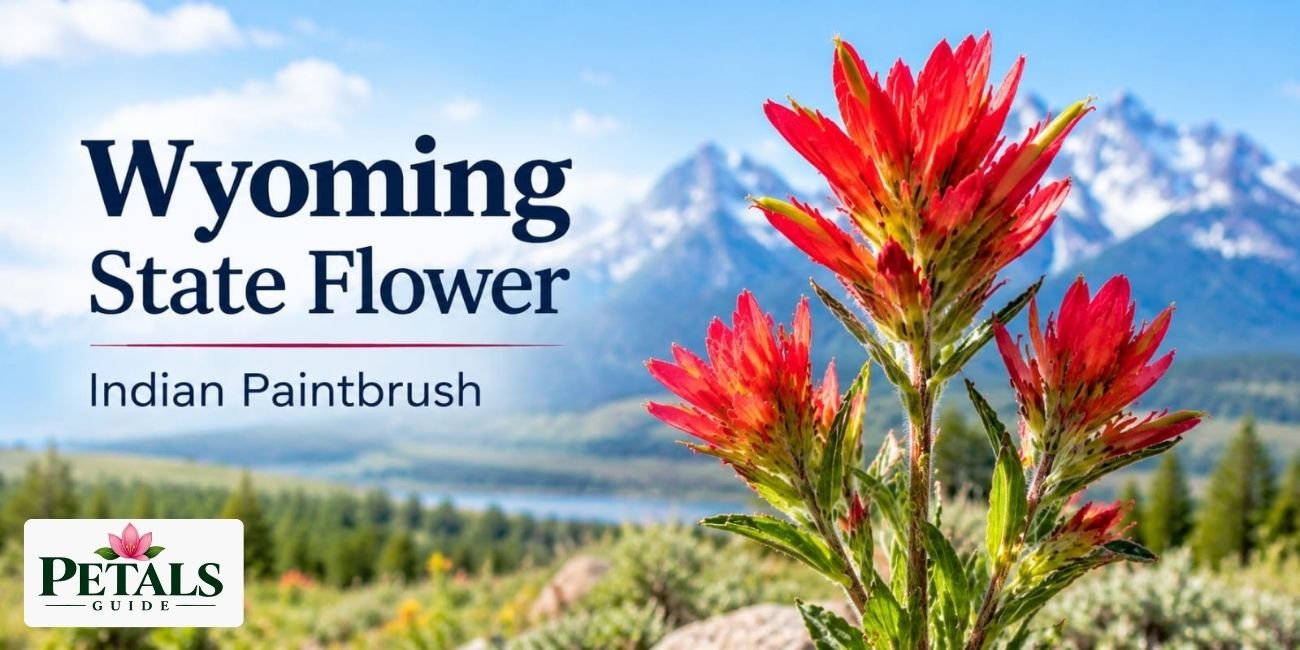
The Wyoming state flower is the Indian paintbrush (Castilleja linariifolia), a native bloom known for its vivid red bracts and erect flower spikes. This wildflower thrives in various regions throughout the western United States, including Wyoming, where it enhances the beauty of open fields, rocky inclines, and mountainous areas.
Although the bright red structures resemble petals, they are actually modified leaves known as bracts, which encase the plant’s tiny flowers. In 1917, the Indian paintbrush was designated as Wyoming’s official state flower. Its unique look and relationship to the area’s native flora have made it a prominent emblem of the state.
What Is the State Flower of Wyoming?
The state flower of Wyoming is the Indian paintbrush (Castilleja linariifolia). This wildflower is native to the area and is known for its bright red bracts and long, narrow leaves. You can find it growing in dry, rocky places and open fields across the western United States. Its colorful flowers look like paintbrushes, making it one of the most well-known wildflowers in Wyoming.
On January 31, 1917, Wyoming officially chose the Indian paintbrush as its state flower. This decision is recorded in state law, which means it is an important symbol for Wyoming. The flower’s bright colors and its link to local plants have helped keep it a significant part of Wyoming’s natural identity.
The name Indian paintbrush represents different plants in the “Castilleja” group, which includes many types. The specific flower chosen for Wyoming is “Castilleja linariifolia”, also known as Wyoming paintbrush or narrowleaf paintbrush. It’s important to note that different types of Indian paintbrush vary in appearance, growing conditions, and natural habitats.
History of the Wyoming State Flower
The history of the Wyoming state flower dates back to the early 20th century, when states across the country were choosing floral emblems to represent their natural identity. In Wyoming, the Indian paintbrush gained support from the Wyoming chapter of the Daughters of the American Revolution (DAR), an organization that helped lead the campaign to select an official flower.
Dr. Grace Raymond Hebard of the University of Wyoming played an important role in the effort by supporting the Indian paintbrush and helping prepare the legislation. During its 1916 annual meeting in Sheridan, the Wyoming DAR decided to campaign for the flower’s adoption. Senator W. W. Daley of Carbon County introduced the bill, which Governor John B. Kendrick signed into law on January 31, 1917. The Indian paintbrush officially became the state flower of Wyoming that day.
Before its official selection, the fringed gentian had been a popular choice among Wyoming schoolchildren and was sometimes treated as an unofficial state flower. However, supporters of the Indian paintbrush considered it a more representative symbol of Wyoming’s native landscape. The decision was not without criticism, but the legislature’s action established the Indian paintbrush as the state’s official floral emblem, a status it continues to hold today.
What Does the Indian Paintbrush Look Like?
The Indian paintbrush (Castilleja linariifolia), Wyoming’s state flower, is known for its bright clusters of red or scarlet flowers that sit on straight stems. The plant’s most noticeable parts are its special leaves, called bracts, which wrap around the smaller, less noticeable flowers. These bracts are usually thin and pointed, resembling a flame or a paintbrush dipped in red paint.
The actual flowers are tube-shaped and mostly have greenish-yellow tips with red edges. They grow tucked in between the colorful bracts, adding to the contrast that makes this plant easy to recognize. Unlike many garden flowers that rely on big, eye-catching petals, the Indian paintbrush gets its bright look mainly from its bracts.
The leaves are long and narrow, usually a grayish-green color. They grow in alternate positions along the stems and may have slightly curled edges or a few narrow lobes at the top. Additionally, the stems can turn a purplish color as they grow older. This mix of long leaves, upright form, and bright red bracts makes the Wyoming paintbrush different from many other wildflowers.
Botanical Classification Wyoming State Flower
The Wyoming state flower belongs to the order Lamiales, a large group of flowering plants that includes several familiar herbs and shrubs. Its family, Orobanchaceae, contains plants with varied nutritional strategies, including species that obtain some water and nutrients through connections with the roots of other plants.
| Botanical Detail | Classification |
| Common Name | Wyoming Indian Paintbrush |
| Scientific Name | Castilleja linariifolia |
| Kingdom | Plantae |
| Plant Group | Angiosperms (flowering plants) |
| Order | Lamiales |
| Family | Orobanchaceae |
| Genus | Castilleja |
| Species | Castilleja linariifolia |
| Plant Type | Perennial herb |
Where does Indian Paintbrush Grow?
The Indian paintbrush, the Wyoming state flower, thrives in diverse environments throughout the western U.S., including within Wyoming itself. This flower has adapted well to the state’s different landscapes, ranging from arid regions to elevated mountainous areas. Its habitat stretches beyond Wyoming, reaching into surrounding states like Montana, Colorado, Utah, and Idaho.
This wildflower grows well in many places, such as rocky slopes, open prairies, sagebrush, and grasslands. You can also find it in woods with pinyon pines and junipers, as well as some conifer forests. This shows it can adapt to different environments.
It usually prefers well-drained soil and can be found between 5,000 and 11,000 feet in elevation. Its ability to grow in both open and mountainous areas shows its toughness. However, it’s not always found everywhere, as its presence depends on the specific habitat and elevation.
Why It Grows Where Others Can’t
The state flower of Wyoming, the Indian paintbrush (Castilleja linariifolia), is a hemiparasite. While it can generate its own food via photosynthesis, it also utilizes unique root systems known as haustoria to connect with neighboring plants for water and nutrients. This adaptation allows it to flourish even in environments where resources are scarce.
Indian paintbrush has been observed growing alongside big sagebrush (Artemisia tridentata). Its reliance on compatible host plants is a key factor in its difficulty to thrive in garden settings, where typical soil, sunlight, and watering may not completely fulfill its requirements.
When Does the Wyoming State Flower Bloom?
The Indian paintbrush (Castilleja linariifolia) usually flowers in the summer months in Wyoming, particularly in July and August, showcasing its vibrant colors. However, when exactly it blooms can vary based on the altitude, local weather, and growth conditions. In some regions, this plant may start flowering in the spring and continue through the fall.
Plants found at lower altitudes generally bloom earlier than those in the cooler mountains. Additionally, the temperatures and moisture levels throughout the season can affect when the first flowers open and how long they stay. Therefore, blooming times can differ between locations, even within the same area.
To catch the Wyoming state flower at its most beautiful, it’s a good idea to visit in midsummer and check local wildflower updates before you go. Since the flowering season depends on local conditions, the ideal time to see the Indian paintbrush can vary from one trail or natural site to another.
The Significance of Indian Paintbrush in Wyoming
The Indian paintbrush (Castilleja linariifolia) serves as the state flower of Wyoming, symbolizing the region’s rugged western terrain. Its vivid scarlet bracts stand out prominently against the soft greens and browns of sagebrush landscapes, making it a recognizable aspect of Wyoming’s natural scenery.
This plant is well-suited for conditions where water and nutrients can be scarce. As a hemiparasite, it latches onto the roots of nearby plants to extract some of these vital resources, all while generating its own nourishment through photosynthesis. This unique survival tactic sheds light on why Indian paintbrush flourishes in specific wild environments, yet can present challenges when cultivated in gardens.
The Toxic Side of the Wyoming State Flower
Some Indian paintbrush species (Castilleja) can accumulate selenium from the soil. Although animals need small amounts of this mineral, excessive intake can cause selenium poisoning, particularly in grazing livestock.
The risk depends on the plant species, soil conditions, and amount consumed. However, not every Indian paintbrush plant contains dangerous levels of selenium, and the toxicity of Castilleja linariifolia, Wyoming’s state flower, should not be assumed without species-specific evidence.
Is Indian Paintbrush Dangerous for Humans?
There is limited scientific information about the effects of Castilleja linariifolia on human health. Evidence that some related species accumulate selenium does not establish that every Indian paintbrush plant is poisonous to people.
As a precaution, do not eat the Wyoming state flower or use it as a home remedy without expert guidance. If someone accidentally swallows the plant, contact a poison-control service or healthcare professional for advice, especially if symptoms develop.
Medicinal Use of Indian Paintbrush
Some ethnobotanical records attribute traditional medicinal uses to Indian paintbrush (Castilleja linariifolia), including preparations used for stomach complaints, menstrual difficulties, and certain skin conditions. However, these reports document historical practices rather than proven medical treatments.
Scientific research has investigated potential medicinal compounds in other species, particularly Castilleja tenuiflora, including compounds with anti-inflammatory activity. These findings cannot automatically be applied to Wyoming’s state flower.
Is It Possible to Cultivate Indian Paintbrush in Your Garden?
It is indeed feasible to cultivate Castilleja linariifolia at home, though growing it from seeds can be somewhat uncertain. Gardeners are encouraged to source plants or seeds from reliable native-plant nurseries that focus on local wildflowers.
Select a sunny spot for planting and steer clear of heavy, poorly draining soil. Since Indian paintbrush develops root connections with surrounding plants, its growth is partially influenced by the suitability of its companion plants. For optimal results, consult with a native-plant nursery that has expertise in nurturing this specific species.
Locations to Spot Wyoming State Flower
Fossil Butte National Monument, located near Kemmerer, is one of the most well-documented sites to observe Wyoming paintbrush (Castilleja linariifolia). According to the National Park Service, this flower is categorized as one of the common wildflowers within the monument, along with various other native species.
Additionally, the flower thrives in suitable environments throughout the region. Botanical records indicate its presence across multiple counties in Wyoming, such as Carbon, Albany, Fremont, Natrona, and Park. While these records demonstrate its broader distribution, they don’t guarantee that visitors will encounter it at specific trails or viewpoints.
To maximize your opportunity to spot Wyoming’s state flower, seek out wildflowers in the summer months and gather information about local parks prior to your visit. Ensure you stick to marked paths when necessary and refrain from picking wild plants to ensure they remain for others to appreciate.
Other State Symbols of Wyoming
Besides the Wyoming state flower, Indian paintbrush, the state has several official symbols that represent its wildlife, landscape, and history. These designations include the state bird, mammal, tree, fish, and other symbols associated with Wyoming’s identity.
| State Symbol | Official Designation |
| State Bird | Western Meadowlark |
| State Mammal | American Bison |
| State Tree | Plains Cottonwood |
| State Fish | Cutthroat Trout |
| State Reptile | Horned Toad |
| State Dinosaur | Triceratops |
| State Fossil | Knightia |
| State Gemstone | Jade (nephrite) |
| State Grass | Western Wheatgrass |
| State Insect | Sheridan’s Green Hairstreak Butterfly |
| State Sport | Rodeo |
| State Motto | Equal Rights |
When exploring Wyoming facts, two well-known symbols are the western meadowlark and Indian paintbrush. Together, the state bird and flower of Wyoming represent the state’s wildlife and native plant life. Wyoming is also widely known as the Cowboy State, a nickname connected to its ranching and Western heritage.
State of Wyoming Facts
- Wyoming nickname: Wyoming is known as the Cowboy State and the Equality State, reflecting its Western heritage and pioneering role in women’s voting rights.
- WY state in USA: Wyoming is located in the western United States and covers about 97,914 square miles, making it the ninth-largest state by area. Wyoming became the 44th U.S. state on July 10, 1890.
- Women’s voting rights: In 1869, Wyoming’s territorial government passed a law granting women the right to vote, years before women’s suffrage became nationwide.
- First national park: Yellowstone National Park, established in 1872, was the first national park in the world. It lies mainly in Wyoming, with smaller sections extending into Montana and Idaho.
- Mountain scenery: Gannett Peak, at 13,804 feet, is Wyoming’s highest point.
- Wildlife and open spaces: Wyoming is known for its wide-open landscapes and wildlife, including bison, pronghorn, elk, and bighorn sheep.
- Wyoming facts about its size: Although Wyoming is the ninth-largest state by area, it has the smallest population among U.S. states, according to recent census rankings.
Conclusion
The Wyoming state flower, Indian paintbrush (Castilleja linariifolia), is a distinctive native wildflower with a special place in the state’s natural heritage. Its vivid red bracts make it recognizable, while its unusual relationship with neighboring plants makes it challenging to grow in gardens. Understanding these features helps explain why this wildflower is both a meaningful state symbol and a unique part of Wyoming’s native flora.