
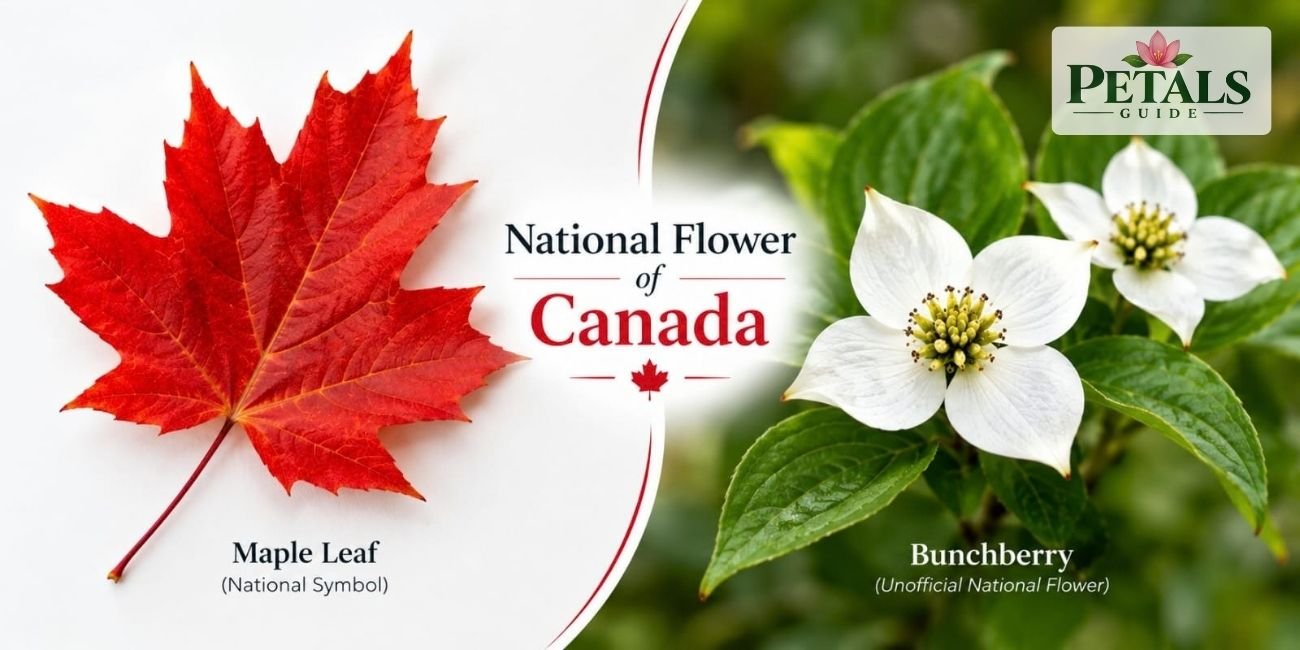
Globally, Canada is celebrated for its iconic maple leaf, expansive woodlands, stunning scenery, and variety of indigenous flora. However, unlike numerous other nations, Canada lacks an officially recognized national flower. Each province and territory has its own floral representation, while the maple leaf stands out as a prominent national emblem.
One plant frequently mentioned in conversations about a potential national flower is the Bunchberry (Cornus canadensis). This indigenous species thrives in much of Canada and is well-suited to northern forest habitats. It’s essential to differentiate between a flower associated with Canada and has been formally recognized as a national symbol.
So, what is the national flower of Canada? The straightforward answer is that Canada has no designated national flower at this time. To comprehend this, one must consider Canada’s framework of national symbols, the historical significance of the maple leaf, and the floral emblems represented by the provinces and territories.
What is the national flower of Canada?
Is There an Official National Flower in Canada?
No, there isn’t. Canada currently lacks an officially recognized national flower or floral emblem. While the Canadian government acknowledges various national symbols, there isn’t one flower designated to embody the nation as a whole.
This situation can be somewhat perplexing, considering that several plants are closely tied to Canada’s national identity. For instance, the maple leaf is among the most prominent symbols and features prominently on the national flag. However, it should be noted that a maple leaf is a leaf and not a flower.
In addition, Canada has multiple official provincial and territorial floral emblems, indicating that while specific flowers can symbolize different regions, no single flower stands for the entire country.
Why Bunchberry Is Often Mentioned
Bunchberry (Cornus canadensis) frequently comes up in conversations about a potential national flower for Canada. This native plant is widely found throughout the country, thriving particularly in forested areas.
Its extensive presence, natural habitat, and adaptability to northern climates enhance its appeal as a representative of Canada’s indigenous plant life. However, widespread recognition alone does not qualify a plant to be designated as an official national symbol.
What Canada Chooses Instead of a National Flower
Instead of a single national flower, Canada has a variety of symbols that reflect different parts of the country.
The maple leaf is Canada’s most well-known plant symbol, while each province and territory has its own flower to showcase its unique landscapes and identities. This results in a unique approach where Canada’s botanical identity is represented by several regional flowers instead of just one national bloom.
Why Canada Lacks a National Flower
Canada does not have a national flower, but it’s not due to a shortage of unique or culturally significant plants. Rather, the country has focused on a limited set of recognized symbols, with floral representations primarily adopted at the provincial and territorial levels.
How Canada’s National Symbols Are Recognized
Canada’s national symbols have been established through various forms of formal recognition. Some symbols have a long-standing history before they received official status, while others were recognized through governmental actions or laws.
For instance, the maple leaf became closely linked to Canada long before it was featured on the national flag. In contrast, symbols like the national flag and the national anthem have specific histories regarding their formal adoption. Thus, a flower doesn’t become a national symbol just because it is common, native, or well-liked.
Official vs. Unofficial Symbols
An essential distinction exists between symbols that are officially recognized and those that are merely associated with Canadian identity. The maple leaf is an important national symbol officially recognized, while Bunchberry is a native Canadian plant that may be considered a potential national flower but lacks federal designation.
This difference clarifies why some sources refer to certain flowers as “Canadian symbols” without indicating they are Canada’s official national flower.
Floral Emblems Developed at the Provincial Level
Flowers have a much more significant formal role at the provincial and territorial levels. Different regions of Canada have adopted specific floral emblems that showcase their local plants, landscapes, and identities. As a result, Canada has an array of recognized provincial and territorial flowers but lacks a single federal flower for the entire nation.
This regional approach is practical given the vast geographic diversity of Canada, which spans from the Atlantic provinces and Great Lakes to the Prairies, Pacific coast, northern forests, and Arctic areas. The plants representing one region may differ significantly from those in another.
Therefore, instead of having one flower symbolize all of Canada, the floral identity is represented through various regional emblems.
The Maple Leaf Became a Symbol Long Before the Flag
While many link Canada’s maple leaf with the current flag, its ties to Canada date back much further. During the 19th century, the leaf grew into a symbol of Canadian identity, well before the recognizable red-and-white flag was designed.
Early Uses of the Maple Leaf in Canada
The maple tree was significant for Indigenous peoples in eastern Canada, who utilized its sap and other products. However, it was only later that the maple leaf itself became a well-known Canadian symbol. By the 19th century, it began appearing more frequently in Canadian culture and public life. A significant moment occurred in 1834, when the Société Saint-Jean-Baptiste made the maple leaf its emblem. Newspapers and literary works quickly followed suit, helping to reinforce its link to Canadian identity.
The Maple Leaf Enters Canadian Public Life
Over the years, the symbol continued to grow in importance. It was seen on military badges, publications, sports uniforms, coins, and other representations of Canadian life.
For instance, in 1860, a maple leaf was included in the badge of the 100th (Prince of Wales’ Royal Canadian) Regiment of Foot. Alexander Muir’s “The Maple Leaf Forever,” penned in 1867 for Confederation, enhanced the leaf’s cultural significance to Canada.
The maple leaf also featured on Canadian coins from 1876 to 1901, and three maple leaves were added to Canada’s Royal Arms in 1921.
From Familiar Emblem to National Identity
The maple leaf’s connection to Canada became even stronger during the First World War, when Canadian soldiers wore it on their badges. This connection continued during the Second World War on military insignia and equipment.
By the time Canada started seriously looking for a new national flag in the 1960s, the maple leaf was not a new symbol created just for the flag. It was already a well-rooted part of Canadian public life. When thousands of flag designs were proposed during the 1964 flag discussions, many showcased maple leaves. The final design featured a single stylized maple leaf in the center of the new flag, which was officially raised for the first time on February 15, 1965.
This long history highlights an important point regarding Canada’s national flower: Canada had a significant plant symbol long before it required a national flag. The maple leaf became the country’s defining botanical emblem, but it never turned into a national flower.
How the Maple Leaf Became Canada’s Flag Symbol
When Canada set out to find a new national flag, the maple leaf was already a well-known representation of Canadian identity. It’s important to note that the maple leaf gained significance as a Canadian symbol long before it appeared on the flag; the flag was created around a symbol that Canadians had embraced for many years.
The Debate Over a New Canadian Flag
The journey toward Canada’s current flag was complex. Prior to 1965, the Union Jack served as the official flag, while the Canadian Red Ensign was also commonly used unofficially. After World War II, discussions about a unique Canadian flag began, but earlier efforts did not achieve consensus on a design.
By the early 1960s, the need for a new flag became more pressing. Prime Minister Lester B. Pearson prioritized the creation of a new Canadian flag, especially with the approaching centennial in 1967. In 1964, a parliamentary committee comprising members from all parties was formed to evaluate various design proposals.
Thousands of Designs Were Considered
Canadians contributed thousands of designs during this process, many of which included the maple leaf, highlighting its established association with Canada. The parliamentary committee eventually focused on three main designs, one of which featured a single maple leaf in red and white.
This single-leaf design was influenced by historian and military officer George F. G. Stanley’s idea was recommended to Parliament. On December 15, 1964, the House of Commons approved this design with a vote of 163 to 78.
Why the Flag Uses an 11-Point Maple Leaf
The maple leaf depicted on the Canadian flag is not an exact representation of any single maple species. It is a stylized 11-point maple leaf specifically designed for the flag.
The initial concept featured a 13-point leaf, but this design was not clear when seen from afar or when the flag was waving. Graphic artist Jacques St-Cyr revised it to 11 points, leading to the well-known version we have today.
When Canada’s Maple Leaf Flag Was Adopted
The new design was officially proclaimed on January 28, 1965, and the National Flag of Canada was first raised at Parliament Hill in Ottawa on February 15, 1965. This date is now recognized every year as National Flag of Canada Day.
The maple leaf’s prominence on the flag is particularly significant in discussions about Canada’s national flower. While the maple leaf is the most recognizable plant symbol for the country, it is not a flower. Its official status as the centerpiece of Canada’s flag should not be mixed up with the designation of a national flower.
Did Canadians Ever Choose a National Flower?
Yes, but it’s important to note that this was not an official Government of Canada election. In 2017, which marked Canada’s 150th anniversary, the Master Gardeners of Ontario held a nationwide contest to select a flower that could symbolize Canada. The goal was to encourage the idea of adopting a national flower, as Canada did not have one at that point.
The 2017 National Flower Contest
The organizers aimed to find a flower that could represent the entire country. Three native species were chosen as finalists: Bunchberry (Cornus canadensis), Hooded Ladies’ Tresses (Spiranthes romanzoffiana), and Twinflower (Linnaea borealis). The selection focused on plants widespread across Canada that were not already used as provincial or territorial floral emblems.
The contest generated significant public interest. According to the organizers, nearly 10,000 Canadians participated, and Bunchberry consistently led the voting throughout the online period.
Bunchberry Won With 79.5 Percent of the Vote
The frequently mentioned “80 percent” figure is based on actual data, but it shouldn’t be misrepresented as 80 percent of all Canadians. When the results were brought up in the House of Commons in December 2017, the parliamentary record noted that nearly 10,000 Canadians had voted, with 79.5% selecting Bunchberry. Thus, the accurate statement is that 79.5% of participants in the Master Gardeners of Ontario’s contest chose Bunchberry , not that 80% of Canada’s overall population voted for it.
The Result Was Meant to Lead to an Official Petition
Winning the contest did not automatically establish Bunchberry as Canada’s national flower. The organizers recognized that an independent horticultural contest could not create an official federal symbol.
Following the vote, the Master Gardeners of Ontario moved to the next step: a petition asking Parliament to declare Bunchberry the official National Flower of Canada. They reported in their newsletter that they had submitted an online petition for this purpose, and the matter was later discussed in the House of Commons.
This distinction clarifies much of the confusion about the national flower of Canada. Bunchberry truly won a national public contest, but winning that contest did not grant it official national-symbol status. Therefore, Bunchberry stands as an intriguing floral option for Canada, rather than being the officially recognized national flower of Canada.
Bunchberry: The Plant That Quietly Covers the Country
Cornus canadensis, known as Bunchberry, is a small perennial plant that belongs to the dogwood family. Unlike the larger dogwood trees, it remains close to the ground and spreads throughout the forest understory.
What Is Bunchberry?
Bunchberry is a low-growing herbaceous plant in the genus Cornus. Its short stems support a cluster of leaves at the top, giving it a tidy appearance. The flowers are notable because what look like four white petals are actually four showy bracts encircling a group of smaller true flowers. After the blooming period, the plant produces bright red berries, adding another distinctive element to the forest floor.
What Does Bunchberry Look Like?
Rather than growing tall like most dogwoods, this plant usually forms low patches. Its green leaves provide a thick cover at ground level, while the white bracts stand out during the flowering stage. As the season changes, the white flowers are replaced by clusters of red fruit. This seasonal shift provides Bunchberry with two distinct phases of visual appeal without needing to be a large plant.
Where Does Bunchberry Grow in Canada?
Bunchberry has an extensive range across Canada. Natural Resources Canada’s database includes over 15,000 unique records, indicating the species can be found in hardiness zones from 0a to 8a. The plant is closely tied to forest habitats. Parks Canada notes Bunchberry as part of the forest ecosystem within Kouchibouguac National Park in New Brunswick and lists it among the species monitored in Forillon National Park in Quebec.
How Bunchberry Fits Canada’s Natural Landscape
Bunchberry illustrates how a plant can enhance Canada’s landscape without being overwhelming. Thriving beneath the forest canopy, it contributes to the lower layer of vegetation, adding seasonal blooms and fruit to woodland areas.
Its presence in a variety of Canadian environments makes Cornus canadensis an important part of the nation’s native plant life. Rather than being recognized for cultivation or landscaping, this plant is found as a natural element in Canadian forests and other wild areas.
A Country of Provincial Flowers but No Federal Bloom
Canada’s floral identity is shaped by its provinces and territories rather than a single national flower. Each of the 10 provinces and 3 territories has its own official symbols, including a floral emblem. The federal Canadian Heritage collection recognizes these emblems as part of the unique identities of Canada’s regions.
How the Floral Emblem System Developed
The flowers representing provinces and territories were adopted at different times and through various methods. There was no unified national effort to select them. Instead, individual areas created their own symbols as local governments, communities, and organizations developed unique emblems.
In some cases, the public had a hand in the selection. For instance, Alberta’s wild rose was chosen by schoolchildren in 1930 after a campaign for a provincial floral emblem. Manitoba’s prairie crocus was picked through an informal vote in schools before becoming the province’s symbol in 1906.
Other flowers were chosen through formal government decisions. Quebec’s blue flag was designated as its official floral emblem by legislation in 1999, while Newfoundland and Labrador selected the pitcher plant as its floral emblem in 1954.
Floral Emblems Became Part of Regional Identity
These flowers are more than just botanical selections. In many provinces, the floral emblem is featured alongside other official symbols in coats of arms, flags, or government imagery.
For example, Saskatchewan’s western red lily is depicted on the province’s coat of arms and flag, while Alberta’s wild rose is integrated into its coat of arms. British Columbia’s Pacific dogwood also appears in the province’s heraldic designs. This gives a provincial flower a significance that goes beyond merely identifying a plant. It can become part of the visual language used to represent a province in official and public contexts.
Canada’s Provincial and Territorial Floral Emblems
Each of Canada’s 13 provinces and territories has its own designated floral emblem. These flowers differ greatly, mirroring the various climates, terrains, and indigenous flora throughout the nation. The table below shows the official floral emblem for each region along with its scientific name.
| Province or Territory | Floral Emblem | Scientific Name |
| Alberta | Wild Rose | Rosa acicularis |
| British Columbia | Pacific Dogwood | Cornus nuttallii |
| Manitoba | Prairie Crocus | Pulsatilla ludoviciana |
| New Brunswick | Purple Violet | Viola cucullata |
| Newfoundland and Labrador | Pitcher Plant | Sarracenia purpurea |
| Nova Scotia | Mayflower (Trailing Arbutus) | Epigaea repens |
| Ontario | White Trillium | Trillium grandiflorum |
| Prince Edward Island | Lady’s Slipper | Cypripedium acaule |
| Quebec | Blue Flag | Iris versicolor |
| Saskatchewan | Western Red Lily | Lilium philadelphicum |
| Northwest Territories | Mountain Avens | Dryas octopetala |
| Yukon | Fireweed | Chamerion angustifolium |
| Nunavut | Purple Saxifrage | Saxifraga oppositifolia |
The list features some particularly unique selections. The pitcher plant from Newfoundland and Labrador feeds on insects, while the mountain avens from the Northwest Territories is suited for the Arctic climate. Another northern flower, Nunavut’s purple saxifrage, blooms during the brief Arctic growing season.
The times of adoption vary widely. Nova Scotia chose the mayflower in 1901, Manitoba picked the prairie crocus in 1906, Alberta opted for the wild rose in 1930, and Ontario officially recognized the white trillium in 1937. More recent additions are Quebec’s blue flag in 1999 and Nunavut’s purple saxifrage in 2000.
Together, these 13 floral emblems create Canada’s official collection of provincial and territorial flowers. They are separate from a national flower of Canada, as none of these regional symbols holds federal recognition as the country’s sole national flower.
The Legal Mechanics of Becoming a National Symbol in Canada
Canada employs various formal processes to create national symbols, such as Acts of Parliament, royal proclamations, and orders in council. The chosen method depends on the specific symbol being recognized.
Who Can Establish a National Symbol?
Parliament has the authority to create a national symbol through legislation. For instance, the National Symbol of Canada Act gained Royal Assent in 1975, officially designating the beaver as a national symbol. Other symbols have been recognized through royal proclamation. The National Flag of Canada was proclaimed in 1965, and the maple tree was recognized as Canada’s national arboreal emblem in 1996.
How Official Recognition Differs From Popular Support
A petition or public campaign can request that the federal government acknowledge a proposed symbol, but it does not automatically grant that status. The Government of Canada’s reply to the 2017 petition for a national flower indicated that Canada does not have a national floral symbol and that national symbols can only be designated through formal processes like proclamations, orders in council, and Acts.
Why Cultural Recognition Is Not the Same as Legal Designation
The maple tree serves as an example of this distinction. The maple has been linked to Canada for many generations before the government officially recognized it as the national arboreal emblem in 1996.
For a national flower to achieve similar official recognition, it would need a formal designation from the federal government, rather than merely relying on winning a public vote or receiving popular acknowledgment.
Maple Leaf vs. Bunchberry
The maple leaf and Bunchberry are both connected with Canada’s botanical identity, but they do not have the same status. The maple leaf is an established national symbol, while Bunchberry is an unofficial candidate for a national flower.
| Feature | Maple Leaf | Bunchberry |
| Type | Leaf | Flowering plant |
| National status | Established national symbol | Not an official national symbol |
| Federal recognition | Associated with the National Flag of Canada; the maple tree was designated Canada’s national arboreal emblem in 1996 | No federal designation |
| National flag | Yes | No |
| Canadian association | Strong and longstanding | Strongly associated with Canada’s native flora |
| National flower status | Not a flower and therefore not a national flower | Proposed candidate, but not officially designated |
| Public vote | Not applicable | Won the 2017 contest with 79.5% of participating votes |
The simplest distinction is that the maple leaf is an established national emblem, while Bunchberry is an unofficial floral candidate. The maple leaf represents Canada through the country’s national flag and other official and cultural uses. Bunchberry represents an idea that Canadians supported in a public contest, but it has not been formally adopted as Canada’s national flower.
Therefore, the maple leaf should not be described as Canada’s national flower, and Bunchberry should not be described as the country’s official national flower. Both are important to Canada’s botanical identity, but they hold very different positions within Canada’s national symbols.
The Bigger Picture of Canadian National Symbols
The lack of a designated national flower does not imply that Canada is devoid of a comprehensive set of national symbols. The nation officially acknowledges various symbols that reflect its history, wildlife, natural landscapes, governance, and identity. Some of these symbols were instituted through formal governmental actions, while others gained recognition over time through traditional usage.
Canada’s National Tree
The maple tree serves as Canada’s official national arboreal symbol. This designation was made formal in 1996 via a federal proclamation. Canada boasts 10 native maple species, and the tree has played a significant role in the country’s natural history, economy, and cultural identity.
The Beaver as a National Symbol
The beaver stands as another crucial emblem for Canada. It was officially recognized as a national symbol of sovereignty when the National Symbol of Canada Act was enacted in 1975. However, its ties to Canada extend much further back, significantly linked to Indigenous peoples and the early fur trade.
The National Flag and Coat of Arms
Canada’s national flag was officially adopted in 1965 and prominently features a stylized 11-point maple leaf at its center. The Coat of Arms of Canada was established even earlier, in 1921, through royal proclamation. Both symbols serve as important representations of Canada on both national and international stages.
Official and Unofficial Symbols Together
Canada’s national identity encompasses both officially recognized symbols and various emblems that have gained significance through historical context and public use. The maple leaf exemplifies this distinction; it was acknowledged as a Canadian emblem for many generations before the maple tree was formally designated as the national arboreal symbol.
This wider system clarifies why the query of a national flower of Canada persists as an unusual one. Canada already possesses several recognized symbols that represent its natural heritage, while floral representations are mainly designated at the provincial and territorial levels.
Conclusion
At present, Canada lacks an officially recognized national flower. Bunchberry (Cornus canadensis) emerged as a strong contender after gaining 79.5% of the votes in a public competition in 2017, yet it was never formally designated as a national symbol.
In contrast, the maple leaf continues to be the most recognized plant emblem of Canada, while each province and territory boasts its own floral symbol. Collectively, these representations highlight Canada’s varied landscapes and botanical legacy.
FAQs
What Is the Most Famous Flower in Canada?
Bunchberry is one of Canada’s best-known flowers because it won a 2017 public contest for a proposed national flower. The maple leaf, however, is Canada’s most famous plant symbol.
What Are 5 Symbols That Represent Canada?
Five well-known Canadian symbols are the maple leaf, beaver, Canadian flag, Coat of Arms, and maple tree.
Does Canada Have Other Floral Emblems?
Yes. Every Canadian province and territory has its own official floral emblem, including the Wild Rose, White Trillium, Pacific Dogwood, and Fireweed.
What Flower Is Native to Canada?
Canada has many native flowers. Bunchberry (Cornus canadensis) is one example, along with White Trillium, Prairie Crocus, and Western Red Lily.