
Did you know that there are over 400,000 species of flowering plants in the world, and many of them begin with the letter “A”? From vibrant blooms to fragrant petals, flowers that start with this letter hold unique beauty and significance. Let’s explore the top 25 flowers that start with A, highlighting their characteristics, meanings, and how they can enhance your garden or home. By the end, you’ll not only recognize these flowers but also appreciate their importance in the botanical world.
List Of Flowers That Start With A
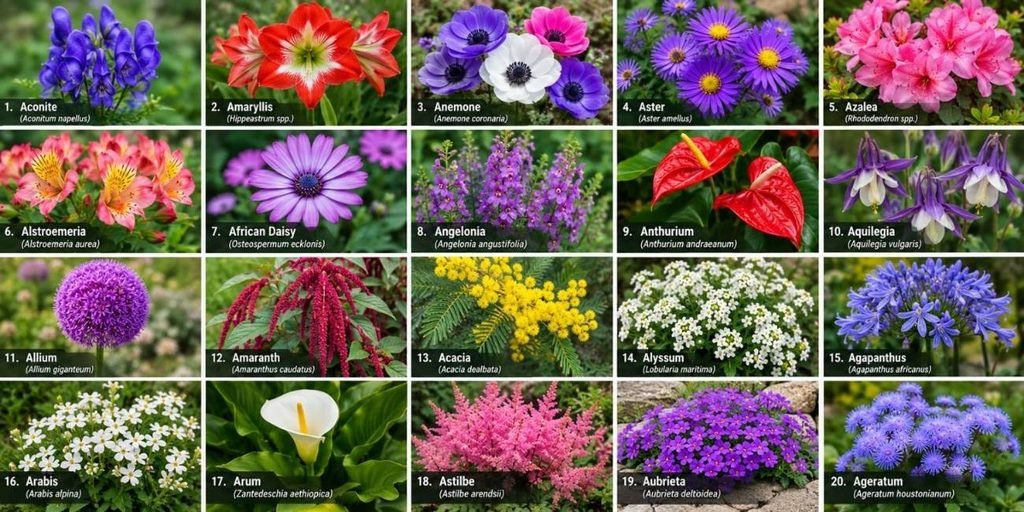
Here is the list of the top 20 Flowers That Start With A.
- 1. Aconite
- 2. Amaryllis
- 3. Anemone
- 4. Aster
- 5. Azalea
- 6. Alstroemeria
- 7. African Daisy
- 8. Angelonia
- 9. Anthurium
- 10. Aquilegia
- 11. Allium
- 12. Amaranth
- 13. Acacia
- 14. Alyssum
- 15. Agapanthus
- 16. Arabis
- 17. Arum
- 18. Astilbe
- 19. Aubrieta
- 20. Ageratum
Flowers That Start With A – Closer Look
Now have a closer look at flowers that start with the letter A.
Aconite
- Scientific Name: Aconitum spp.
- Plant Type: Herbaceous perennial
- Flower Colors: Blue, purple, yellow, white, and pink
- Blooming Season: Summer to early fall
- Native Region: Europe, Asia, and parts of North America
Common/Popular Species:
- Monkshood ( Aconitum napellus )
- Wolfsbane. (Aconitum lycoctonum)
- Carmichael’s Monkshood(Aconitum carmichaelii
- Blue Monkshood – (Aconitum variegatum)
Aconite flowers have a distinctive hood-like upper sepal that curves over the other flower parts. The flower does not have true petals in the usual sense. Instead, its modified sepals create the colorful, helmet-like appearance that gives monkshood its familiar name.
The flowers are arranged along upright stems, often forming tall clusters. Hidden beneath the hood are specialized nectar-bearing structures that help guide visiting insects toward the flower’s reproductive parts. This unusual design makes Aconite one of the more distinctive flowers that start with A.
Interesting Fact: All parts of many Aconitum species contain potent toxic alkaloids, including aconitine, making these plants highly poisonous if consumed.
Amaryllis
- Scientific Name: Hippeastrum spp.
- Plant Type: Bulbous perennial
- Flower Colors: Red, pink, white, orange, and striped variations
- Blooming Season: Late winter to early spring
- Native Region: Central and South America
Popular Amaryllis Cultivars
- Hippeastrum ‘Apple Blossom’
- Hippeastrum ‘Exotica’
- Hippeastrum ‘Royal Velvet’
- Hippeastrum ‘Nymph’
Indoor Amaryllis produces large, trumpet-shaped flowers on tall, sturdy stalks that emerge directly from the bulb. A mature bulb can produce one or several flower stalks, with each stalk carrying several blooms. Some modern hybrids also have double flowers with extra layers of petals.
One unusual feature of Hippeastrum is that its flower stalk can emerge before the leaves, creating a striking display with the blooms rising directly from the bare bulb. The flowers can also last for several weeks indoors, depending on the variety and growing conditions.
Interesting Fact: Amaryllis bulbs can be saved after blooming and stored for the next season, allowing you to enjoy their beauty year after year. The plant commonly sold as “Amaryllis” actually belongs mainly to the genus Hippeastrum. True Amaryllis is a separate genus that includes Amaryllis belladonna.
Anemone
- Scientific Name: Anemone spp.
- Plant Type: Perennial flowering plant
- Flower Colors: White, pink, red, purple, blue, and sometimes yellow
- Blooming Season: Early spring to autumn, depending on the species
- Native Region: Temperate and subtropical regions of Europe, Asia, North America, and other parts of the world
Popular Species:
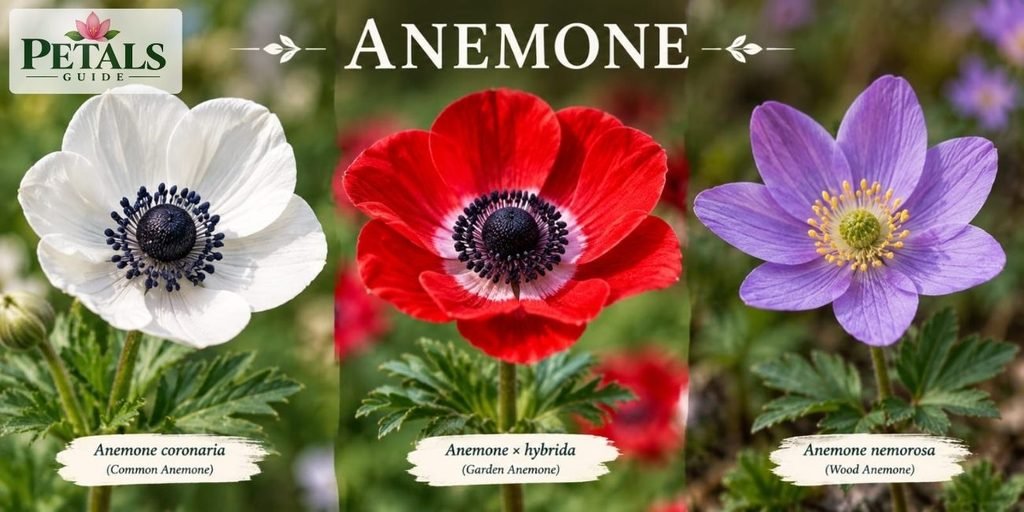
- Wood Anemone (Anemone nemorosa)
- Japanese Anemone (Anemone hupehensis)
- Pasque Flower (Anemone patens)
- Poppy Anemone (Anemone coronaria)
Anemone flowers are known for their unique petal structure, resembling soft, delicate butterflies. The blooms can have numerous petal shapes, often appearing as singles or in clusters, giving them a striking presence in gardens. Anemones produce cup-shaped flowers that can range from two to several layers of petals. This layered effect not only enhances their beauty but also helps attract various pollinators.
Some species, like the Japanese Anemone, can bloom in late summer and even fall, setting them apart from most flowers that start with A, which typically bloom earlier in the year. Their ability to thrive in partial shade makes them suitable for diverse garden settings, offering splashes of color when most other flowers have finished their show for the year.
Interesting Fact: The Pasque Flower (Anemone patens) is one of the first flowers to bloom in spring, often appearing even before the last snow has melted, representing hope and resilience against the harsh winter.
Aster
- Scientific Name: Aster spp.
- Plant Type: Herbaceous perennial
- Flower Colors: Blue, purple, pink, and white
- Blooming Season: Varies by species, mainly spring to autumn
- Native Region: Mainly Europe and Asia, with some species native to other regions
Popular Species:
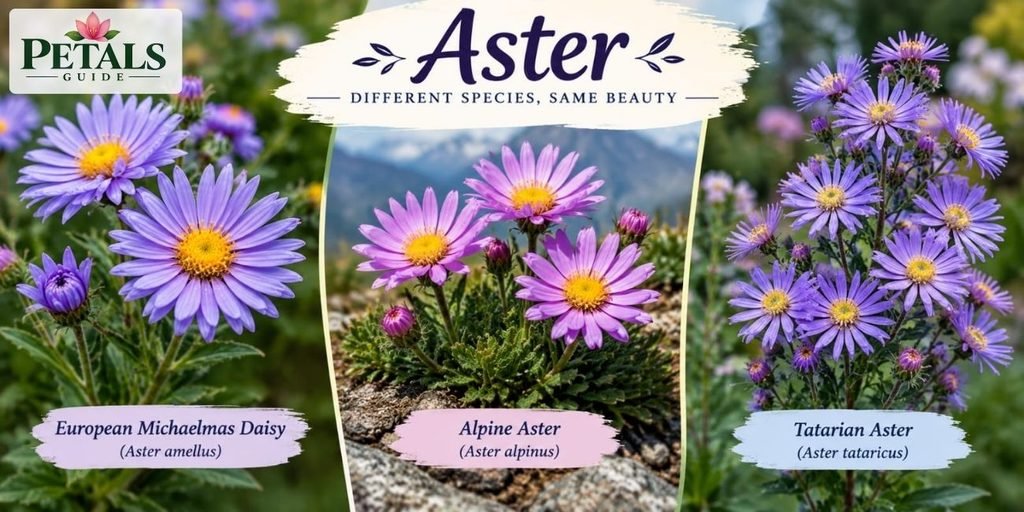
- European Michaelmas Daisy – Aster amellus
- Alpine Aster – Aster alpinus
- Tatarian Aster – Aster tataricus
- Blue Star – Aster tongolensis
Aster flowers are known for their distinctive, daisy-like structure, consisting of numerous ray florets surrounding a central cluster of disc florets. This arrangement creates a striking starburst effect, making them a favored choice for gardens and wildflower meadows. Asters vary widely in size and color, with some species producing large blooms that reach several inches across, while others are more compact and delicate, with softer hues.
Asters have unique leaf arrangement and growth habits. Mostly, the leaves are lance-shaped and can grow alternately along the stem or in clusters, enhancing the plant’s bushy appearance. This combination of sturdy stems and lush foliage supports vibrant flower heads that attract pollinators like bees and butterflies and add a delightful splash of color to autumn landscapes.
Interesting Fact: The genus name Aster comes from the Greek word for “star,” referring to the star-like appearance of its flower heads.
Azalea
Azalea is a group of flowering shrubs in the genus Rhododendron and is a popular example of flowers that start with A.
- Scientific Name: Rhododendron spp.
- Plant Type: Deciduous or evergreen shrub
- Flower Colors: White, pink, red, purple, orange, and yellow
- Blooming Season: Mainly spring, depending on the species or cultivar
- Native Region: Asia, Europe, and North America
Common/Popular Species and Cultivars
- Mollis Azalea (Rhododendron molle)
- Rhodora (Rhododendron canadense)
- Indian Azalea (Rhododendron simsii)
- Kurume Azaleas )Rhododendron × kurume hybrids)
Azalea flowers are distinctively funnel-shaped and typically grow in clusters, creating vibrant displays that can light up any garden. Their petals can have intricate markings or blotches, adding a unique touch to each bloom. Azaleas boast an impressive range of colors that can draw attention and create a stunning contrast against their lush green foliage. The cluster formation allows for a rich visual experience as multiple blooms can open simultaneously, transforming each shrub into a stunning spectacle.
Azaleas are especially known for producing many flowers at once, sometimes covering much of the shrub during peak bloom. Some types are evergreen and retain their leaves through winter, while others are deciduous and lose their leaves before the next growing season. This difference gives azaleas a wide range of appearances beyond their colorful flowers.
Interesting Fact: The name “azalea” comes from an ancient Greek word meaning “dry,” possibly referring to the dry habitats associated with some early-known azalea plants.
Alstroemeria
Alstroemeria, belonging to the genus Alstroemeria, is a group of flowering plants widely known for its colorful, patterned blooms. It is named after Clas Alströmer, a Swedish botanist and merchant who collected and introduced the plant to Europe in the 18th century.
- Scientific Name: Alstroemeria spp.
- Plant Type: Herbaceous perennial
- Flower Colors: Pink, orange, yellow, purple, red, and white
- Blooming Season: Late spring to early fall, depending on the species or cultivar
- Native Region: South America, especially Chile and Brazil
Common/Popular Species and Cultivars:
- Golden Peruvian Lily ( Alstroemeria aurea)
- Ligtu Lily ( Alstroemeria ligtu)
- Pelegrina Lily (Alstroemeria pelegrina)
- Parrot Lily (Alstroemeria psittacina)
- Princess Lilies (Alstroemeria hybrids)
Alstroemeria flowers have six petal-like tepals arranged in two groups of three. Several inner tepals often have dark streaks or spots, creating patterns that are especially noticeable on the open blooms. The flowers are usually held in clusters on leafy stems, with their form and markings varying between species and cultivars.
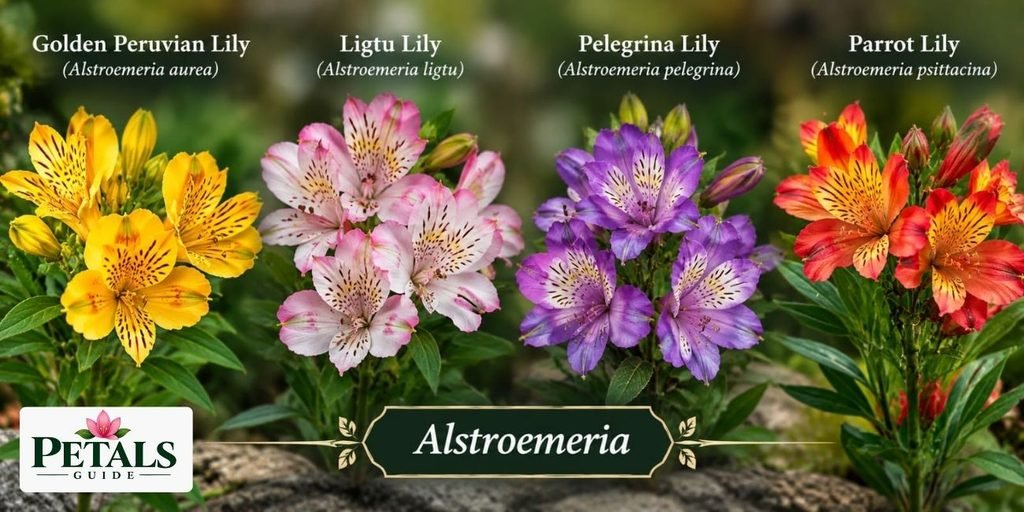
One useful feature of cultivated Alstroemeria is its long vase life, which makes it a popular cut flower. Many modern hybrids have been developed in different colors and flower forms, while the wild species provide considerable variation in size, markings, and growth habits.
Interesting Facts: Alstroemeria is commonly called the Peruvian lily, even though the genus is native to several parts of South America, including Chile and Brazil.
African Daisy
- Scientific Name: Osteospermum spp.
- Plant Type: Perennial herbs and shrubs
- Flower Colors: White, purple, yellow, orange, pink, and red
- Blooming Season: Varies by species and cultivar
- Native Region: Mainly southern and eastern Africa
Common/Popular Species and Cultivars:
- Common African Daisy (Osteospermum ecklonis)
- Osteospermum ‘Blue-Eyed Beauty’ -cultivar
- Osteospermum ‘Sunny’ – cultivar
- Osteospermum ‘Whirligig’- cultivar
African Daisy flowers have a familiar daisy-like form, with colorful ray florets surrounding a central disc. The ray florets come in a wide range of colors, and some cultivated varieties have contrasting centers or unusual petal forms. In many Osteospermum plants, the flower heads close or become less open in low light and reopen in brighter conditions.
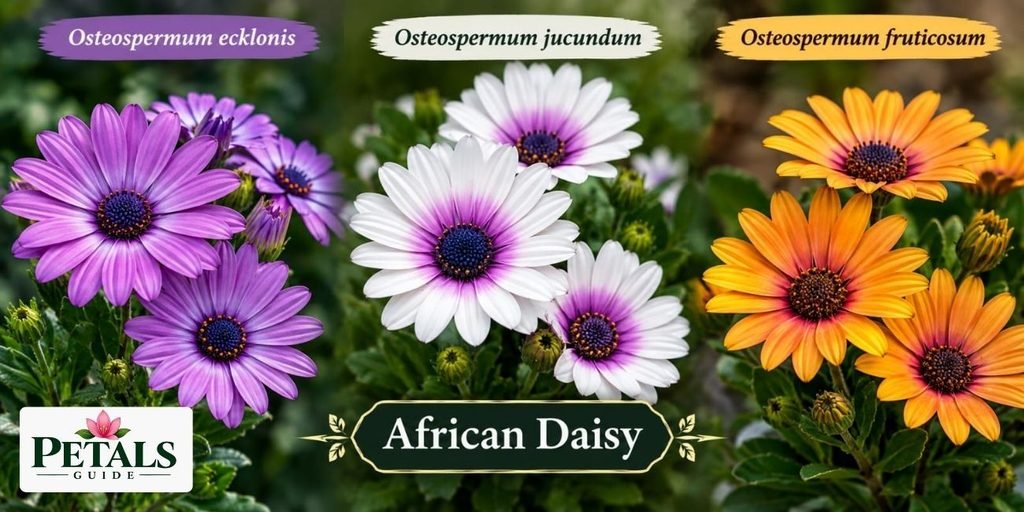
The genus includes a wide variety of flower shapes and plant forms, from low-growing garden plants to woody shrubs. Cultivated Osteospermum hybrids have been selected for a particularly broad range of colors and flower patterns, making them popular for containers, borders, and other ornamental plantings.
Interesting Fact: The genus name Osteospermum comes from Greek words meaning “bone” and “seed,” referring to the hard seeds produced by these plants.
Angelonia
- Scientific Name: Angelonia spp
- Plant Type: Perennial
- Flower Colors: Purple, Pink, White, Blue
- Blooming Season: Summer to Fall
- Native Region: Central and South America
Popular Species:
- Angelonia angustifolia (Summer Snapdragon)
- Angelonia alpedrialis (Alpine Angelonia)
- Angelonia goyazensis (Brazilian Angelonia)
- Angelonia purpurea (Purple Angelonia)
Angelonia flowers have a two-lipped, snapdragon-like shape and grow closely along upright flower spikes. The individual blooms have a small opening between their upper and lower lips, giving them a distinctive form. Some flowers also have contrasting markings inside the throat.
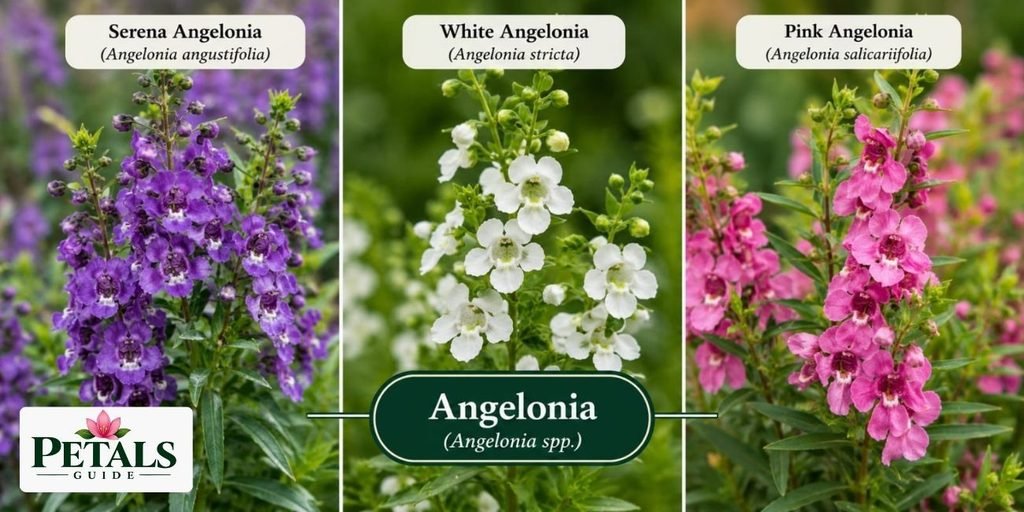
A useful feature of Angelonia is its ability to keep producing new flower spikes during warm weather when growing conditions are suitable. The flowers are also visited by bees and other pollinators, while their upright spikes give the plant a different look from low-growing bedding flowers.
Interesting Fact: Angelonia is commonly called Summer Snapdragon because its flowers resemble snapdragons, even though the two plants belong to different genera.
Anthurium
- Scientific Name: Anthurium spp.
- Plant Type: Evergreen herb, often epiphytic
- Flower Colors: Red, pink, white, green, purple, orange, and yellow
- Blooming Season: Year-round in suitable conditions
- Native Region: Central and South America
Common/Popular Species:
- Flamingo Flower (Anthurium andraeanum)
- Painter’s Palette (Anthurium scherzerianum)
- Crystal Anthurium (Anthurium crystallinum)
- Queen Anthurium (Anthurium warocqueanum)
Anthurium has an unusual flower structure consisting of a spadix surrounded by a colorful spathe. The spadix is covered with numerous tiny true flowers, while the spathe is a modified bract that often provides the bright color associated with the plant. The tiny flowers become sexually receptive at different times, with the female phase occurring before pollen is released.
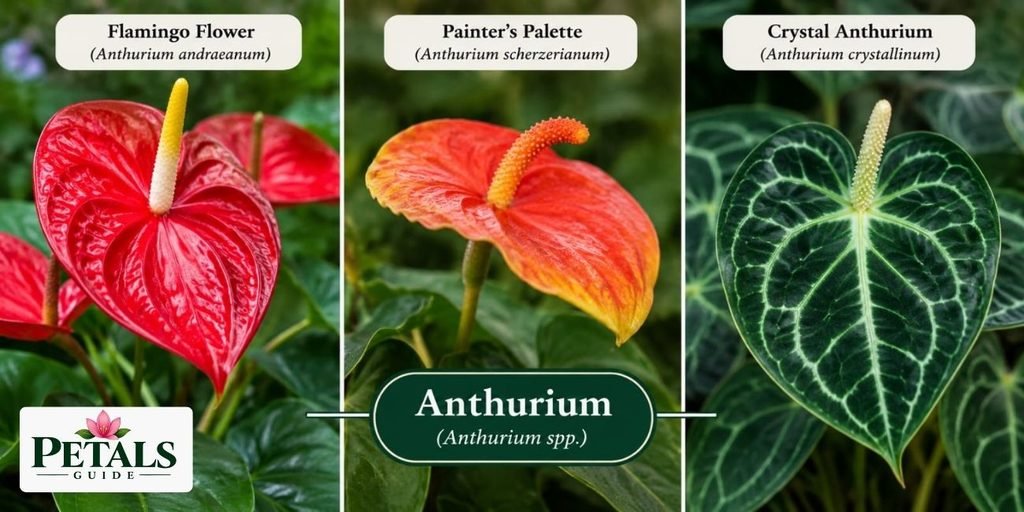
The timing of these reproductive stages helps reduce self-pollination and encourages pollen transfer between different flowers. After successful pollination, many Anthurium species develop small, fleshy berries along the spadix, which can make the structure look very different from its appearance during flowering.
Interesting Fact: In some Anthurium species, the spadix can become covered with colorful berries after pollination, making the plant’s reproductive structure look completely different from the familiar flower display.
Aquilegia
- Scientific Name: Aquilegia spp.
- Plant Type: Herbaceous perennial
- Flower Colors: Blue, purple, red, pink, yellow, white, and combinations
- Blooming Season: Spring to early summer
- Native Region: Northern Hemisphere, especially Europe, Asia, and North America
Common/Popular Species:
- European Columbine (Aquilegia vulgaris)
- Rocky Mountain (Columbine Aquilegia caerulea)
- Golden Columbine (Aquilegia chrysantha)
- Canadian Columbine ( Aquilegia canadensis)
Aquilegia, commonly known as columbine, delights gardeners with its unique, spurred flowers that attract hummingbirds and pollinators alike. These charming perennials thrive in a variety of conditions, making them versatile additions to any garden. Their foliage is often as striking as their blooms, featuring delicate, lobed leaves that can add texture to your landscape. In particular, Aquilegia shares a unique symbiosis with local ecosystems, as its nectar-rich flowers provide essential sustenance for birds and bees.
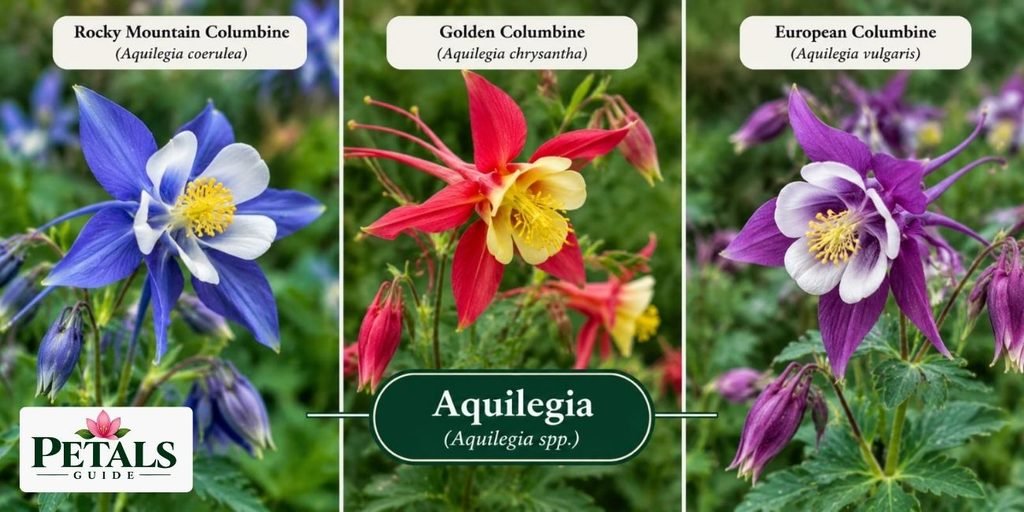
Interesting Fact: The name “Aquilegia” is derived from the Latin word for “eagle,” referring to the flower’s spurred petals that are said to resemble an eagle’s claws.
Allium
- Scientific Name: Allium spp.
- Plant Type: Bulbous or rhizomatous perennial
- Flower Colors: Purple, white, pink, yellow, and blue
- Blooming Season: Spring to summer, depending on the species
- Native Region: Mainly Europe, Asia, and North America, with some species in Africa
Common/Popular Species:
- Giant Onion (Allium giganteum)
- Golden Garlic (Allium moly)
- Chives (Allium schoenoprasum)
- Garlic Chives (Allium tuberosu)
At first glance, an Allium flower head may look like one large flower, but it is actually a tightly packed group of many tiny individual flowers. Each small flower has its own petals and reproductive parts, while the combined cluster creates the rounded head seen on many ornamental Alliums.
There is also a familiar secret hidden in the plant’s tissues. When an Allium leaf or bulb is crushed, it releases sulfur-containing compounds that produce the characteristic onion or garlic smell. The same chemical group is responsible for the strong aroma found in edible Allium crops such as onions and garlic.
Interesting Fact: Allium giganteum* can produce flower heads made up of hundreds of individual flowers, with the entire spherical cluster held high above the foliage on a single stem.
Amaranth
- Scientific Name: Amaranthus spp.
- Plant Type: Annual or perennial flowering plants
- Flower Colors: Red, purple, green, and white
- Blooming Season: Summer to fall
- Native Region: Americas, Africa, Asia
Popular Species:
- Amaranthus caudatus ( Love-Lies-Bleeding )
- Amaranthus cruentus ( Red Amaranth)
- Amaranthus hypochondriacus (Prince’s Feather)
- Amaranthus retroflexus ( Redroot Pigweed)
The Amaranthus genus shows an impressive array of vibrant flowers that come in dense clusters, captivating anyone who spots them. Their unique upright or drooping flower spikes create a stunning visual display in gardens and fields alike. Each tiny flower blooms in summer and can last well into the fall, adding color and texture long after many other plants have faded away.
What makes Amaranth especially intriguing is their ability to produce an abundance of seeds from each flower. For species like, Amaranthus caudatus, seed heads can resemble beautiful, cascading tassels, serving not just as a feast for birds but also as a way for the plant to thrive in various environments. This resilience makes Amaranth a cherished addition to both ornamental gardens and agricultural fields.
Interesting Fact: The name Amaranthus comes from a Greek word meaning “unfading,” referring to the way the flower clusters of some species retain their color for a long time
Acacia
- Scientific Name: Acacia spp.
- Plant Type: Tree or shrub
- Flower Colors: Yellow, white, and cream
- Blooming Season: Varies by species, often spring or summer
- Native Region: Mainly Australia and Africa, with species also native to parts of Asia and the Americas
Common/Popular Species:
- Golden Wattle ( Acacia pycnantha)
- Silver Wattle ( Acacia dealbata)
- Taiwan Acacia ( Acacia confusa)
- Sydney Golden Wattle ( Acacia longifolia)
Look closely at an Acacia flower cluster and you will see that much of its color comes from long, numerous stamens rather than large petals. Hundreds of tiny flowers can be packed together into rounded heads or elongated spikes, giving the plant a soft, brush-like appearance when many clusters open at once.
Some Acacia flowers also produce nectar and a noticeable fragrance that can attract insects and other pollinators. The tiny individual flowers may be difficult to notice on their own, but their dense arrangement makes the flower clusters highly visible from a distance.
Interesting Fact: Acacia pycnantha, the Golden Wattle, is the official floral emblem of Australia, having been proclaimed the national floral emblem in 1988.
Alyssum
- Scientific Name: Alyssum spp.
- Plant Type: Annual or perennial herb
- Flower Colors: White, yellow, pink, lavender
- Blooming Season: Spring to early summer
- Native Region: Europe, Asia, and North Africa
Common/Popular Species:
- Alyssum montanum (Mountain Alyssum)
- Alyssum saxatile (Basket-of-Gold)
- Alyssum alyssoides (Alyssum)
Picture a carpet of tiny, radiant flowers hugging the ground, their dense clusters creating a cheerful tapestry. The flowers of Alyssum, with their characteristic four-petaled shape, tend to bloom in rich hues that range from bright yellows to soft pinks, attracting pollinators like bees and butterflies. Each slender stem holds sweetly fragrant blooms, particularly in Alyssum saxatile, which not only brighten the landscape but also fill the air with a delightful scent.
Basket-of-Gold stands out with its golden-yellow blossoms that form impressive mounds, particularly stunning in rock gardens or borders. Alyssum also has an unusual feature hidden after flowering. The plant produces small, flattened seed pods called silicles, which develop from the individual flowers. Their shape and arrangement can help botanists distinguish Alyssum species from other members of the mustard family.
Interesting Fact: The genus Alyssum has a historical significance as it was once believed to cure rabies, which is reflected in its name derived from the Greek words for “without” and “madness.”
Agapanthus
- Scientific Name: Agapanthus spp.
- Plant Type: Herbaceous perennial
- Flower Colors: Blue, purple, and white
- Blooming Season: Summer to early fall, depending on species and climate
- Native Region: Southern Africa
Common/Popular Species:
- Agapanthus africanus ( African Lily)
- Agapanthus praecox ( Blue Lily)
- Agapanthus inapertus ( Wild African Lily)
- Agapanthus orientalis ( Oriental Lily)
Large clusters of Agapanthus flowers burst forth like fireworks, creating striking displays in gardens and landscapes. Each flower head, supported by long, slender stalks, showcases individual tubular blooms that gradually unfold within the cluster. This arrangement gives the flower head its rounded, full appearance and makes each individual bloom easy to notice.
Look closely at an Agapanthus flower and you will find six petal-like parts surrounding the stamens and style. After pollination, the flowers develop into small seed capsules that eventually split open to release their seeds. These changing stages give the flower stalk a different appearance as it moves from fresh blooms to mature seed heads.
Interesting Fact: The name Agapanthus comes from Greek words associated with love and flower, which is why the genus is sometimes linked with the common name “flower of love.”
Arabis
- Scientific Name: Arabis spp.
- Plant Type: Perennial herb
- Flower Colors: White, pink, purple, and yellow
- Blooming Season: Spring to summer
- Native Region: Mainly Europe, Asia, and North America
Popular Species:
- Garden Rockcress (Arabis caucasica)
- Alpine Rockcress ( Arabis alpina)
- Coast Rockcress ( Arabis blepharophylla)
- Carpathian Rockcress ( Arabis procurrens)
From rocky cliffs to sunny meadows, the genus Arabis brings clusters of delicate flowers to a wide range of landscapes. The blossoms usually have four petals arranged in a cross-like shape, a common feature of the mustard family. In many species, the flowers grow closely together above low rosettes of leaves, creating a simple but distinctive display that can attract bees and other pollinators.
What makes Arabis interesting is its ability to grow in rocky and well-drained places where many plants may struggle. Some species form low, spreading mats that help cover exposed ground and are often used in rock gardens. After flowering, the plants produce narrow seed pods called siliques, which split open when mature to release their seeds.
Interesting Fact: Some *Arabis* species are not just beautiful; they are also edible! The young leaves can be used in salads or as a garnish, offering a peppery bite while adding a pop of color to your dish.
Arum
- Scientific Name: Arum spp.
- Plant Type: Perennial herbaceous plants
- Flower Colors: Mainly white, green, or purple
- Blooming Season: Spring to early summer, depending on the species
- Native Region: Europe, Asia, and North Africa
Common/Popular Species:
- Lords-and-ladies, Cuckoo-pint ( Arum maculatum)
- Italian arum ( Arum italicum)
- Dioscorides’ arum ( Arum dioscoridis)
- Eastern Mediterranean arum ( Arum hygrophilum)
Nestled within lush, wooded areas or by the edges of gardens, Arum flowers are distinctive for their unusual structure and intriguing lifecycle. The plants feature a spathe surrounding a spadix, creating an eye-catching display that can attract pollinators such as flies. In some species, the flowers also produce odors that help lure these insects, making their pollination strategy quite different from that of many familiar garden flowers.
Aside from their unusual flowers, Arum plants have an interesting reproductive cycle. After pollination, the spathe eventually fades and reveals clusters of berries that develop around the spadix. These berries can add another splash of color to the plant, although they are not safe to eat.
Interesting Fact: Many Arum species contain calcium oxalate crystals, which can cause a burning or irritating sensation if the plant tissue is chewed.
Astilbe
- Scientific Name: Astilbe spp.
- Plant Type: Herbaceous perennial
- Flower Colors: Pink, white, red, purple, and peach
- Blooming Season: Late spring to mid-summer
- Native Region: Asia and North America
Common/Popular Species:
- Chinese Astilbe ( Astilbe chinensis)
- Thunberg Astilbe ( Astilbe thunbergii)
- Japanese Astilbe ( Astilbe japonica)
- Arends’ Astilbe ( Astilbe × arendsii) (hybrid group)
The feathery flower plumes of Astilbe are made up of countless tiny flowers packed along branching stems. Depending on the variety, the plumes may be upright, arching, or slightly drooping, giving each flower cluster a different shape. The tiny blooms create a soft, airy texture that makes the flower heads easy to recognize.
Another interesting feature is the way the individual flowers open gradually along the branches of the plume rather than all at once. This creates a layered look as the flower cluster develops. The blooms also produce nectar and pollen that can attract bees, butterflies, and other visiting insects.
Interesting Fact: The genus name Astilbe comes from Greek and refers to the flowers being relatively inconspicuous in some species, although cultivated varieties can have much fuller flower plumes.
Aubrieta
- Scientific Name: Aubrieta spp.
- Plant Type: Herbaceous perennial
- Flower Colors: Purple, blue, pink, and white
- Blooming Season: Spring to early summer
- Native Region: Europe and parts of Asia
Common/Popular Species:
- Wall Cress ( Aubrieta deltoidea)
- Aubrieta maculata ( Aubrieta maculata)
- Aubrieta columnae ( Aubrieta columnae)
The vibrant clusters of Aubrieta flowers can spread across rocks and walls, creating a carpet of small blooms. Each flower has four petals arranged in a cross-like shape, with a small yellow or pale center in some varieties. The flowers grow on slender stems above compact foliage, giving the plant a soft, flowing appearance.
As they grow, these flowers can form a low, spreading cover that spills over rocks and garden edges. Their compact growth and ability to spread across crevices make them closely associated with rock gardens and stone walls. After flowering, the plant develops small seed pods that contain its seeds.
Interesting Fact: Aubrieta deltoidea is named after the French flower painter Claude Aubriet, whose name was used for the genus.
Ageratum
- Scientific Name: Ageratum spp.
- Plant Type: Annual or perennial herb
- Flower Colors: Blue, purple, pink, and white
- Blooming Season: Summer to fall, depending on the species
- Native Region: The Americas, mainly tropical and subtropical regions
Common/Popular Species:
- Floss Flower ( Ageratum houstonianum)
- Billygoat Weed ( Ageratum conyzoides)
- Mexican Ageratum ( Ageratum mexicanum)
- Golden Floss Flower ( Ageratum conyzoides)
The whimsical blooms of Ageratum catch your eye with their tiny, fluffy flower heads that resemble soft pom-poms scattered across the garden. The delicate, thread-like florets cluster together to create full flower heads, giving them a soft, fuzzy texture. This unusual texture makes the blooms easy to recognize and adds interest when many flower heads appear together.
Beyond their charm, Ageratum flowers can attract pollinators such as bees and butterflies. As the flowers fade, they develop small, dry fruits that contain the seeds. These tiny fruits often have fine bristles that can help the seeds move with the wind.
Interesting Fact: The genus name Ageratum comes from a Greek word meaning “not growing old,” referring to the long-lasting appearance of its flowers.
Why Are Flowers Starting With A So Popular?
Flowers starting with the letter A have a special charm that makes them incredibly popular among gardeners and flower enthusiasts alike. With their wide variety of colors and shapes, they can brighten up any space. For instance, the vibrant Amaryllis can bring a touch of elegance to indoor decor, while the cheerful Azalea often creates stunning displays in gardens. Whether you’re looking for the bold blooms of an Allium or the delicate petals of an Anemone, there’s an A-flower to suit every taste.
These flowers also have different blooming periods, meaning you can enjoy a colorful garden from spring to fall. Many A-flowers, like Aster and Astilbe, not only look beautiful but are also great for attracting pollinators like bees and butterflies. Additionally, their scents can add a lovely fragrance to bouquets, making them perfect for gifts or special occasions. Overall, flowers that start with the letter A offer versatility, beauty, and ecological benefits, making them a top choice for any flower lover.
Girls Names of Flowers That Start With A
When it comes to unique girl names inspired by nature, flowers that start with the letter A offer enchanting options. Consider “Azalea,” a name that evokes vibrant blooms known for their vivid colors and rich symbolism of femininity. Not only does this name carry a lyrical quality, but it also represents the beauty and warmth of spring, making it a perfect choice for parents seeking something fresh and lively.
Another delightful option is “Aster,” which denotes a flower symbolizing love and wisdom. Rich in history, the name pays homage to the Greek word for “star,” resonating with those who appreciate a celestial touch. Similarly, “Amaryllis” offers a stunning choice, reminiscent of elegance and charisma, as these flowers bloom dramatically, creating a lasting impression.
For an even more poetic flair, “Anemone” stands out; its name comes from the Greek word for “wind,” presenting a captivating metaphor for resilience and grace. Each of these names not only embodies the delicate beauty of flowers but also inspires a deeper connection to nature and the qualities one might wish to imbue in their daughter’s name.
Practical Planting Tips for Busy Homeowners
When you’re a busy homeowner, you can still cultivate a vibrant garden by choosing the right flowers. Here are some practical planting tips to maximize your time and effort:
- Choose Low-Maintenance Varieties: Opt for flowers that require minimal pruning, watering, and fertilization.
- Plan for Perennials: Select plants that return each year to reduce replanting tasks.
- Utilize Containers: Plant in pots for easy mobility and to optimize space without heavy garden work.
- Group Flowers by Water Needs: Designate areas for drought-tolerant and moisture-loving plants to simplify watering routines.
- Go for Native Species: Incorporate regional flowers which adapt well and attract local pollinators, lessening the need for chemical treatments.
By focusing on these strategies, you can simplify your gardening experience while still enjoying the beauty of blooms that start with “A”. Embrace your space; every corner can burst into color without consuming your precious time.
Conclusion
We’ve looked at 20 lovely flowers that start with “A” and how they can make our world more colorful. From the bright colors of the Azalea to the sweet smell of the Amaryllis, these blooms can brighten anyone’s day. You can enjoy these beauties in your garden or even as gifts for friends. If you’re interested in learning about flowers that start with other letters, be sure to check out our article on “J” flowers too. Discovering more about flowers can help you appreciate nature even more!
FAQs
What are some beautiful flowers that start with the letter ‘A’?
Some beautiful flowers include Amaryllis, Azalea, Aster, and Anemone.
What are the best uses for flowers starting with ‘A’?
Flowers like Alstroemeria and Anemone are great for bouquets, landscaping, and attracting pollinators to gardens.
How do I care for Amaryllis flowers?
Amaryllis needs bright, indirect sunlight, well-drained soil, and regular watering but avoid overwatering to prevent rot.