
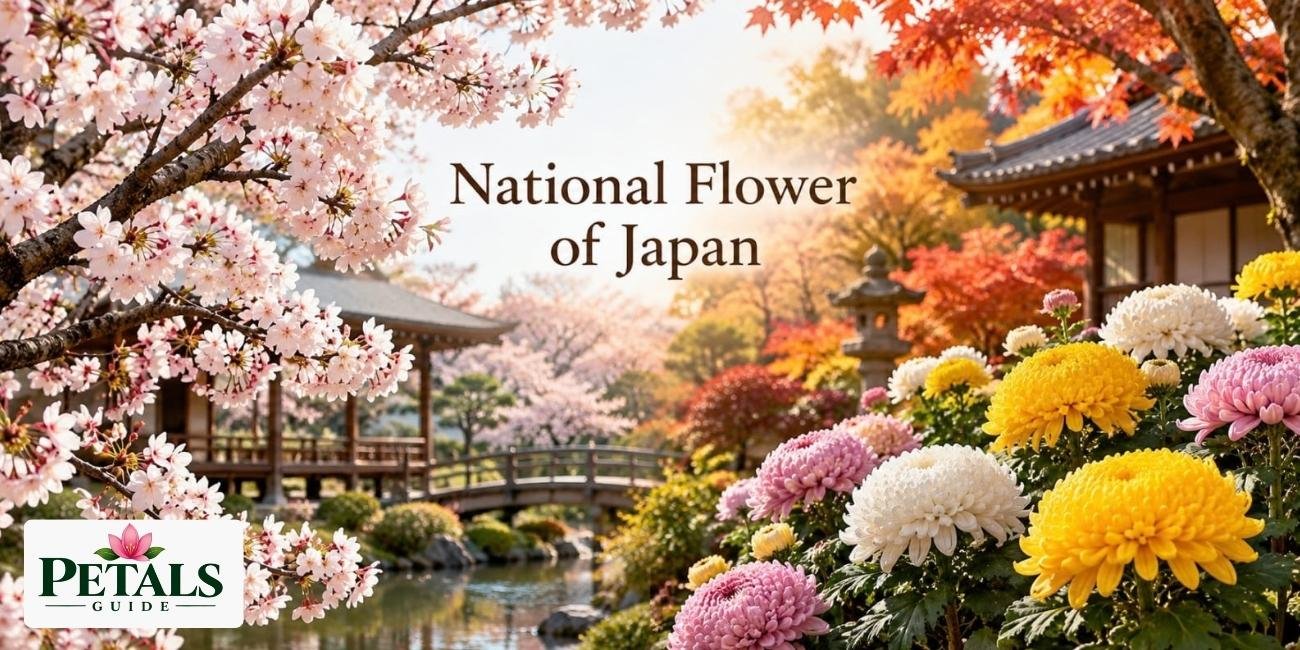
The National Flower of Japan is closely associated with two flowers that reflect the country’s culture, traditions, and connection with nature. The cherry blossom, or sakura, is the most widely recognized, while the chrysanthemum holds a special place in Japanese history and Imperial tradition.
Although Japan does not have an officially designated national flower, both flowers are strongly associated with the country in different ways. In this article, we’ll explore these two important flowers and what they symbolize in Japanese culture. Their stories offer a glimpse into Japan’s rich traditions and values.
What Is the National Flower of Japan?
There is no single official answer to this question because Japan has not designated a national flower by law. Instead, two flowers are especially associated with the country: the cherry blossom, or sakura, and the chrysanthemum, or kiku.
The cherry blossom is widely regarded as the flower most representative of Japan. The Government of Japan itself describes sakura in these terms, reflecting its strong connection with the country’s spring landscape and cultural life. This is why the cherry blossom is often identified when discussing the National Flower of Japan, even though it is not an officially designated national symbol.
The chrysanthemum has a different position. It has a long-standing connection with the Japanese Imperial Family and appears in the Imperial chrysanthemum crest, including its use on Japanese passports. Because of this, kiku is another major floral symbol of Japan, but its Imperial association should not be confused with an official national-flower designation.
Cherry Blossom: Japan’s Most Famous Flower
- Japanese name: Sakura (桜)
- Plant group: Prunus
- Best-known cultivated variety: Somei-Yoshino
- Typical flower colors: White to pale pink
- Main flowering period: Spring
The cherry blossom, known as sakura in Japanese, is widely regarded as the flower most representative of Japan. The cherry blossom scientific name is not limited to one species because sakura refers to numerous wild cherry species and cultivated varieties within the genus Prunus. These cherries differ in their flowers, growth habits, and flowering periods, but together they have become a familiar part of Japan’s landscapes.
Somei-Yoshino is the most widely planted and recognizable species of Sakura. It is a cultivated cherry known for producing abundant flowers along its branches. The blossoms are usually five-petaled and range from very pale pink to nearly white, with the color often becoming lighter as the flowers open.
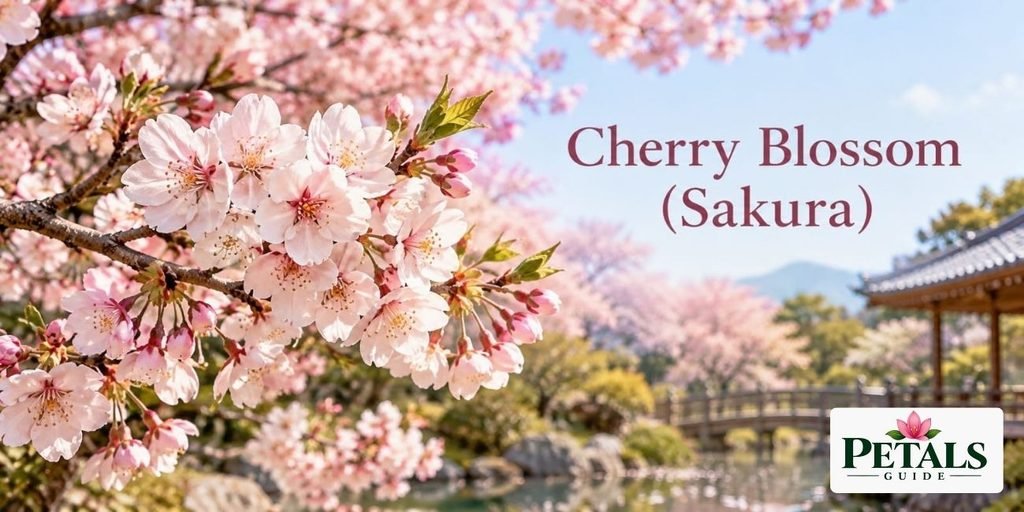
Cherry blossoms can vary considerably depending on the variety. Some have single flowers with a small number of petals, while others have fuller, more layered blooms. Their trees can also differ in size and form, giving different areas of Japan their own distinctive cherry displays. This variety is an important part of understanding sakura as a broad group rather than as one identical flower.
The timing of flowering also varies across Japan. Japan pink trees begin blooming earlier in warmer regions, while colder northern areas experience blossoms later in spring. Because different varieties flower at different times, cherry blossoms can be enjoyed across the country over an extended period.Their widespread presence and familiar spring appearance have helped establish sakura as one of Japan’s most recognizable floral symbols.
What Does Sakura Symbolize in Japan?
Sakura is strongly associated with impermanence because its beauty lasts for only a short time. The blossoms appear, reach full bloom, and then fall within a relatively brief period. This temporary nature has long been connected with the Japanese appreciation of things that are beautiful precisely because they do not last forever.
This idea is closely related to the Japanese aesthetic concept of wabi-sabi, which recognizes beauty in simplicity, imperfection, and transience. The Japan Cherry Blossom Flower became connected with Shinto ideas of impermanence, hope, and renewal. Its yearly return creates a sense of continuity, while the short life of each bloom reminds people that change is a natural part of life.
The connection between sakura and these ideas is one reason the phrase cherry blossom, the national flower of Japan, is often associated with the country’s cultural identity. Although Japan does not officially designate a national flower, the cherry blossom has become one of its strongest floral symbols.
The flower has also been used in Japanese poetry and literature to express the temporary nature of human life and beauty. Historical poems about falling cherry blossoms show that this association is not simply a modern interpretation but has deep roots in Japanese cultural expression.
Because of these associations, sakura represents more than the arrival of spring. It brings together ideas of transience, renewal, hope, and the changing nature of life, which helps explain its lasting importance in Japanese culture.
Chrysanthemum: Another Important Flower of Japan
The chrysanthemum, called kiku (菊)in Japanese, is another flower with a long-standing place in Japanese culture. Unlike sakura, which is mainly associated with spring, chrysanthemums are closely connected with autumn. They belong to the genus Chrysanthemum and are grown in Japan as ornamental plants in gardens and other cultivated settings.
Japanese chrysanthemums include many forms that differ in flower size, shape, and petal arrangement. Some varieties have simple, open blooms, while others develop dense layers of petals that create rounded or highly structured flowers. Common colors include white, yellow, pink, red, and purple, giving chrysanthemum displays considerable variety.
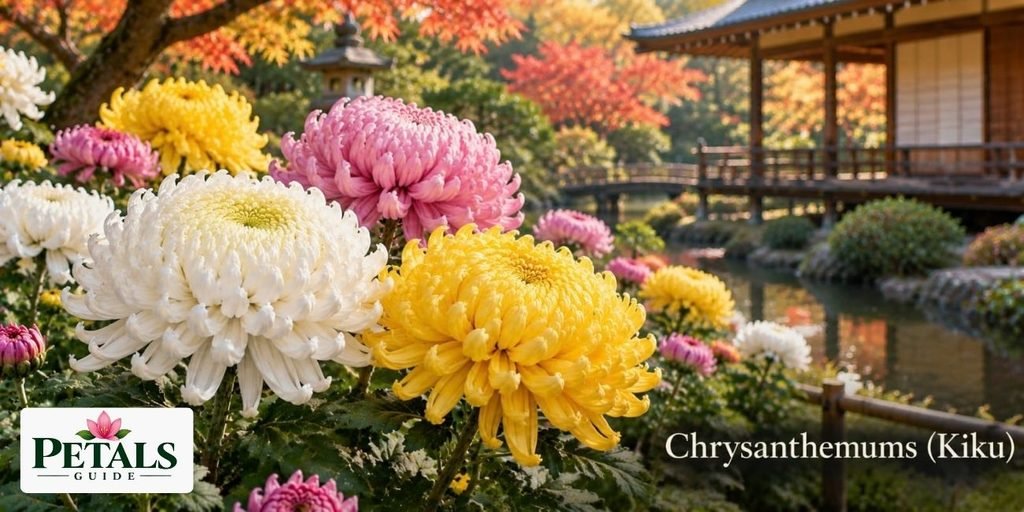
Autumn is an important season for viewing chrysanthemums in Japan. Gardeners and specialist growers carefully cultivate different varieties for their flower form and appearance, and some plants are trained to produce large, carefully shaped displays. This cultivation tradition has helped make kiku an important part of Japan’s seasonal gardening culture.
Why Is the Chrysanthemum Important in Japanese Culture?
The chrysanthemum has a particularly strong connection with Japan’s Imperial Family. The flower’s importance is represented by the 16-petal chrysanthemum crest, which has long been used as an emblem of the Imperial household. Because of this association, the chrysanthemum is closely connected with the Imperial institution and appears in important official and ceremonial contexts.
The flower’s Imperial connection can also be seen on Japanese passports, where the chrysanthemum design appears on the cover. The name “Chrysanthemum Throne” is another expression associated with Japan’s Imperial institution. These uses give kiku a status that is quite different from the broader cultural popularity of sakura.
Chrysanthemums have also been regarded in Japanese culture as a flower associated with nobility and high status. Their connection with the Imperial household has helped preserve this meaning over time, while chrysanthemum exhibitions and traditional displays continue to give the flower a visible place in Japanese cultural life.
Cherry Blossom vs. Chrysanthemum in Japan
Cherry blossoms and chrysanthemums have different roles in Japanese culture. Sakura is the flower most closely associated with Japan in everyday life and is widely described by the Japanese government as the flower most representative of the country. Kiku, meanwhile, has a particularly strong connection with the Imperial Family and formal Japanese traditions.
| Feature | Cherry Blossom (Sakura) | Chrysanthemum (Kiku) |
|---|---|---|
| Main season | Spring | Autumn |
| Japanese name | Sakura (桜) | Kiku (菊) |
| Cultural role | Closely connected with Japan’s seasonal landscape, festivals, and everyday cultural life | Strongly associated with Imperial, ceremonial, and formal traditions |
| Symbolic associations | Impermanence, renewal, and the changing nature of life | Longevity, nobility, and Imperial tradition |
| Public recognition | Widely recognized internationally as a symbol associated with Japan | Widely recognized for its historical and continuing Imperial association |
| Major cultural connection | Hanami (cherry blossom viewing) and spring traditions | Chrysanthemum cultivation, exhibitions, festivals, and Imperial symbolism |
| Official Japan national flower? | No | No |
The two flowers therefore represent Japan in different ways. Sakura has a broad connection with the country’s seasonal landscape and public cultural life, while kiku carries a more formal historical association. Neither has been established by Japanese law as an official national flower, so descriptions such as Japan National Flower are generally referring to cultural symbolism rather than a legal designation.
History of Japan’s Floral Symbols
Flowers have been part of Japanese cultural life for centuries, especially through poetry, seasonal customs, gardens, and the appreciation of nature. During the Heian period (794–1185), flowers were closely connected with court culture and literature. Cherry blossoms appeared frequently in poetry and other writings, helping sakura develop a deeper cultural presence beyond its role as a seasonal flower. Historical records also show that the word hanami became associated specifically with enjoying cherry blossoms during this period.
Sakura also had older connections with agricultural traditions. According to the Japan National Tourism Organization, cherry blossoms were originally used to help divine the year’s harvest before their meaning developed through Japanese religious and cultural ideas. Over time, their place in poetry, seasonal customs, and public life helped establish sakura as one of Japan’s most recognizable natural symbols.
The chrysanthemum followed a different historical path. It was introduced to Japan from China around the Nara period (710–794), initially with medicinal uses. By the Heian period, chrysanthemums were appearing in court poetry and seasonal culture. Their importance grew further during later centuries, when Japanese growers developed many new varieties and cultivation became increasingly popular. The flower eventually gained a particularly strong connection with the Imperial institution, giving it a different historical role from sakura.
These separate histories explain why both flowers became deeply associated with Japan without there being a single legally designated national flower.
Cherry Blossom Season and Hanami in Japan
Cherry blossom season generally spreads across Japan from spring, with flowering beginning in warmer southern areas and continuing northward as temperatures rise. In many parts of the country, the main season falls between March and April, while colder regions such as Hokkaido can have blossoms into May. The exact timing changes from year to year depending on weather conditions.
This movement is known as the cherry blossom front, or sakura zensen. It begins in the south and gradually travels toward northern Japan. Because different regions and varieties bloom at different times, the overall season lasts much longer across the country than it does in any single location. In one place, the period of full bloom may last only around a week, so local forecasts are closely followed by people planning their viewing.
Hanami means enjoying or viewing flowers, and in modern Japan it usually refers to gatherings beneath blooming cherry trees. Families, friends, and colleagues may meet in parks or other public spaces, spread out a picnic sheet, share food and drinks, and spend time together beneath the trees. Some popular viewing areas also offer evening illuminations, allowing people to enjoy the blossoms after sunset.
The timing of hanami can be planned around local bloom forecasts, but there is always some uncertainty because rain, wind, and temperature can affect flowering and how long the blossoms remain. This is why cherry blossom viewing takes place at different times throughout Japan rather than on one fixed national date.
What Does the Cherry Blossom Mean to Japanese People?
For many people in Japan, cherry blossoms are closely connected with new beginnings. They usually appear around the time when the new school and business years begin in April. First-year students may walk beneath blooming trees on their way to school entrance ceremonies, making sakura part of an important moment in the start of a new stage of life.
Sakura also has a place in everyday social life. Families, friends, classmates, and coworkers may make time to enjoy the blossoms together, while some people return to the same parks or viewing spots each year. These experiences connect the flower with personal memories and the arrival of a new season.
Chrysanthemum Festivals and Japanese Traditions
Chrysanthemum festivals, known as kiku matsuri, are held in different parts of Japan mainly during autumn. These events feature carefully cultivated chrysanthemums arranged in formal displays, with some exhibitions showing flowers trained into particular shapes and designs. The displays allow growers to present the results of detailed cultivation and training.
One distinctive example is the Nihonmatsu Chrysanthemum Doll Festival in Fukushima Prefecture. Held from early October to mid-November, it features life-sized figures dressed with living chrysanthemum flowers, along with large floral displays and competition exhibits by local growers. The festival’s official history dates its first organized event to 1955, building on a much older local tradition of chrysanthemum cultivation.
Chrysanthemums are also displayed at historic religious and garden sites. At Shinjuku Gyoen National Garden in Tokyo, the annual Chrysanthemum Exhibition is held from November 1 to 15, with flowers arranged in traditional styles inside temporary wooden pavilions along the Japanese garden paths. At Yahiko Shrine in Niigata, the November Chrysanthemum Festival features a large-scale display of around 30,000 chrysanthemums arranged as a Japanese landscape.
Other Important Japanese Flowers and Floral Symbols
Japan has several other flowers with important cultural and seasonal connections besides sakura and kiku. Plum blossom (ume) has been familiar in Japan since ancient times and was already celebrated in poetry during the Nara period. It blooms earlier than cherry blossom and became closely associated with the arrival of early spring.
Wisteria (fuji) has its own long history in Japan. It appears in poetry and traditional stories, while its connection with the Fujiwara clan gave it an important historical association. At Kasuga Taisha Shrine in Nara, wisteria is also represented in the shrine’s emblem and has been cultivated on the grounds for centuries.
Iris is another familiar seasonal flower, with iris gardens and festivals held in different parts of Japan. At Suigo Sawara Ayame Park in Chiba, an annual June festival features around 1.5 million irises representing about 400 species. Lotus also has a strong place in Japanese temple gardens and Buddhist traditions, where it is associated with the Buddhist universe.
Japan National Flower in Art, Culture, and Everyday Life
Sakura and chrysanthemums have been used as decorative motifs in Japanese art and clothing for centuries. Cherry blossoms appear in ukiyo-e prints, paintings, and traditional textiles, while chrysanthemums are frequently seen on kimono, screens, ceramics, and other decorative objects. Japanese artists often used these flowers as part of larger seasonal designs rather than showing them as isolated subjects.
Kimono provide some clear examples of this tradition. The Tokyo National Museum has Edo-period garments decorated with chrysanthemum patterns, while the National Museum of Modern Art, Kyoto, documents yuzen textiles featuring chrysanthemums and other seasonal plants. Cherry blossoms were also used on formal kimonos, including garments decorated with embroidered and dyed sakura designs.
These floral patterns also reflect the Japanese practice of using seasonal motifs in everyday design. Government sources note that cherry and plum blossoms are traditional spring patterns for kimono, while chrysanthemums are associated with autumn designs. This seasonal use allows flowers to appear in clothing and decorative objects as part of the visual language of Japanese culture.
Why Japan Has No Official National Flower
Japan has no law that designates a national flower. The country does have legally established national symbols, including the national flag and national anthem, which were formally defined by the 1999 Law Regarding the National Flag and National Anthem. However, that law does not name a national flower.
The absence of an official designation does not mean that Japan lacks a widely recognized floral symbol. Sakura is commonly regarded as the flower that best represents Japan, while the chrysanthemum has a separate association with the Imperial Family. Japan’s own Web Japan explains that there is no official national flower, while noting that sakura is widely considered the national flower because of its strong place in Japanese life and spring traditions.
This is why the phrase “National Flower of Japan” can have a cultural meaning rather than a legal one. Sakura and chrysanthemum can both be described as important floral symbols of Japan, but neither has been officially designated as the country’s national flower by law.
Final Thoughts on Japan National Flower
The National Flower of Japan is not officially designated by law, but the cherry blossom and chrysanthemum (kiku) are two of the country’s most important floral symbols. Sakura reflects the beauty of changing seasons and the temporary nature of life, while the chrysanthemum has a long connection with longevity, nobility, and Imperial tradition.
Together, these flowers reflect the close relationship between nature, culture, and seasonal traditions in Japan. Their continued presence in festivals, art, gardens, and everyday life helps explain why they remain meaningful symbols of the country.
FAQs
What is the national flower of Japan?
Japan has no officially designated national flower. However, cherry blossom (sakura) is widely regarded as the flower that best represents Japan. The chrysanthemum (kiku) is also an important floral symbol.
Does Japan have two national flowers?
Not officially. Japan has no legally designated national flower, but sakura and chrysanthemum are both commonly associated with the country.
What is the Japanese symbol for flower?
The Japanese word for flower is “hana (花)”. “Sakura (桜)” means cherry blossom and is one of Japan’s best-known floral symbols
What is Japan’s famous flower?
The cherry blossom, or sakura, is Japan’s most famous flower. It is closely associated with spring, hanami, and Japanese cultural traditions.
What is the national symbol of Japan?
Japan has several national symbols. The Hinomaru flag and Kimigayo national anthem are officially established by law. The chrysanthemum crest is also an important symbol of the Imperial Family.