
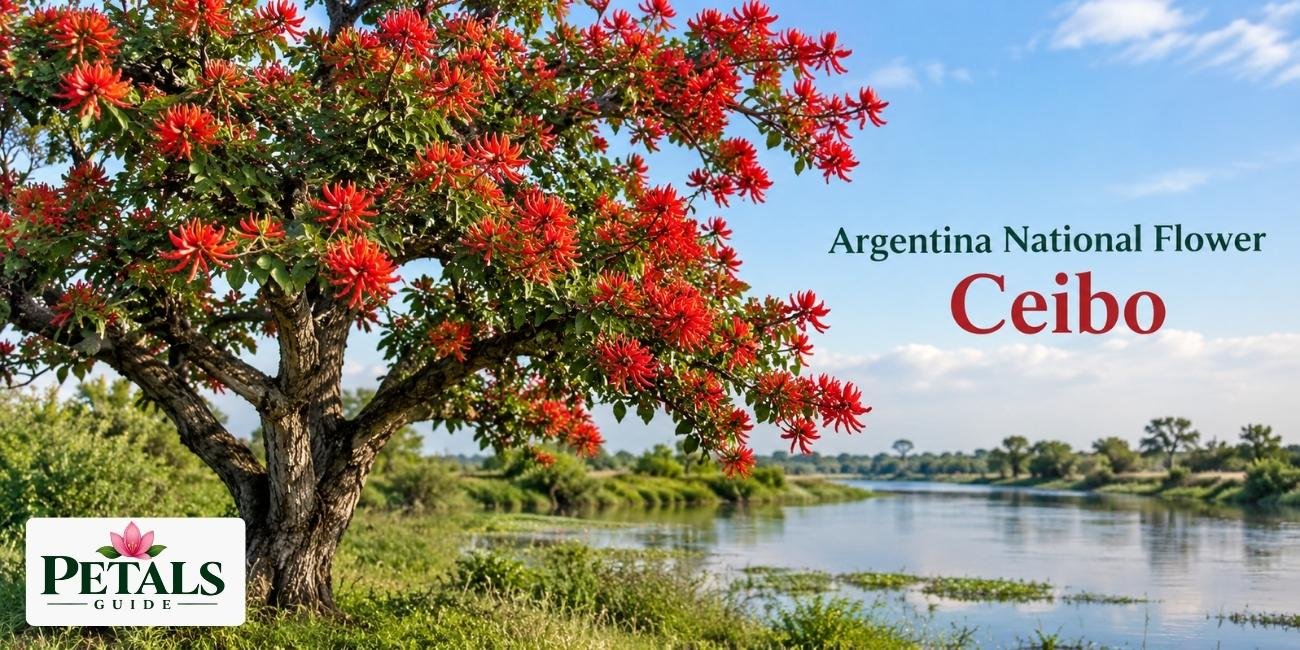
Argentina National Flower is the ceibo, a tree with bright red flowers known scientifically as Erythrina crista-galli. This tree is found in South America and is deeply tied to Argentina’s nature, stories, and culture. Its colorful blooms and unique shape make the ceibo one of the country’s best-known floral symbols.
The ceibo is not just a flower; it has a background linked to the legend of Anahí. Additionally, the tree is important for wetland and river areas. With its unusual flowers, relationship with wildlife, and role in Argentine culture, the ceibo highlights how a native plant can become a strong national symbol.
What Is the National Flower of Argentina?
The Argentina National Flower is the ceibo, scientifically known as Erythrina crista-galli. This flowering tree belongs to the Fabaceae family and is native to South America. In Argentina, it commonly grows in moist areas, especially along riverbanks, wetlands, and marshes. Its vivid red or coral-red flowers are one of its most recognizable features.
On December 22, 1942, the ceibo was officially declared the national flower of Argentina through Decree No. 13,847. Its native presence, cultural connections, and place in Argentine folklore helped establish it as a national symbol. Today, the ceibo remains closely associated with Argentina’s natural heritage and is also grown in parks, gardens, and public spaces.
Ceibo Names in Argentina and Around South America
The ceibo is known by several names across South America. In Argentina and other Spanish-speaking countries, ceibo and seibo are commonly used. Its English names include cockspur coral tree, cock’s comb, common coral tree, and cry-baby tree. The name cock’s comb refers to the shape of its red flowers, while the common name ceibo is closely associated with this well-known Argentina flower.
In Portuguese-speaking regions, the tree is called corticeira, while bucaré is another regional name. All of these names refer to the same species, Erythrina crista-galli, although their use varies by country and language.
Why Was Ceibo Chosen as Argentina’s National Flower?
The selection of the ceibo as Argentina’s national flower involved a thoughtful process that spanned several years. Initially, the magnolia was considered because of its stunning appearance, but it ultimately was rejected as it was not native to the country. This decision paved the way for a more suitable candidate that truly represented Argentina’s natural heritage.
Public surveys, including one that engaged around 20,000 participants, revealed overwhelming support for the ceibo. Feedback from these surveys emphasized its widespread presence across the nation, connecting it deeply with various Indigenous legends, poetry, and folklore. A special commission noted the ceibo’s established cultural significance, making it a fitting floral emblem that resonated with the national identity.
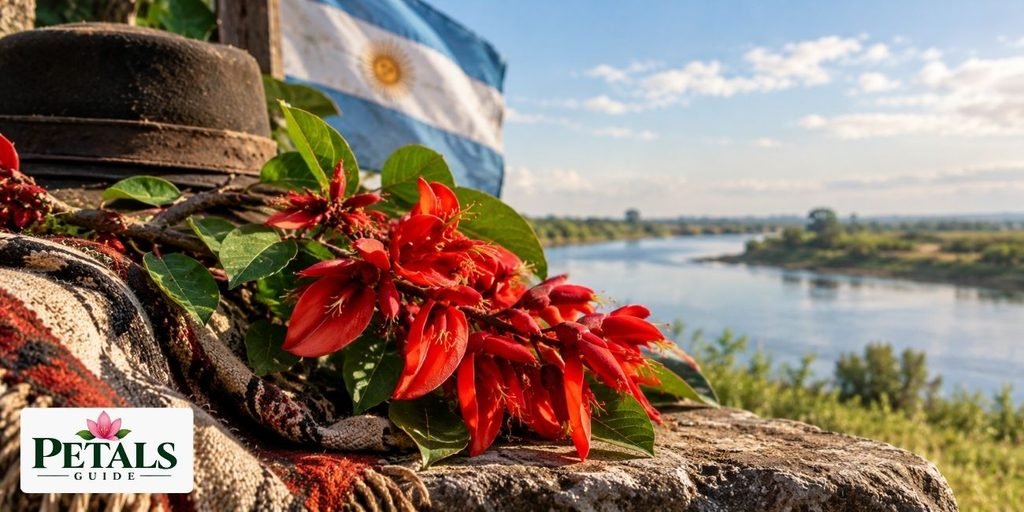
On December 22, 1942, the importance of the ceibo was officially recognized when it was declared Argentina’s national flower via Decree No. 13,847. This decision highlighted the ceibo’s native roots and celebrated its role as a symbol of Argentina’s rich cultural landscape.
How the Ceibo Became a Symbol of Resistance
According to a traditional Guaraní legend, Anahí was a young Indigenous woman who lived along the Paraná River and was known for her beautiful singing. When Spanish invaders arrived, she was captured and taken prisoner. The story says that Anahí later escaped, but was recaptured after killing her guard while trying to flee.
As punishment, she was tied to a tree and condemned to die in a fire. The legend tells that as the flames rose, Anahí slowly transformed into a tree. When the soldiers returned the next morning, they found a ceibo covered with green leaves and velvety red flowers where she had been.
The story has become one of the best-known legends connected with Argentina’s national flower. Because Anahí resisted captivity and endured her punishment, the ceibo that emerged from the legend came to represent courage, endurance, and resistance. This is a folkloric tradition, rather than a documented historical account of Anahí’s life.
What Does the Ceibo Flower Symbolize in Argentina?
The ceibo, with its vivid red flowers, carries deep cultural meaning in Argentina. It is commonly associated with courage, strength, resilience, and perseverance, particularly through the traditional legend of Anahí. The story has helped connect the flower with the idea of standing firm through suffering and hardship.
The ceibo also represents memory and national identity. Its presence in Argentine poetry, music, legends, and folklore has made it more than a natural part of the landscape. As Argentina’s national flower, it brings together the country’s natural heritage and cultural traditions. Its bright blooms continue to appear in public spaces and cultural settings, keeping the ceibo closely connected with Argentine life and helping preserve its symbolic meaning across generations.
Ceibo in Argentine Public Life
November 22 is observed in Argentina as National Flower Day, with schools and cultural institutions using the occasion to highlight native botanical heritage. Educational activities, exhibitions, drawings, and reading materials can introduce children to the Argentina National Flower while also encouraging interest in other Argentina flowers.
The ceibo is also represented in Argentine cultural materials, including illustrations, literary references, folk traditions, and educational publications. These appearances keep the flower familiar in everyday cultural life and provide different ways for people to learn about Argentina’s native plant heritage.
What Does the Ceibo Tree Look Like?
The ceibo tree (Erythrina crista-galli), Argentina’s national flower, can grow up to about 15 meters (50 feet) tall and may develop a broad, spreading crown. Its trunk is stout and can flare near the base, with rough gray-brown bark. The branches grow outward and may have sharp thorns, giving the tree a distinctive appearance.
Its leaves have a three-part, or trifoliate, structure, with green leaflets that form a full canopy during the growing season. The broad crown can provide dappled shade beneath the tree. During its blooming period, clusters of bright red flowers appear along the branches, adding strong color to the green foliage. The combination of its sturdy trunk, spreading branches, three-part leaves, and red blooms makes this Argentina flower easy to recognize.
Where Does the Ceibo Grow Naturally?
The ceibo, Argentina’s National Flower, naturally grows in moist environments across its native range in South America. It is commonly found along riverbanks, streams, wetlands, marshes, and low-lying areas that may experience seasonal flooding. In Argentina, it is especially associated with the Paraná River and Río de la Plata, as well as the wetlands and gallery forests of the Litoral region. The tree is particularly common in the Pre-Delta and Paraná River Delta, where the warm climate and abundant moisture provide suitable conditions for its growth.
Beyond Argentina, the ceibo is native to Uruguay, Paraguay, and parts of Brazil. It is also found in eastern Bolivia, although its native range is more strongly centered on Argentina, Uruguay, Paraguay, and Brazil. These wet habitats provide an important setting for the Argentina flower, allowing it to grow as part of native riverside and wetland vegetation. Its close connection with rivers and marshy landscapes is one of the natural features that makes Argentina’s national flower such a familiar part of the country’s Litoral region.
Ceibo Flowers, Pollination, and Fruit
The ceibo flower has vivid red to scarlet petals that grow in clusters along the branches, creating a strong contrast with the green foliage. Its unusual structure is well suited to bird pollination, with nectar attracting hummingbirds that visit the blossoms and transfer pollen between flowers. Bees, including honeybees, also visit the flowers and contribute to pollination.
After pollination, the ceibo produces elongated, curved pods containing several seeds. As the pods mature, they open and release the seeds. Since the tree commonly grows beside rivers, wetlands, and other moist habitats, water can help carry its seeds to new locations. This process allows the Argentina National Flower to reproduce naturally within the wet.
The Ceibo’s Role in Argentina’s Wetland Ecosystems
The ceibo tree, recognized as Argentina’s national flower, is an important part of the riverside forests and wetland plant communities found along waterways such as the Paraná. It grows alongside native species including willows and river alders, helping form the vegetation that gives these wetland habitats their structure. Its branches and foliage also provide shelter and living space for insects, birds, and other small organisms.
The ceibo’s role continues even after its leaves fall. In the Middle Paraná River, research has shown that decomposing ceibo leaves become both a food resource and a surface for aquatic invertebrates, including insects, crustaceans, worms, and mollusks. This makes the Argentina National Flower part of the wetland food web beyond its living form.
Wildlife and Ceibo Flower
Hummingbirds are frequent visitors to ceibo flowers, feeding on their nectar while moving between blossoms. Bees are also important flower visitors. A study of ceibo populations in Argentina and Uruguay recorded four hummingbird species along with carpenter bees and honeybees, with bees accounting for most of the recorded flower visits. This makes the tree a useful floral resource for both birds and insects.
Fallen ceibo leaves also support aquatic organisms after entering the water. In a secondary channel of the Middle Paraná River, decomposing leaves were colonized by chironomid larvae, crustaceans, aquatic worms, and mollusks. The leaf litter provided both food and a surface for these small organisms, linking fallen plant material with aquatic life.
Argentina Flower Uses
The ceibo is widely planted as an ornamental tree in Argentina, adding color to parks, plazas, gardens, streets, and other public spaces. Its showy flowers make it especially suitable for landscape planting. The lightweight wood has also been used for local crafts and traditional objects, including the bombo legüero, a drum associated with Argentine folk music.
Other parts of the tree have traditional practical uses. The flowers can be used to produce natural dyes, while bark and other plant parts have been used in traditional remedies in some communities. These medicinal applications belong to folk practice and should not be considered scientifically proven treatments.
How to Grow a Ceibo Tree
To cultivate Erythrina crista-galli, choose a sunny location with fertile, well-draining soil that can retain some moisture. The tree prefers consistently moist conditions but should not be left in waterlogged soil. Regular watering is helpful while young plants establish their roots, particularly during dry periods.
Give the ceibo plenty of room to develop its broad crown when planting it outdoors. It can be propagated from seeds, softwood cuttings, or semi-hardwood cuttings. Soaking seeds in warm water before sowing can help with germination, while cuttings need suitable rooting conditions and are generally taken during the growing season.
Pruning is usually limited to removing dead, damaged, or crossing branches and maintaining a balanced canopy. Because the species is sensitive to frost, young trees should be protected from severe cold. In cooler regions, a sheltered planting site or container growing can make winter protection easier.
National Flower vs National Tree of Argentina
Argentina’s national flower is the ceibo (Erythrina crista-galli), and its official national forest tree is the quebracho colorado chaqueño (Schinopsis balansae). The quebracho earned this title on August 21, 1956, through Decree No. 15,190. While the ceibo is notable for its beautiful blooms, the quebracho symbolizes the country’s forest legacy and is recognized for its strong and resilient wood.
These two symbols showcase different aspects of Argentina’s botanical heritage. The ceibo is predominantly linked to the wetlands and riverbanks of the Litoral region, whereas the quebracho is typical of the northern forests, especially in the Chaco area. Hence, when discussing national plants in Argentina, it’s important to differentiate between the national flower and the national forest tree rather than conflating them into a single category.
Important Flowers of Argentina
Beyond the ceibo, Argentina has many native flowers and flowering plants adapted to its forests, grasslands, mountains, dry regions, and southern landscapes. Some of the notable Argentina flowers include:
- Notro (Embothrium coccineum): A small tree native to the Andean forests of Patagonia. It produces clusters of bright red flowers that are especially noticeable against the green forest vegetation.
- Amancay (Alstroemeria aurea): A native Andean and Patagonian plant known for its yellow to orange flowers, often found in mountain forests, clearings, and open areas during the warmer season.
- Chilco (Fuchsia magellanica): Found in southern Argentina, particularly in moist areas of Patagonia and the Andean region. Its hanging flowers have colorful red, purple, or pink tones and are well suited to cool, wet environments.
- Calafate (Berberis microphylla): A Patagonian shrub with small yellow flowers that appear in spring. After flowering, it produces dark blue to nearly black berries that are an important part of local plant life and are also used as food.
- Espinillo (Vachellia caven): A native tree or shrub of central and northern Argentina. Its small, fragrant yellow flower heads appear in clusters and give the plant a strong floral presence in grasslands and open woodland.
- Jarilla (Larrea spp.): Common in Argentina’s dry regions, including parts of the Monte. These hardy shrubs produce small yellow flowers and are well adapted to hot conditions and limited rainfall.
These plants show the wide range of forms, colors, and habitats found among Argentina flowers. The Argentina National Flower, the ceibo, is one part of this larger native floral heritage, while each of these species is associated with particular regions and environments.
Wild Animals in Argentina
Argentina is home to a wide variety of wild animals, from the high Andes and Patagonian forests to grasslands, wetlands, and northern forests. Some notable species include:
- Puma: This adaptable wild cat lives across many parts of Argentina, including mountains, forests, grasslands, and dry regions.
- Guanaco: Common in Patagonia and other open landscapes, the guanaco is a close relative of the llama and is well adapted to harsh environments.
- Vicuña: Found mainly in the high Andes, the vicuña is a small wild camelid known for its fine wool and ability to live at high elevations.
- Yaguareté: Also known as the jaguar, this large cat is native to northern Argentina and is an important species in the country’s conservation programs.
- Andean Condor: One of the largest flying birds in Argentina, it can be seen soaring over the Andes and other mountainous areas.
- Capybara: This large semi-aquatic rodent lives near rivers, wetlands, and lagoons, particularly in northern and northeastern Argentina.
Argentina has many protected native species, and the country’s wildlife conservation programs focus on protecting threatened animals and their habitats. Although terms such as Argentina National animal are sometimes used for individual species, Argentina’s officially recognized national symbols are the flag, coat of arms, and national anthem rather than a designated national animal.
Interesting facts about Argentina National Flower
- Its scientific name has a special meaning: Erythrina comes from the Greek word erythros, meaning “red,” while crista-galli refers to a rooster’s crest, describing the color and shape associated with its flowers.
- The ceibo belongs to the bean family: It is a member of the Fabaceae family, the same large plant family that includes beans and peas.
- It is not limited to Argentina: The species naturally occurs in Argentina, Uruguay, Paraguay, and Brazil. It is also the national flower of Uruguay, giving the Argentina National Flower a special connection with a neighboring country.
- Its wood is unusually light: Ceibo wood is soft, porous, and lightweight. In Argentina, it has traditionally been used for lightweight objects and for making the body of the bombo legüero, a traditional folk drum.
- It can form natural riverside forests: Ceibo is characteristic of gallery forests, where trees grow along rivers and other waterways. This makes the Argentina National Flower closely connected with some of the country’s wetland landscapes.
Conclusion
The ceibo is deeply rooted in Argentina’s cultural and natural legacy. Found in local landscapes, folklore, education, and public areas, this iconic flower remains well-known to people throughout generations. As Argentina National Flower, the ceibo is emblematic of more than just its vibrant red petals. It embodies the nation’s native flora while intertwining with traditions and tales that shape Argentine identity, ensuring that this flower holds a significant spot in the country’s cultural history.
FAQs
What is the national symbol of Argentina?
Argentina has several official national symbols, including the National Flag, National Coat of Arms, and National Anthem. The ceibo is officially recognized as the country’s national flower, while the Bandera Nacional de la Libertad Civil is also recognized as a historical patriotic symbol.
Does Argentina have a national flower?
Yes. Argentina’s national flower is the ceibo (Erythrina crista-galli). It was officially declared the national flower by Decree No. 13,847 on December 22, 1942.
What is the flower of Buenos Aires?
The ceibo is closely associated with Buenos Aires and can be found in the city’s parks, plazas, and other green spaces. However, it is important to distinguish the national flower of Argentina from a separate officially designated “flower of Buenos Aires.”
What is the flower of Patagonia?
There is no single official flower representing all of Patagonia. The region has many native flowering plants, including amancay (Alstroemeria aurea) and notro (Embothrium coccineum), which are associated with different Patagonian landscapes.