
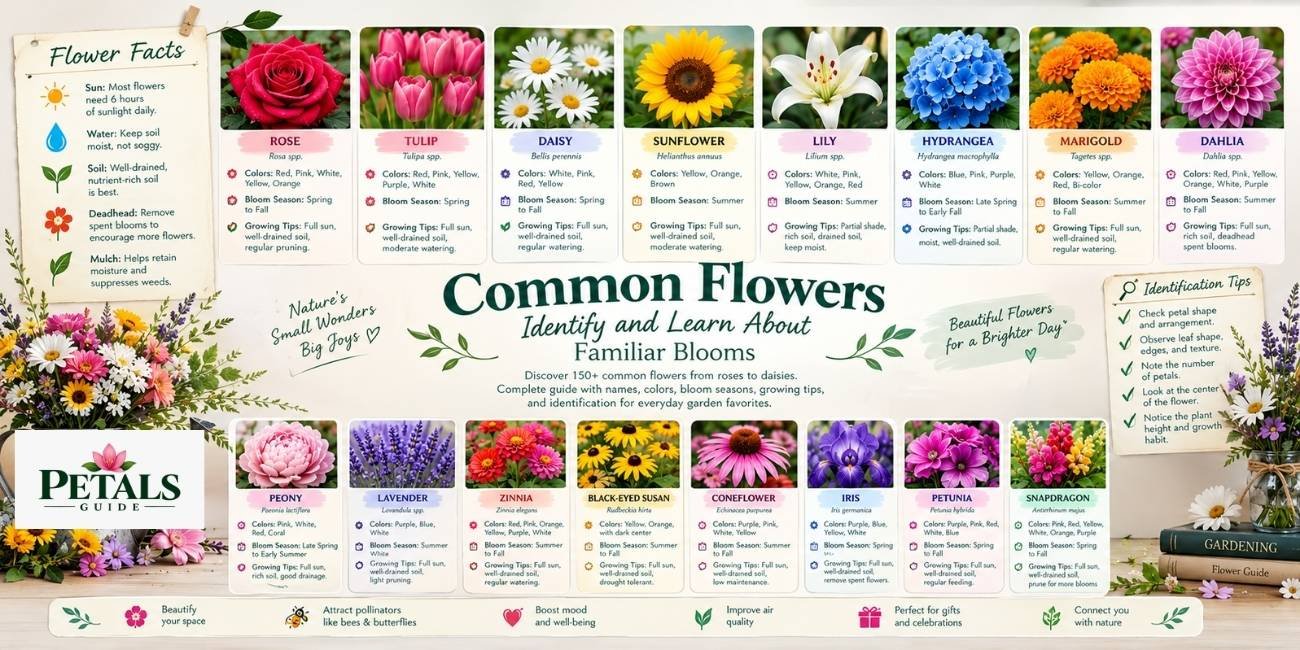
Common flowers aren’t just pretty faces, they are rich in meaning and history. From backyard gardens to bustling city parks, these blooms have a way of capturing our hearts. In this article, we’ll look at different types of flowers and their names, offering you insights into their beauty and importance. By the end, you’ll appreciate these familiar flowers in a whole new light.
Simple Ways to Identify Common Flowers
Identifying common flowers can be a joyful adventure. While the world is home to more than 400,000 flowering plant species, only a few hundred regularly grace our gardens, florist shops, parks, and roadside meadows. Learning to spot these familiar blooms is surprisingly simple once you pay attention to basic colors and shapes. For instance, sunflowers stand tall with wide, bright yellow faces, while clovers stay low with delicate leaves and round pink or white blooms. Noticing these everyday details helps you remember their names and adds an entirely new layer of color to your nature walks.
Another approach is to observe the flowers’ environments. Daisies often pop up in sunny fields, while violets tend to hide in shady spots. Learning about the types of flowers that thrive in different settings can enrich your understanding of local flora. A little curiosity goes a long way, turning each flower into a little treasure waiting to be discovered.
How to Spot the Clues: Shape, Color, and Leaves
When identifying common flowers, shape, color, and leaves provide key clues. Here’s how to decipher nature’s hints:
Shape: The form of the petals can reveal a lot. Think about the delicate star shape of a starflower or the bold, cup-like form of a tulip. Each flower shape tells its own story, often linked to its pollinators.
Color: Colors play a vital role in attracting bees, butterflies, and birds. Bright yellows and purples might signal a sunflower or lavender, while softer whites and pinks could hint at a cherry blossom. Understanding the color spectrum helps narrow down the types of flowers you might encounter.
Leaves: Don’t overlook the leaves! The size, shape, and texture can differentiate flowers. For instance, broad, jagged leaves may indicate a daisy, while elongated, smooth leaves could belong to a lily. Observing these details helps paint a complete picture of the flower.
By tuning into these clues, you elevate your flower identification skills and deepen your appreciation of nature’s beauty.
Spring Common Flowers List
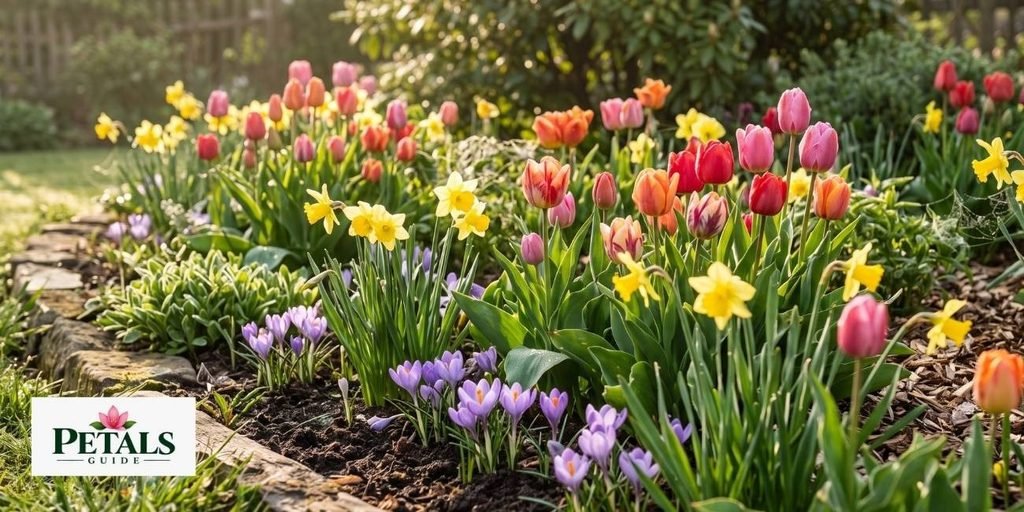
Spring brings a cheerful burst of common flowers that transform gardens and parks into vibrant tapestries. These spring flowers have diverse colors and shapes. They offer a comforting connection to renewal and hope. Every garden, big or small, thrives with the joy of these beautiful types of flowers.
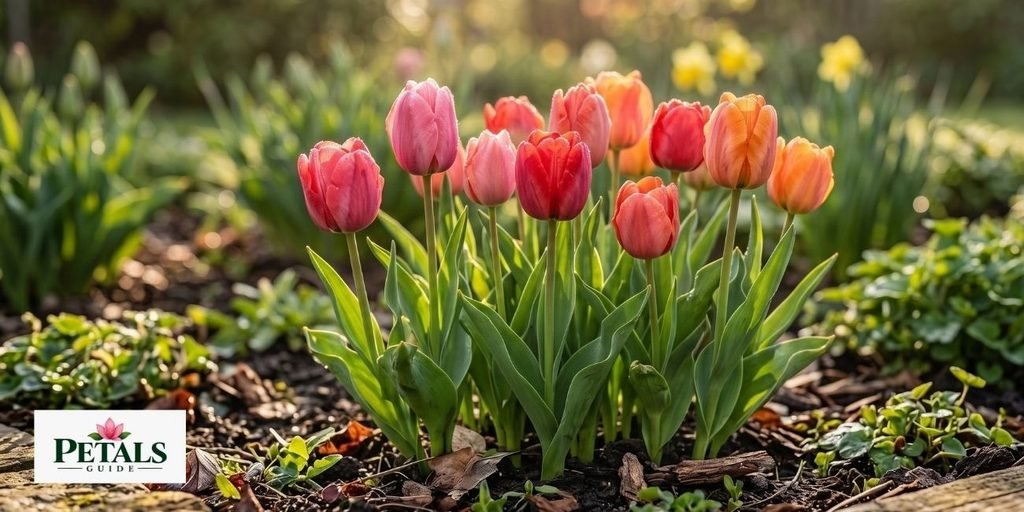
- Tulip
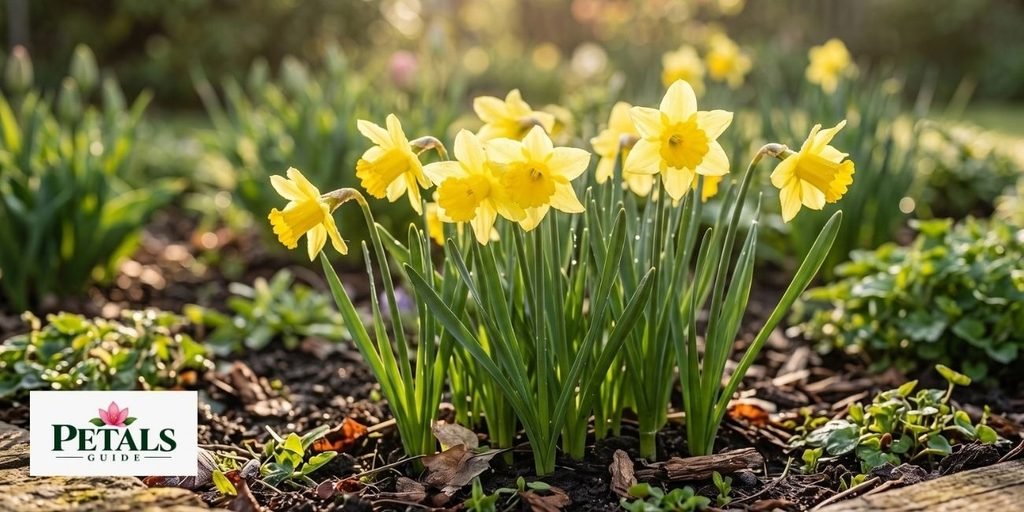
- Daffodil
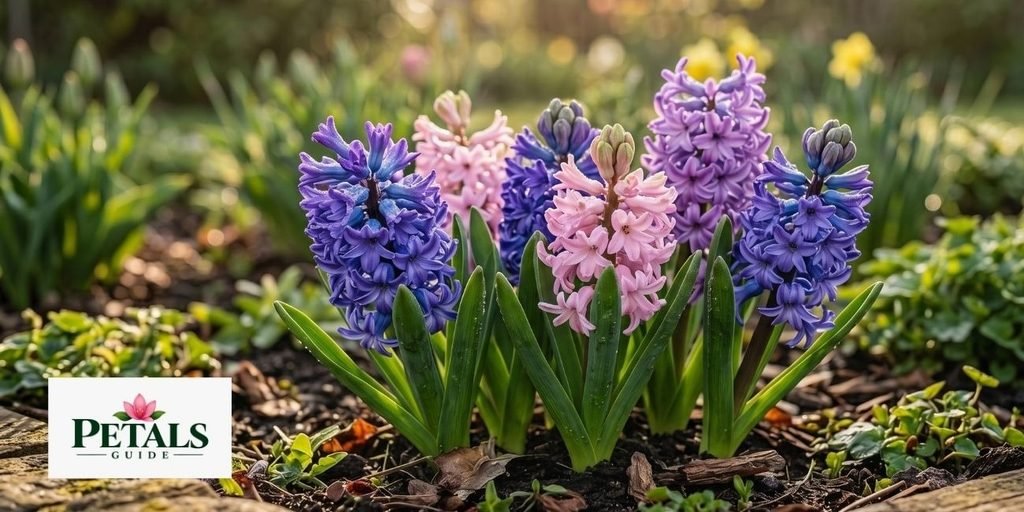
- Hyacinth
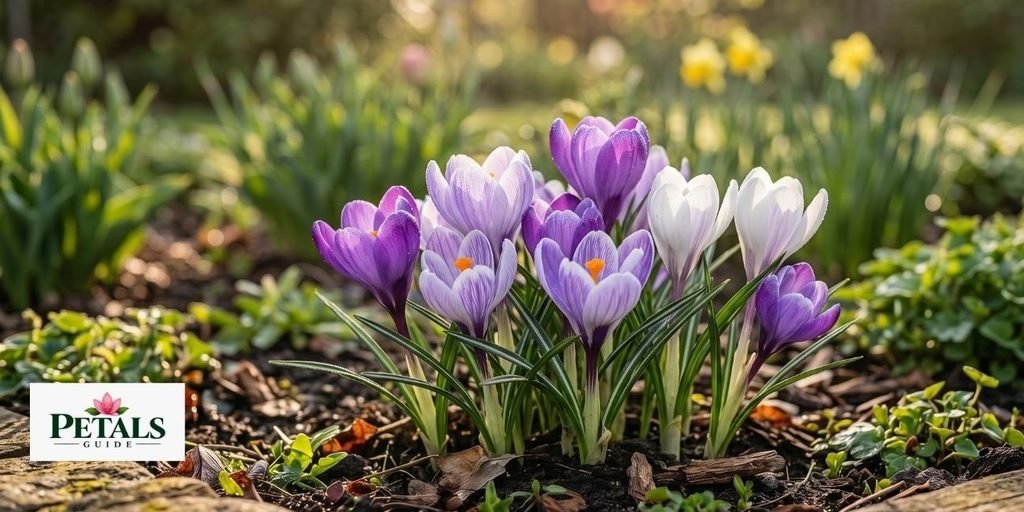
- Crocus
- Primrose
- Forget-Me-Not
- Lilac
- Bleeding Heart
- Dutch Iris
- Freesia
- Anemone
- Ranunculus
- Muscari (Grape Hyacinth)
- Pansy
- Viola
- Snapdragon
- Sweet Pea
- Wallflower
- Lungwort
- Bergenia
- Hellebore (Lenten Rose)
- Virginia Bluebell
- Glory of the Snow
- Snowdrop
- Star of Bethlehem
- Cowslip
- Lily of the Valley
- Pasque Flower
- Trillium
- Bloodroot
- Spring Beauty
- Marsh Marigold
- Periwinkle (Vinca)
- Aubrieta
- Basket of Gold
- Rock Cress
- Creeping Phlox
- Jacob’s Ladder
- Columbine (early spring varieties)
- Brunnera (Siberian Bugloss)
Summer Common Flowers List
Summer often paints the world with a vibrant palette of common flowers, each with its own unique story. Each common types of flowers not only adds vibrancy to our gardens but also holds a special place in our hearts, reminding us of sun-soaked days and warm gatherings.
- Rose
- Lily (Asiatic, Trumpet)
- Peony
- Hydrangea
- Daisy
- Sunflower
- Zinnia
- Marigold
- Lavender
- Coneflower (Echinacea)
- Black-Eyed Susan (Rudbeckia)
- Daylily (Hemerocallis)
- Bee Balm (Monarda)
- Salvia
- Pentas
- Lantana
- Verbena
- Petunia
- Geranium (Pelargonium)
- Begonia
- Impatiens
- Coleus
- Calibrachoa (Million Bells)
- Portulaca (Moss Rose)
- Cosmos
- Hollyhock
- Foxglove
- Delphinium
- Larkspur
- Lobelia
- Alyssum
- Nicotiana (Flowering Tobacco)
- Four O’Clocks
- Morning Glory
- Moonflower
- Clematis
- Honeysuckle
- Trumpet Vine
- Wisteria (some summer-blooming varieties)
- Canna Lily
- Gladiolus
- Dahlia
- Freesia (summer-blooming varieties)
- Gardenia
- Plumeria
- Hibiscus (hardy and tropical)
- Oleander
- Bougainvillea
- Mandevilla
- Jasmine
- Phlox (garden and creeping)
- Campanula (Bellflower)
- Coreopsis (Tickseed)
- Gaillardia (Blanket Flower)
- Achillea (Yarrow)
- Sedum (summer-blooming varieties)
- Hosta (flowers)
- Astilbe
- Heuchera (Coral Bells)
- Ligularia
- Gooseneck Loosestrife
- Purple Loosestrife (caution: invasive)
- Mallow (Malva)
- Hollyhock
- Lavatera
- Rose of Sharon
- Butterfly Bush (Buddleia)
- Lantana
- Vitex (Chaste Tree)
- Abelia
- Spirea (summer-blooming varieties)
- Potentilla
- Cinquefoil
- Rock Rose
- Portulaca
- Moss Rose
- Wax Begonia
- Dusty Miller (grown for foliage with small flowers)
- Angelonia
- Bacopa
- Diascia
- Nemesia
- Scaevola
- Supertunia
- Wave Petunia
- Surfinia
Fall Common Flowers List
Fall flowers bring a cozy warmth to the changing season, transforming gardens and homes alike. These unique flowers do more than beautify, they remind us of resilience. Even as summer fades, these types of flowers thrive, showcasing nature’s ability to adapt and flourish. Adding a few of these blooms to your space not only brightens up the scenery but also lifts your spirits during those shorter, cooler days.
- Chrysanthemum
- Aster
- Goldenrod
- Sedum (Autumn Joy)
- Japanese Anemone
- Toad Lily
- Chelone (Turtlehead)
- Tricyrtis (Toad Lily)
- Sneezeweed (Helenium)
- Tithonia (Mexican Sunflower)
- Salvia (autumn-blooming varieties)
- Verbena (autumn-blooming varieties)
- Marigold (continues until frost)
- Zinnia (continues until frost)
- Cosmos (continues until frost)
- Snapdragon (cool-season rebloom)
- Pansy (cool-season rebloom)
- Violas (cool-season rebloom)
- Ornamental Kale and Cabbage
- Dusty Miller
- Flowering Cabbage
- Black-Eyed Susan (late bloomers)
- Coneflower (late bloomers)
- Joe Pye Weed
- Ironweed
- New York Aster
- New England Aster
- Symphyotrichum (all aster varieties)
- Boltonia
- Physostegia (Obedient Plant)
- Gentian
- Saffron Crocus (blooms fall, source of saffron)
- Colchicum (Autumn Crocus)
- Nerine (Guernsey Lily)
- Lycoris (Spider Lily, Surprise Lily)
- Sternbergia (Winter Daffodil)
- Cyclamen (hardy autumn varieties)
Winter Common Flowers List
Winter flowers, often overlooked, bring unexpected beauty to the colder months. These popular flowers remind us that even in the chill, life continues to thrive, offering a sense of hope and renewal.
- Hellebore (Christmas Rose, Lenten Rose)
- Camellia (winter-blooming varieties)
- Witch Hazel
- Snowdrop
- Winter Jasmine
- Daphne (winter-blooming varieties)
- Christmas Cactus (indoor)
- Poinsettia (indoor)
- Cyclamen (indoor and hardy winter varieties)
- Pansy (in mild winter climates)
- Violas (in mild winter climates)
- Primrose (in mild winter climates)
- Mahonia (Oregon Grape)
- Edgeworthia (Paperbush)
- Viburnum x bodnantense
- Lonicera fragrantissima (Winter Honeysuckle)
- Hamamelis (Witch Hazel all varieties)
- Eranthis (Winter Aconite)
- Galanthus (Snowdrop)
- Iris unguicularis (Algerian Iris)
Common Wildflowers List
Wildflowers share a special bond with their more cultivated cousins, often thriving unnoticed in fields and meadows. Wildflowers quietly create a tapestry of life that supports bees, butterflies, and other critters, enriching our ecosystems.
- Black-Eyed Susan
- Purple Coneflower
- Buttercup
- Dandelion
- Queen Anne’s Lace
- Wild Violet
- Clover (red, white, and crimson)
- Bird’s Foot Trefoil
- Oxeye Daisy
- Chicory
- Milkweed (Common, Butterfly, Swamp)
- Joe Pye Weed
- Ironweed
- Goldenrod
- Aster (many wild species)
- Fireweed
- Lupine (wild varieties)
- Blue Flag Iris
- Jack-in-the-Pulpit
- Trillium
- Bloodroot
- Mayapple
- Dutchman’s Breeches
- Squirrel Corn
- Spring Beauty
- Trout Lily
- Fawn Lily
- Glacier Lily
- Avalanche Lily
- Mariposa Lily
- Tiger Lily (wild varieties)
- Canada Lily
- Michigan Lily
- Turk’s Cap Lily
- Wood Lily
- Prairie Smoke
- Pasque Flower
- Shooting Star
- Monkey Flower
- Mimulus
- Penstemon (wild varieties)
- Beardtongue
- Liatris (Blazing Star)
- Prairie Blazing Star
- Meadow Blazing Star
- Rattlesnake Master
- Compass Plant
- Cup Plant
- Rosinweed
- Prairie Dock
- Silphium (all species)
- Partridge Pea
- Wild Senna
- Baptisia (False Indigo)
- Leadplant
- Purple Prairie Clover
- White Prairie Clover
- Roundhead Lespedeza
- Bush Clover
- Wild Indigo
- Coreopsis (tickseed, many wild species)
- Silky Aster
- Prairie Aster
- Smooth Aster
- Calico Aster
- Heath Aster
- Frost Aster
- Panicled Aster
- Willow Aster
- Stiff Aster
- Aromatic Aster
- Sky Blue Aster
- Prairie Sage
- Meadow Sage
- Wild Bergamot
- Spotted Bee Balm
- Horsemint
- Dotted Mint
- Wild Mint
- Mountain Mint
- Hyssop
- Giant Hyssop
- Agastache (wild varieties)
- Culver’s Root
- False Dragonhead
- Turtlehead
- Beardtongue (many wild species)
- Penstemon digitalis
- Penstemon hirsutus
- Penstemon grandiflorus
- Penstemon cobaea
- Foxglove Beardtongue
- Smooth Beardtongue
- Hairy Beardtongue
- Shell-leaf Penstemon
- Cliff Penstemon
- Royal Penstemon
- Prairie Penstemon
Common Annual Flowers List
Annual flowers are the cheerful stars of many gardens, bringing bursts of color and joy each season. Whether in pots on a balcony or as a vibrant border in a yard, annual flowers easily transform any space into a lively tapestry.
- Marigold
- Zinnia
- Petunia
- Geranium
- Impatiens
- Begonia
- Cosmos
- Snapdragon
- Alyssum
- Lobelia
- Calibrachoa
- Portulaca
- Dusty Miller
- Annual Phlox
- Cleome
- Sunflower (annual varieties)
- Morning Glory
- Moonflower
- Nicotiana
- Four O’Clocks
- Balsam
- Cockscomb
- Strawflower
- Bachelor Button
- Cornflower
- Love-in-a-Mist
- Nigella
- Poppy (annual varieties)
- California Poppy
- Clarkia
- Godetia
- Linaria
- Torenia (Wishbone Flower)
- Bacopa
- Diascia
- Nemesia
- Scaevola
- Angelonia
- Pentas
- Lantana (annual in cold climates)
- Verbena (annual varieties)
- Annual Vinca (Catharanthus)
- Moss Rose
- Wax Begonia
- Dragon Wing Begonia
- Nonstop Begonia
- Rieger Begonia
- Fibrous Begonia
- Tuberous Begonia
- Boliviensis Begonia
Common Perennial Flowers List
Perennial flowers are like the steadfast friends of the garden world. Unlike annuals that fade away after one season, these common flowers return year after year, bringing familiar beauty without much fuss. With their ability to thrive through changing seasons, these common types of flowers remind us of nature’s resilience and grace.
- Peony
- Daylily
- Hostas (grown for foliage, but flowers)
- Bearded Iris
- Siberian Iris
- Japanese Iris
- Louisiana Iris
- Crested Iris
- Peony (herbaceous and tree)
- Bleeding Heart
- Fernleaf Bleeding Heart
- Dutchman’s Breeches
- Corydalis
- Lenten Rose
- Christmas Rose
- Hellebore (all species)
- Lungwort
- Bergenia
- Coral Bells (Heuchera)
- Foamflower
- Tiarella
- Astilbe
- False Spirea
- Goatsbeard
- Meadowsweet
- Queen of the Prairie
- Filipendula
- Lady’s Mantle
- Alchemilla
- Cranesbill (Hardy Geranium)
- Geranium (perennial species)
- Salvia (perennial varieties)
- Russian Sage
- Perovskia
- Lavender (English, French, Spanish)
- Catmint (Nepeta)
- Walkers Low Catmint
- Six Hills Giant Catmint
- Blue Wonder Catmint
- Meadow Sage (Salvia nemorosa)
- May Night Salvia
- Caradonna Salvia
- Blue Hill Salvia
- East Friesland Salvia
- Snow Hill Salvia
- Purple Rain Salvia
- Lyrical Salvia
- Rose Wine Salvia
- Merleau Blue Salvia
- Blue By You Salvia
Common Climbing and Vine Flowers List
Climbing and vine flowers bring a unique charm to gardens and landscapes. These common flowers thrive in small spaces, often climbing trellises or walls.
- Clematis (many species and varieties)
- Honeysuckle (Lonicera)
- Trumpet Vine (Campsis)
- Wisteria (Chinese, Japanese, American)
- Morning Glory
- Moonflower
- Sweet Pea
- Black-Eyed Susan Vine (Thunbergia)
- Mandevilla
- Dipladenia
- Jasmine (Star, Confederate, Arabian)
- Carolina Jessamine
- Crossvine
- Coral Honeysuckle
- Trumpet Honeysuckle
- Scarlet Trumpet Vine
- Chilean Trumpet Vine
- Pink Trumpet Vine
- Cat’s Claw
- Climbing Hydrangea
- Climbing Rose
- Rambler Rose
- Hyacinth Bean Vine
- Cypress Vine
- Cardinal Climber
- Canary Creeper
- Nasturtium (climbing varieties)
- Climbing Snapdragon (Asarina)
- Dutchman’s Pipe
- Pipevine
- Pelican Flower
- Passionflower (Passiflora)
- Blue Passionflower
- Maypop
- Red Passionflower
- Banana Passionfruit
- Purple Passionflower
- White Passionflower
- Climbing Lily (Gloriosa)
- Flame Lily
- Glory Lily
- Climbing Fumitory
- Coral Pea
- Climbing Rhatany
- Coral Vine (Antigonon)
- Queen’s Wreath (Petrea)
- Sandpaper Vine
- Bower Vine
- Pandorea
- Wonga Wonga Vine
- Tea Climbing Rose
- New Dawn Rose
- Zephirine Drouhin Rose
- Eden Rose
- Golden Showers Rose
- Don Juan Rose
- Joseph’s Coat Rose
- Fourth of July Rose
Common Bulb Flowers List
Bulb flowers are among the most loved common flowers, bringing vibrant colors and easy care to gardens everywhere. Their underground bulbs store energy, allowing them to burst into life every spring.
- Tulip
- Daffodil
- Hyacinth
- Crocus
- Grape Hyacinth (Muscari)
- Allium (Ornamental Onion)
- Snowdrop
- Glory of the Snow (Chionodoxa)
- Striped Squill (Puschkinia)
- Siberian Squill (Scilla)
- Star of Bethlehem (Ornithogalum)
- Summer Snowflake (Leucojum)
- Spring Snowflake (Leucojum vernum)
- Winter Aconite (Eranthis)
- Fritillaria (Crown Imperial, Checkered Lily)
- Iris (bulbous varieties: Dutch, English, Spanish)
- Gladiolus
- Lily (Asiatic, Trumpet, Tiger, Turk’s Cap)
- Canna Lily
- CallaLily (Zantedeschia)
- Caladium (grown for foliage)
- Elephant Ear (Colocasia, Alocasia)
- Oxalis (Shamrock, many bulbous species)
- Rain Lily (Zephyranthes)
- Prairie Lily (Cooperia)
- Atamasco Lily
- Fairy Lily (Zephyranthes)
- Crinum Lily
- Spider Lily (Hymenocallis, Lycoris)
- Magic Lily (Lycoris squamigera)
- Surprise Lily (Lycoris radiata)
- Hurricane Lily (Lycoris aurea)
- Naked Lady (Amaryllis belladonna)
- Belladonna Lily
- Amaryllis (Hippeastrum, indoor forcing)
- Nerine (Guernsey Lily)
- Montbretia (Crocosmia)
- Saffron Crocus (Crocus sativus)
- Autumn Crocus (Colchicum)
- Winter Daffodil (Sternbergia)
- Glory Lily (Gloriosa superba)
- Climbing Lily
- Flame Lily
- Sand Lily (Leucocrinum)
- Lily of the Valley (Convallaria – technically a rhizome, not a true bulb)
Common Fragrant Flowers List
Fragrant flowers are often the unsung heroes of gardens. These unique flowers not only please our noses but also attract butterflies and bees, adding life to our surroundings. Embracing these lovely scents can reconnect us with nature in a way that brightens our daily lives.
- Rose (many varieties, especially old garden roses)
- Lavender (English, French, Spanish)
- Gardenia
- Jasmine (Star, Arabian, Confederate)
- Lilac
- Peony
- Hyacinth
- Stock (Matthiola)
- Sweet Pea
- Honeysuckle
- Nicotiana (Flowering Tobacco)
- Four O’Clocks (Mirabilis)
- Moonflower
- Evening Primrose
- Night-Blooming Jasmine (Cestrum nocturnum)
- Daphne
- Magnolia (Southern, Star, Saucer)
- Freesia
- Sweet Alyssum
- Heliotrope
- Mignonette (Reseda)
- Wisteria
- Mock Orange (Philadelphus)
- Viburnum (some species)
- Clematis (some species)
- Buddleia (Butterfly Bush – some find scent unpleasant)
- Osmanthus (Sweet Olive, Tea Olive)
- Edgeworthia (Paperbush)
- Chimonanthus (Wintersweet)
- Lonicera (Honeysuckle all species)
- Philadelphus (Mock Orange all species)
- Dianthus (Carnation, Sweet William, Pinks)
- Pinks (Dianthus plumarius)
- Cheddar Pinks
- Maiden Pinks
- China Pinks
- Sweet William
- Carnation (perpetual flowering types)
- Border Carnation
- Malmaison Carnation
- Clove Pink
- Grass Pink
- Cheddar Pink
- Alpine Pink
Common Flowers by Colour List
Flowers come in a beautiful array of colors, each evoking different feelings and meanings.
The simple beauty of flowers unites us with nature, reminding us of life’s fleeting moments and joys.
Red Common Flowers
- Rose
- Tulip
- Geranium
- Begonia
- Zinnia
- Dahlia
- Carnation
- Peony
- Poppy
- Salvia
- Pentas
- Verbena
- Petunia
- Lantana
- Cardinal Flower
- Bee Balm
- Canna Lily
- Gladiolus
- Amaryllis
- Hibiscus
- Poinsettia
Pink Common Flowers
- Rose
- Peony
- Carnation
- Tulip
- Dianthus
- Phlox
- Bleeding Heart
- Hydrangea
- Camellia
- Azalea
- Rhododendron
- Geranium
- Begonia
- Zinnia
- Dahlia
- Lily
- Lotus
- Cherry Blossom
- Dogwood
- Magnolia
- Spirea
- Weigela
- Crape Myrtle
- Oleander
- Mimosa
Yellow Common Flowers
- Sunflower
- Daffodil
- Marigold
- Tulip
- Rose
- Lily
- Daylily
- Black-Eyed Susan
- Coreopsis
- Goldenrod
- Zinnia
- Dahlia
- Buttercup
- Primrose
- Evening Primrose
- Canna Lily
- Gladiolus
- Forsythia
- Witch Hazel
- Mahonia
- Barberry
- Kerria
- Jasminum nudiflorum
Orange Common Flowers
- Marigold
- Tulip
- Lily
- Rose
- Zinnia
- Dahlia
- Canna Lily
- Butterfly Weed
- Mexican Sunflower (Tithonia)
- California Poppy
- Helenium
- Gaillardia
- Blanket Flower
- Copper Canyon Daisy
- Clivia
- Lycoris (Spider Lily)
- Crocosmia (Montbretia)
- Tritonia
- Freesia (orange varieties)
Purple Common Flowers
- Lavender
- Lilac
- Iris
- Allium
- Salvia
- Verbena
- Petunia
- Zinnia
- Dahlia
- Clematis
- Wisteria
- Morning Glory
- Aster
- Coneflower (purple varieties)
- Joe Pye Weed
- Ironweed
- Liatris
- Blazing Star
- Gayfeather
- Speedwell (Veronica)
- Catmint
- Russian Sage
- Perovskia
- Hyssop
- Agastache
- Bluebeard (Caryopteris)
Blue Common Flowers
- Hydrangea (blue varieties)
- Morning Glory
- Delphinium
- Larkspur
- Lobelia
- Forget-Me-Not
- Brunnera
- Virginia Bluebell
- Bluebell (Hyacinthoides)
- Grape Hyacinth (Muscari)
- Siberian Squill (Scilla)
- Glory of the Snow (Chionodoxa)
- Striped Squill (Puschkinia)
- Blue Poppy (Meconopsis)
- Gentian
- Plumbago
- Eryngium (Sea Holly)
- Aconitum (Monkshood)
- Borage
- Ceanothus (California Lilac)
White Common Flowers
- Rose
- Lily
- Peony
- Daisy
- Hydrangea
- Gardenia
- Jasmine
- Magnolia
- Camellia
- Azalea
- Rhododendron
- Dogwood
- Cherry Blossom
- Pear Blossom
- Apple Blossom
- Plum Blossom
- Snowdrop
- Snowflake
- Crocus (white varieties)
- Tulip (white varieties)
- Daffodil (white varieties)
- Iris (white varieties)
- Orchid (white varieties)
- Anemone (white varieties)
- Ranunculus (white varieties)
- Zinnia (white varieties)
- Dahlia (white varieties)
- Chrysanthemum (white varieties)
- Aster (white varieties)
- Baby’s Breath (Gypsophila)
- Queen Anne’s Lace
- Alyssum
- Lobelia (white varieties)
- Petunia (white varieties)
- Nicotiana (white varieties)
- Moonflower
- Four O’Clock (white varieties)
- Evening Primrose (white varieties)
- Candytuft (Iberis)
- Snow-in-Summer (Cerastium)
- Snow-on-the-Mountain
- Dusty Miller
- Lamb’s Ear (grown for foliage)
- Silver Mound
- Artemisia
Green Common Flowers
- Bells of Ireland
- Hellebore (green varieties)
- Hydrangea (green varieties, often aging from white)
- Zinnia (green varieties like ‘Queen Lime’)
- Chrysanthemum (green varieties like ‘Shamrock’)
- Carnation (green varieties)
- Orchid (green varieties, especially Cymbidium)
- Tulip (green varieties, often “viridiflora” types)
- Rose (green varieties, rare, like ‘Green Diamond’)
- Nicotiana (green varieties)
- Amaranthus (Love-Lies-Bleeding, green forms)
- Hosta (flowers are often white-lavender with green tones)
- Euphorbia (Poinsettia’s colorful bracts, but green flowers are tiny)
- Aralia (Fatsia japonica – green flower clusters)
Final Thoughts
Common flowers not only enhance our appreciation for nature’s beauty but also enriches our understanding of ecosystems. From the cheerful daisy to the elegant rose, each bloom carries its own story and significance. By recognizing these familiar flowers in our gardens and local parks, we foster a deeper connection to the environment around us. Additionally, engaging with floral identification can open doors to gardening, conservation, and even artistry. So, grab your field guide and start identifying the flowers that brighten your days.
Frequently Asked Questions About Common Flowers
1. What are the 10 most popular flowers?
The most popular flowers include roses, tulips, lilies, daisies, and sunflowers, along with orchids, carnations, chrysanthemums, peonies, and hydrangeas.
2. What flowers are good for floral arrangements?
Roses, lilies, and orchids are great choices for arrangements, as they add beauty and structure. Don’t forget about fillers like baby’s breath!
3. What are common flowers in bouquets?
Common flowers in bouquets are roses, gerberas, and daisies. They’re loved for their colors and cheerful look.
4. How to identify common flowers?
You can identify flowers by their shape, color, and size. Using a flower identification app can also help you learn more.
5. What are the most common flowers in the world?
Some of the most common flowers worldwide include roses, tulips, and sunflowers. These flowers are loved for their beauty and variety.
6. What are some common names for flowers around the world?
Flowers have different names, like “rose” in English and “rosa” in Spanish. It’s fun to see how names can change across languages!
7. How can I grow flowers at home?
You can grow flowers at home by planting seeds in good soil and ensuring they get enough sunlight and water. It’s a rewarding hobby!