
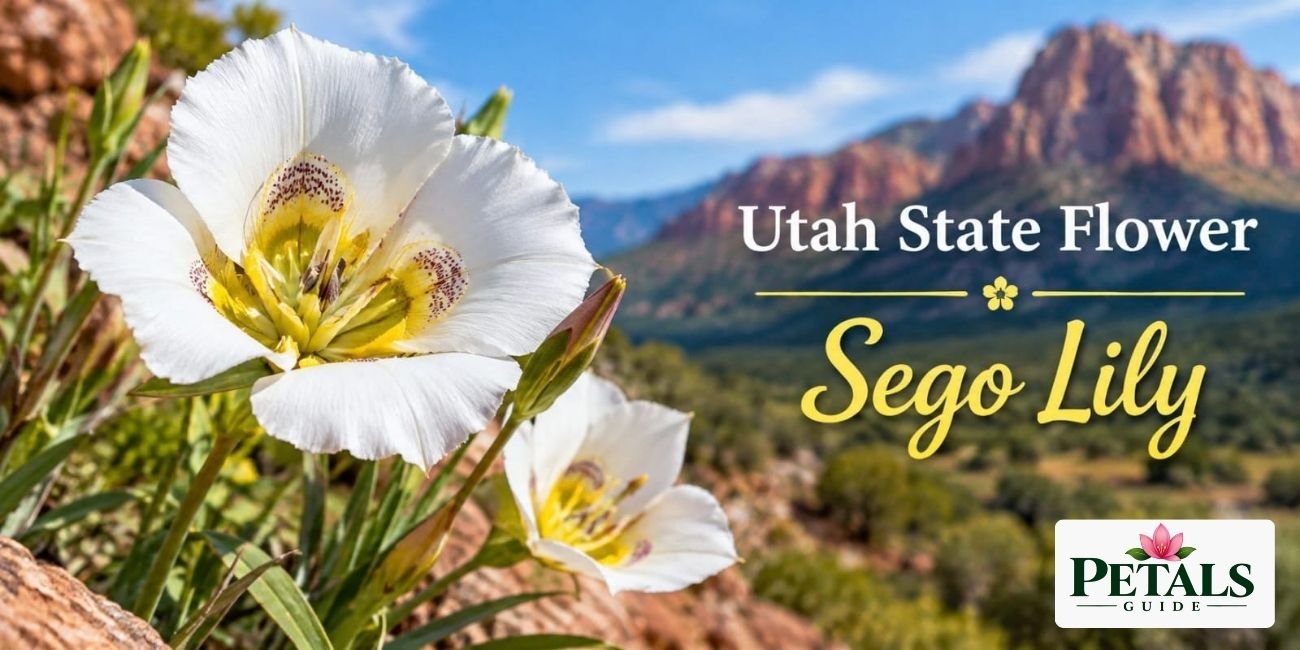
The Utah state flower, the Sego Lily (Calochortus nuttallii), is a native wildflower with a long connection to the state’s natural and cultural heritage. It grows across the western United States and has been an official symbol of Utah since 1911. In this article, we’ll explore the Sego Lily’s characteristics, habitat, blooming season, history, and its importance to Utah.
What Is Utah’s State Flower?
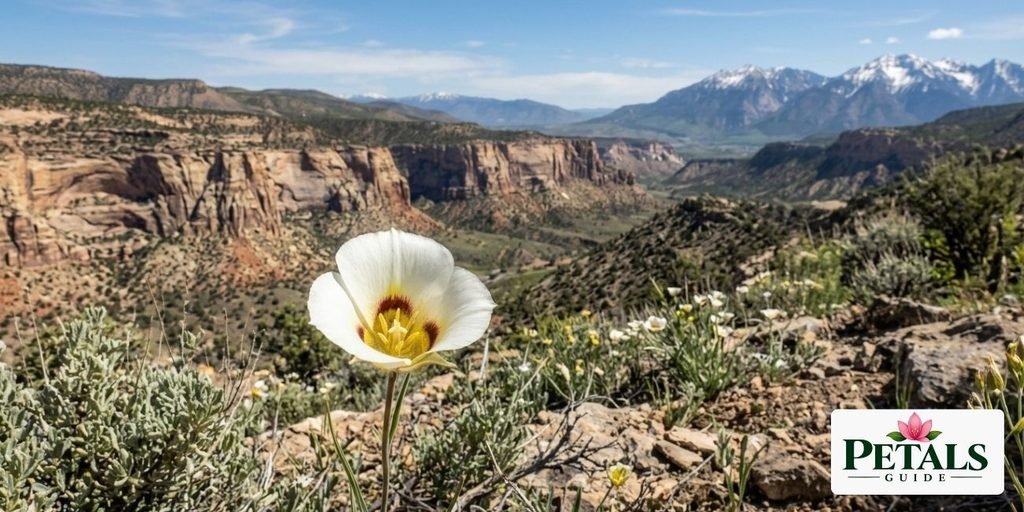
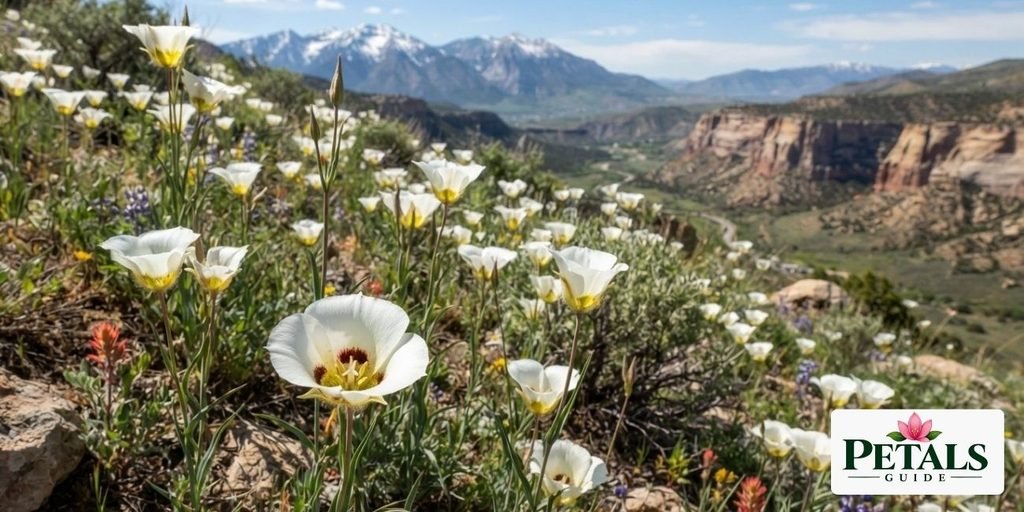
Utah’s state flower is the Sego Lily, scientifically known as Calochortus nuttallii. It belongs to the Liliaceae family and the Calochortus genus and is a native wildflower of the western United States. Its white to cream-colored flowers have distinctive yellow and purple markings. Utah officially adopted the Sego Lily as its state floral emblem on March 18, 1911.
Its place among Utah’s state symbols reflects the flower’s long connection with the state. Today, the Sego Lily is recognized alongside other official symbols that represent Utah’s natural and cultural heritage.
Botanical Characteristics of the Utah State Flower
The Utah state flower, Calochortus nuttallii, is a bulbous perennial in the family Liliaceae and genus Calochortus. The plant grows from a small underground bulb and usually develops a slender, upright, mostly unbranched stem. Mature plants commonly reach about 10 to 20 inches in height.
Its flowers have a distinctive three-petaled structure accompanied by three sepals. The petals are usually white or creamy white, although they can have lilac or pinkish tones. Near the base, each petal has a yellow area and may show a reddish-brown or purplish band or blotch. Fine hairs surround the nectar gland near the petal base, creating one of the flower’s most recognizable details.
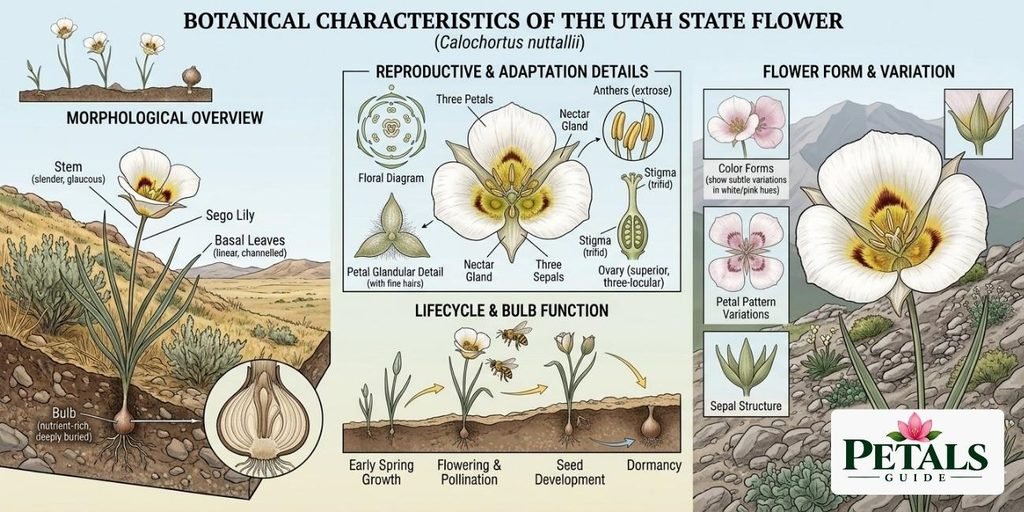
The leaves are narrow, linear, and grass-like, with several leaves arising along the plant. After flowering, the aboveground growth dries back as the plant enters its dormant period. The state of Utah flower therefore spends part of its life cycle largely hidden below ground in its bulb.
Where Does the State Flower of Utah Grow?
The state flower of Utah, Sego Lily, is adapted to the dry conditions found across much of the interior West. Its range extends through Utah and into parts of Arizona, Colorado, Idaho, Montana, Nebraska, Nevada, New Mexico, North Dakota, South Dakota, Wyoming, and other western regions documented in botanical references.
Within this broad range, the plant occurs in open and relatively dry environments. USDA information records it in brushy or grassy slopes, open sagebrush country, and open pinyon-juniper and ponderosa pine communities. It is associated with well-drained soils and can occur across a wide elevation range, from lower dry country to mountain landscapes.
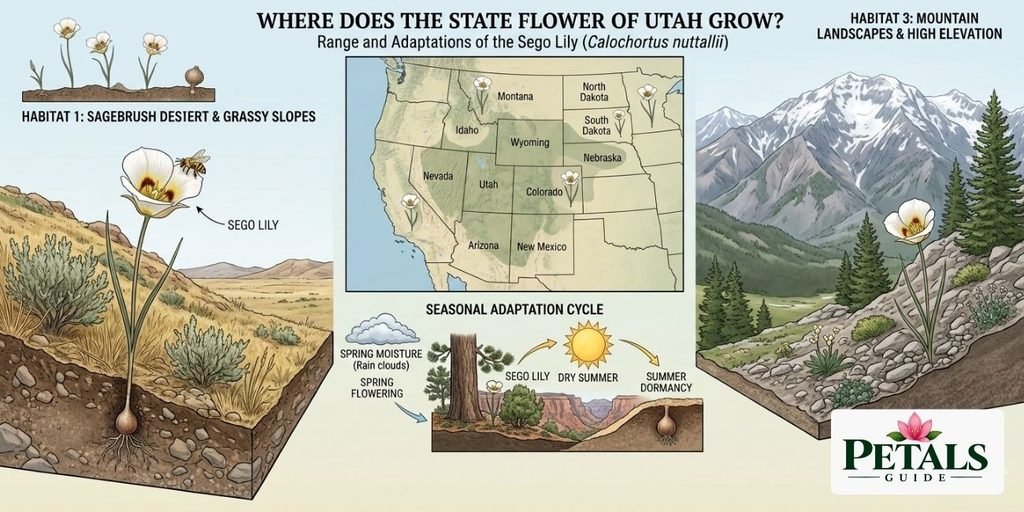
The Utah state flower is particularly well suited to places where spring moisture is followed by a dry summer. Its ability to complete much of its visible growth before the hottest part of the year is an important part of its adaptation.
Blooming Season of Utah’s State Flower
The flowering period of Utah’s state flower generally falls from late spring into summer. USDA sources give May through July as a typical blooming period, while the exact timing changes with elevation and local conditions. Plants in warmer or lower locations may flower earlier than those growing at higher elevations.
The Sego Lily begins its seasonal growth from an underground bulb. As conditions become favorable in spring, the stem and leaves emerge, followed by the flowers. After blooming and seed development, the aboveground portion of the plant dries back. The bulb remains underground during the dry part of the year.
Temperature, available spring moisture, elevation, and local weather can all affect when individual populations bloom. This is why wild Sego Lilies may not flower at exactly the same time throughout Utah.
Why is Sego Lily Utah’s State Flower?
The history behind the Utah state flower is closely connected with the plant’s practical value and its place in Utah’s early history. The Utah Legislature officially designated the Sego Lily as the state floral emblem on March 18, 1911. Utah’s Online Public Library notes that the selection followed a census of schoolchildren about their preferred state flower.
The Sego Lily was already associated with Utah before it became the official state flower. When Utah’s Great Seal was adopted in 1896, it featured two Sego Lilies growing on either side of the beehive. The flower then appeared on Utah’s first flag, created in 1903 and based on the state seal. The flag was developed under the direction of the Daughters of the American Revolution at the request of Governor Heber M. Wells. It was initially known as the Governor’s flag before the Legislature formally adopted the design as the official state flag in 1911.
The plant also has an important food history. USDA research records that several Indigenous peoples of the Great Basin and surrounding regions harvested and ate Sego Lily bulbs. The Northern Paiute, Northern Shoshone, Bannock, Goshute, Ute, and other groups used the bulbs in different ways, including eating them fresh, roasting them, drying them, or storing them for later use.
Historical Utah sources also document that Indigenous people taught Mormon pioneers about edible plant foods, including Sego Lily bulbs, during periods when food was scarce. The bulbs became particularly associated with the food shortages faced by early settlers. This history later became an important part of the flower’s identity in Utah.
It is useful to separate documented history from later folklore. The connection between Sego Lily bulbs and food use is well documented, while some popular stories about exactly why the flower was chosen should be treated as historical tradition rather than unquestioned fact. The official designation itself, however, is clear: Utah’s official state flower became the Sego Lily in 1911.
Utah State Bird and Flower
Utah’s two official natural symbols include the Sego Lily as the state flower and the California Gull (Larus californicus) as the state bird. The Utah state bird and flower therefore bring together a native wildflower and a bird strongly associated with Utah history.
The Sego Lily was officially designated as the state flower in 1911. The California Gull was formally designated Utah’s state bird in 1955. Utah historical sources connect the gull with the well-known 1848 cricket episode involving early settlers and crops near the Great Salt Lake.
Together, the state bird and flower of Utah reflect different parts of the state’s natural and cultural heritage. The Sego Lily represents native plant life and a documented food history, while the California Gull became an important symbol through its association with a significant episode in Utah’s settlement history.
Ecological Importance of the Utah State Flower
The Utah state flower is a native member of dry western plant communities, where it grows alongside grasses, sagebrush, pinyon, juniper, and other plants suited to relatively dry conditions. Its seasonal growth pattern allows it to flower during a period when moisture is more available before the landscape becomes much drier in summer.
The Sego Lily’s flowers are visited by insects, and the National Park Service identifies insects as its pollinators. Native bees are among the insects documented visiting Sego Lilies; the U.S. Geological Survey has even photographed a native bee collecting pollen from the species in Nevada.
Protecting native habitats therefore helps preserve the plant communities in which the state flower of Utah naturally occurs. Maintaining healthy open landscapes and avoiding unnecessary disturbance of native plant populations can benefit the Sego Lily along with the many other species that share its habitat.
Growing and Care Information
Growing the Sego Lily at home is possible when its natural growing conditions are taken into account. Calochortus nuttallii prefers full sun and well-drained soil, particularly soil that does not remain wet for long periods. Sandy, rocky, or other fast-draining soils can work well. During active growth, the plant needs some moisture, but overwatering can create problems for its underground bulb.
The Sego Lily grows from a bulb and naturally becomes dormant after flowering. As the leaves and stems dry back, watering should be reduced rather than increased. This dormant period is a normal part of the plant’s life cycle. Gardeners interested in growing it should also avoid collecting bulbs from wild populations. Using nursery-propagated plants or responsibly sourced seed is a better way to add this native wildflower to a garden.
Bringing Utah’s Floral Spirit Home
The Sego Lily can bring a distinctly western character to a garden, especially in landscapes designed around native or drought-tolerant plants. Its preference for open, sunny locations and well-drained soil makes it suitable for rock gardens, dry garden beds, and other areas where plants adapted to low-moisture conditions can thrive.
One of the plant’s interesting qualities is its seasonal nature. The Sego Lily puts on its floral display during its growing season and then retreats underground as conditions become hotter and drier. Gardeners should allow this natural cycle rather than trying to keep the plant green with excessive watering. Choosing propagated plants or seeds also helps preserve wild populations while allowing people to enjoy a plant that has such a strong connection with Utah’s natural heritage.
Interesting Facts About the Utah State Flower
- The name “Sego” has Indigenous roots. USDA research explains that the English word “sego” comes from similar words for the plant in several Numic languages of the Great Basin.
- The scientific name honors Thomas Nuttall. The species name nuttallii recognizes Thomas Nuttall, the English botanist and ornithologist whose work contributed greatly to the study of North American plants.
- The genus name has a Greek origin. The National Park Service explains that Calochortus comes from Greek words meaning “beautiful” and “grass,” referring to the plant’s flowers and grass-like leaves.
- Its seeds are remarkably numerous. USDA information reports approximately 190,000 Sego Lily seeds per pound. Despite producing many seeds, the plant can be difficult to establish and grow.
- Transplanting mature bulbs is difficult. USDA guidance notes that collected bulbs are not likely to survive transplantation well, which is one reason the plant is better understood as a native wildflower than as an easy garden bulb.
- The plant spends much of the year underground. After flowering, its aboveground growth dries up, allowing the bulb to remain through the hotter and drier part of the season.
- It is a true member of the lily family. Although its flower can resemble a small tulip or mariposa lily, its botanical classification places it in Liliaceae alongside other true lilies.
State Flower of Utah Crossword: The Answer
For the common state flower of Utah crossword clue, the answer is Sego Lily. Its scientific name is Calochortus nuttallii. Depending on the number of spaces in a particular crossword, the clue may simply expect “SEGO” or “SEGO LILY.”
Conclusion
The Utah state flower, the Sego Lily, is more than a pretty flower; it has an important story. Its bulbs were used as food by Indigenous peoples and early settlers, especially during times when food was scarce. The flower grows across Utah’s dry landscapes, making it a familiar part of the state’s natural heritage. Learning about the Sego Lily helps us appreciate Utah’s history and native plants. So, the next time you see one, take a moment to appreciate this small but meaningful symbol of Utah.
FAQs
What is Utah’s state flower and bird?
Utah’s state flower is the Sego Lily, while its state bird is the seagull, commonly identified as the California Gull. Both are official state symbols of Utah.
What are 5 symbols of the state of Utah?
Five official Utah state symbols are the Sego Lily (state flower), seagull (state bird), elk (state animal), honeybee (state insect), and beehive (state emblem).
What is Utah’s state bug?
Utah’s state insect is the honeybee. It is an official state symbol and is closely connected with Utah’s well-known beehive symbol and the state motto, “Industry.”
Why is Utah’s state flower a Sego Lily?
The Sego Lily was chosen as Utah’s state flower because of its strong connection with the state’s history and landscape. Its bulbs were also used as food by Indigenous peoples and early settlers during times of scarcity. Utah officially designated it as the state flower in 1911.